
In this guide
The score appears, and the temptation is immediate: compare it with your target, decide whether the test went well, and take another one. But the most useful work may begin after the score screen. A practice test contains evidence about decisions, misunderstandings, and habits that a single total cannot show.
This guide is a close look at the first review cycle after a Bluebook test. It is designed for a student who has already completed an attempt and wants to know what to do with it. The aim is to leave the review with a small, specific plan rather than a long list of topics to “improve.”
The sample scores, study records, and examples below are fictional teaching scenarios. They illustrate a review method and do not predict an actual test score or promise a particular amount of improvement.
Read the visual as text
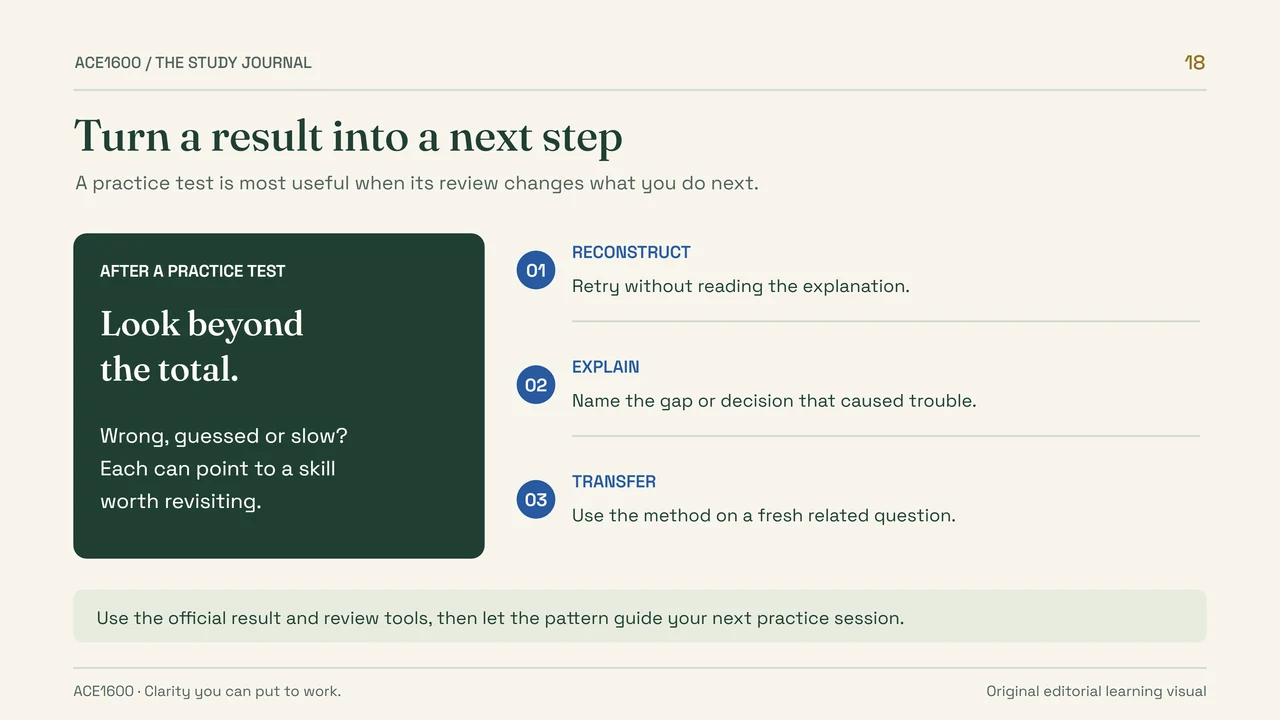
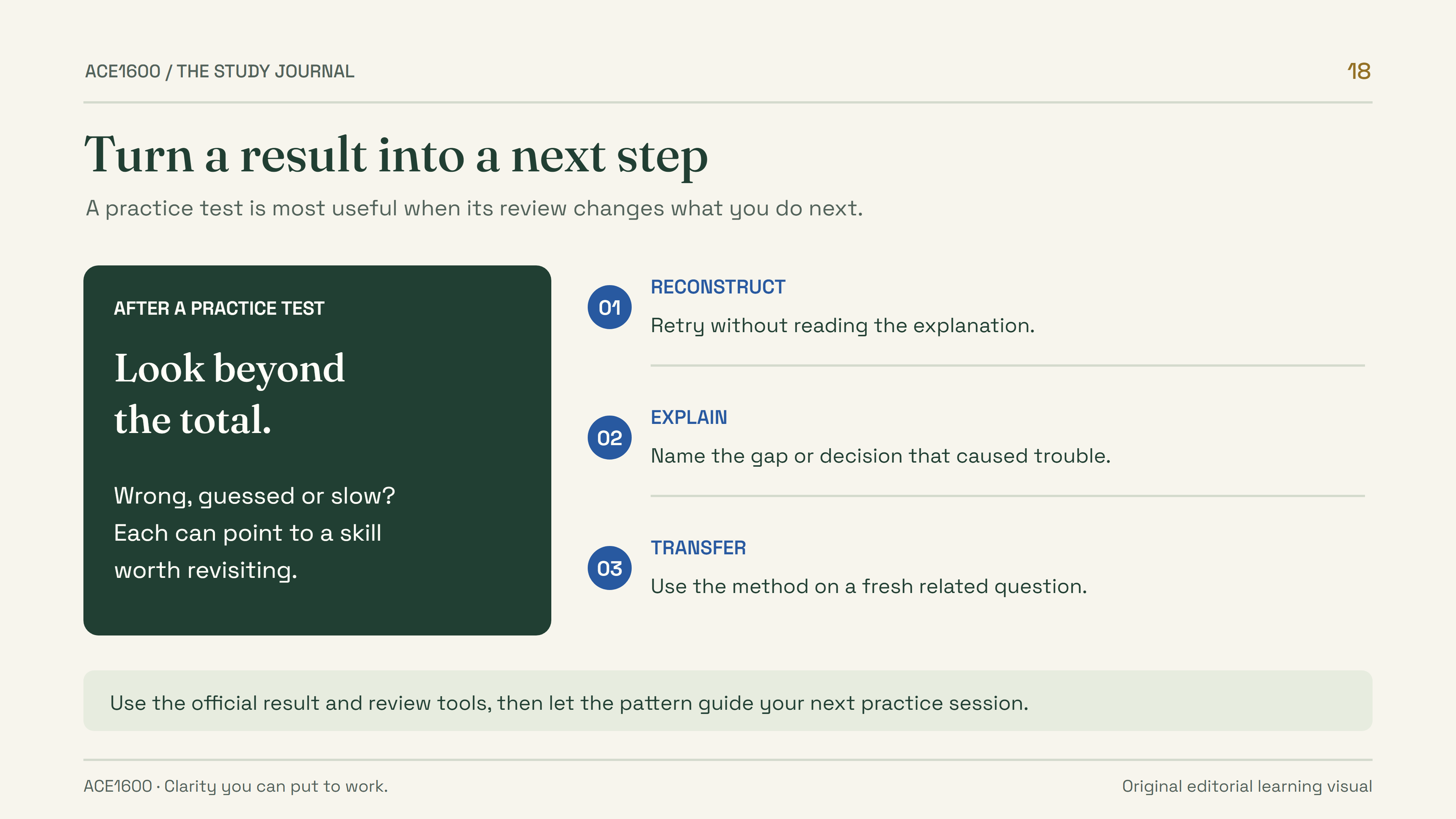
- Review wrong answers, guesses and answers that took unusually long.
- Reconstruct: try the question again before reading the explanation.
- Explain: identify the specific knowledge gap or decision that caused trouble.
- Transfer: apply the method to a fresh related question.
- Use official result tools, then select future practice from the patterns you find.
1. Capture the experience while it is still fresh
Before opening every explanation, write a brief account of the session. Note the practice test, date, interruptions, any extra time, questions you recognized, and which parts felt rushed. Record these observations neutrally. They explain the conditions under which the result was produced.
Bluebook offers official full-length digital practice tests. [1] Their value as a rehearsal is greatest when you know how your attempt differed from your intended test-day conditions. An interrupted attempt still contains useful work, but it should not be treated as identical to an uninterrupted one.
The first review cycle
- CaptureConditions and memory
Record what happened before explanations replace your original reasoning.
- InspectQuestion-level evidence
Separate misses, uncertain successes, and time-consuming answers.
- RepairOne cause at a time
Learn the missing idea or improve the decision that broke down.
- Plan and verifyFresh work
Choose a few priorities and check them later on unfamiliar examples.
Write down uncertain successes if you remember them. A correct answer reached by guessing, an unverified calculator entry, or a lucky elimination can disappear from review if you inspect only the red marks. The point is to find skills that need work, not merely to account for lost points.
Also note a few things that worked. Perhaps you recognized a structure more quickly or used a short reset after a difficult question. Effective habits deserve to be repeated. A review that records only failure can miss the process changes that made other parts of the session more stable.
2. Open the report with a question to investigate
Use the same credentials in My Practice that you used for Bluebook. The Score Details view lists the questions, your responses, correct answers, and review explanations. [2] Start by asking a concrete question, such as “Did my algebra misses come from setup or calculation?” rather than browsing every result without a purpose.
Treat a domain-level pattern as a starting point, not a diagnosis. Several errors classified within a broad area can have different causes. A low-looking area may reflect one prerequisite, several unrelated gaps, or time pressure near the end. You need the actual questions and your working to distinguish those possibilities.
| What you notice | What to investigate |
|---|---|
| Several misses in one content area | Do they share a specific skill or a common misunderstanding? |
| Errors concentrated late in a module | Were the concepts unfamiliar, or did earlier decisions leave too little time? |
| Correct answers you cannot explain | Was the reasoning sound, partly understood, or guessed? |
| A large change from an earlier attempt | Were the questions, conditions, and familiarity comparable? |
Do not calculate an exact future score by imagining that every missed item will become correct. Review is about building skills, and a later test will present a different combination of questions and conditions. Use the report to choose work you can evaluate, not to manufacture a forecast.
If the overall result is disappointing, begin with a small review target rather than attempting to explain everything at once. One completed repair can make the next step clearer. If the result is encouraging, use the same disciplined review; success can still contain fragile reasoning worth strengthening.
3. Re-solve before reading the explanation
Choose a handful of missed or uncertain questions and try them again with the answer hidden. Work without the original time pressure if your purpose is to test understanding. This second attempt helps distinguish “I did not know how” from “I had a workable method but did not execute it during the test.”
Original scenario: a second attempt reveals the cause
A student missed a teaching problem asking for the original price before a 20% discount. On the test, she multiplied the discounted price by 1.20.
During review, she writes 0.80P = 64 and finds P = 80. She can now explain why adding 20% of 64 uses the wrong base.
The key question is whether she independently identified the original amount as the unknown. If she could only do so after seeing the solution, the concept still needs explicit practice.
Keep the second attempt visible. When you open the explanation, compare the first point where your reasoning differs. Did you misread a condition, choose an inefficient method, or apply a rule incorrectly? The earliest meaningful difference is usually more useful than the final wrong number.
For Reading and Writing, explain why the nearest alternative fails. A correct choice becomes more secure when you can identify the unsupported claim, wrong relationship, or scope mismatch in the tempting distractor. Merely recognizing the right option after seeing it is weaker evidence.
Limit this deep review to a manageable number of questions at a time. If attention is fading, split the work into several sessions. A rushed review of twenty explanations can leave less usable understanding than a careful review of five followed by a later transfer check.
4. Sort errors by the repair they need
Use categories that lead to actions. A content gap needs instruction and practice. A task-interpretation error needs a better way to represent the request. An execution error needs a check at the point where work breaks. A pacing issue needs investigation of how time was allocated, often alongside content work.
Match the cause to the next action
- Concept missingLearn and explain
Return to the prerequisite and solve a simple example independently.
- Task misreadRepresent the request
Name the quantity, claim, relationship, or goal before solving.
- Method breaksInspect the step
Find the sign, unit, copying, or answer-entry error and build a specific check.
- Time runs outStudy allocation
Review early stalls and test a more purposeful skip-and-return routine.
Original example: one result, different repairs
Two students miss a problem involving the roots of (x − 4)(x + 2) = 0. One reports 4 and 2 because she does not understand the sign in the second factor. The other finds 4 and −2 but enters −2 when asked for the positive root.
The first student needs to solve x + 2 = 0 and connect factors to roots. The second needs a final comparison between the computed values and the requested quantity.
Calling both errors “careless algebra” would obscure the difference and make the follow-up less useful.
Correct but slow items belong in this classification too. A long solution may be mathematically valid but difficult to sustain under time constraints. Compare it with a shorter method only after you understand why both work. Replacing a reliable method with a mysterious shortcut can create a new weakness.
If several errors share a prerequisite, teach that prerequisite first. Do not spread the next week across six broad categories when one missing idea explains most of the pattern.
5. Choose two priorities and one maintenance habit
After review, create a short queue. Select two priorities that recur or block other work, then one maintenance habit that you want to preserve. The exact number is an editorial starting point; the principle is to choose a workload you can finish and evaluate rather than a list that expands indefinitely.
Original scenario: a focused week
A student’s review shows repeated confusion about percent-change bases and several synthesis answers that are true but miss the stated goal. Her algebra is mostly sound, but she occasionally answers for x when the task asks for an expression.
Priority one: model percentage changes with an explicitly named original amount. Priority two: turn each synthesis goal into a short checklist before evaluating options.
Maintenance habit: reread the requested quantity before entering each Math answer. The week now has specific behaviors and concepts to practice, rather than “improve Math and English.”
Use the Student Question Bank to select official questions by skill and difficulty. [3] Keep a note of material you have already seen so you can distinguish practice from an unfamiliar check. If a question reminds you strongly of a completed test item, mark that familiarity honestly.
Begin at a level where the method can be learned clearly. Moving straight to the hardest examples may repeatedly expose the same gap without repairing it. Once the explanation is secure, vary the wording, numbers, and context so the skill must transfer.
For lesson support, My Practice connects students with Official SAT Prep on Khan Academy, which includes explanations and related learning material. [4] Use that support for a diagnosed need, then close the lesson and work independently. Watching a solution is preparation for doing the reasoning yourself.
6. Turn priorities into a week you can actually complete
A review plan should name the task and the evidence of completion. “Study percentages” is vague. “Solve five original-amount problems, explain the base in each, and review any miss” is concrete. The latter can fit into a short session and produces something you can inspect.
| Session | Main task | Evidence to keep |
|---|---|---|
| One | Repair the first recurring concept without a timer. | A clear explanation and two independently solved examples. |
| Two | Practice the second priority with a small focused set. | Reasons for rejecting the closest wrong choices. |
| Three | Retry earlier misses after a delay. | A note distinguishing reconstructed reasoning from remembered answers. |
| Four | Use fresh mixed questions under a modest time limit. | Accuracy, unfinished items, and any repeated cause. |
| Five | Review the week and choose what still needs work. | A revised queue with completed repairs moved to maintenance. |
Adapt the plan to school demands and your available time. If you have three sessions rather than five, combine tasks carefully or extend the review cycle. Removing the verification step to fit more new questions usually makes the plan less informative.
Full-length tests require time not only for the attempt but also for review. Schedule the next one when you have made changes worth evaluating and have room to inspect its results. Repeated testing without intervening learning can consume practice material while leaving the same errors intact.
If you test with accommodations, use your approved arrangements when rehearsing the full experience and interpret pacing within that context. A standard-time comparison may not be the right measure of whether your personal routine is working.
7. Verify the repair before closing the review
At the end of the cycle, ask whether you can solve a fresh problem without the explanation or a hint. Also ask whether you can explain why the method fits. A remembered answer to the original item is useful rehearsal but not enough to establish transfer.
Original transfer check: the base changes
After studying discounts, try this new problem: an amount rises by 25% to reach 150. The original amount is 150/1.25 = 120.
Now compare it with an amount that falls by 25% to reach 150. The original amount is 150/0.75 = 200.
The final amount is the same, but the relationship changes. Explaining both equations demonstrates more understanding than recalling one discount answer.
For synthesis, reuse a note set with a different goal. If you can change which facts you select and explain why, the goal-first habit is becoming more flexible. For pacing, check whether a new skip rule improved coverage without reducing accuracy. Verification should match the repair you attempted.
Keep the next-step decision simple: secure enough for maintenance, needs another focused session, or needs help with an earlier prerequisite. You do not need to declare an entire subject mastered after one successful set. You need enough evidence to choose the next useful task.
A Bluebook score report becomes valuable when it changes what you do. The finished review is not a highlighted screen or a copied explanation. It is a clearer diagnosis, a workable week of practice, and fresh evidence that a once-fragile skill is becoming more reliable.
Sources & further reading
Rules and policies were checked on October 4, 2026. Follow the linked official pages for changes. Study plans and worked examples are A1600 editorial guidance.
- Full-Length Digital Practice Tests on Bluebook (opens in a new tab)College Board
- My Practice 101 (opens in a new tab)College Board
- How to Use the Student Question Bank (opens in a new tab)College Board
- How to Use Khan Academy (opens in a new tab)College Board