
In this guide
You finish a practice test, check the score, read several explanations, and promise to be more careful next time. A few days later, a different question exposes the same mistake. The missing step may not be more practice material. It may be a clear connection between the answer you missed and the action you will rehearse next.
Free official resources can support that connection. Each resource has a useful role, but opening all of them is not a study method by itself. This article offers an original A1600 review routine, with invented teaching examples, for turning a test or question set into specific learning tasks. Use it with the time you have; the process does not require purchasing a course or predicting a particular score gain.
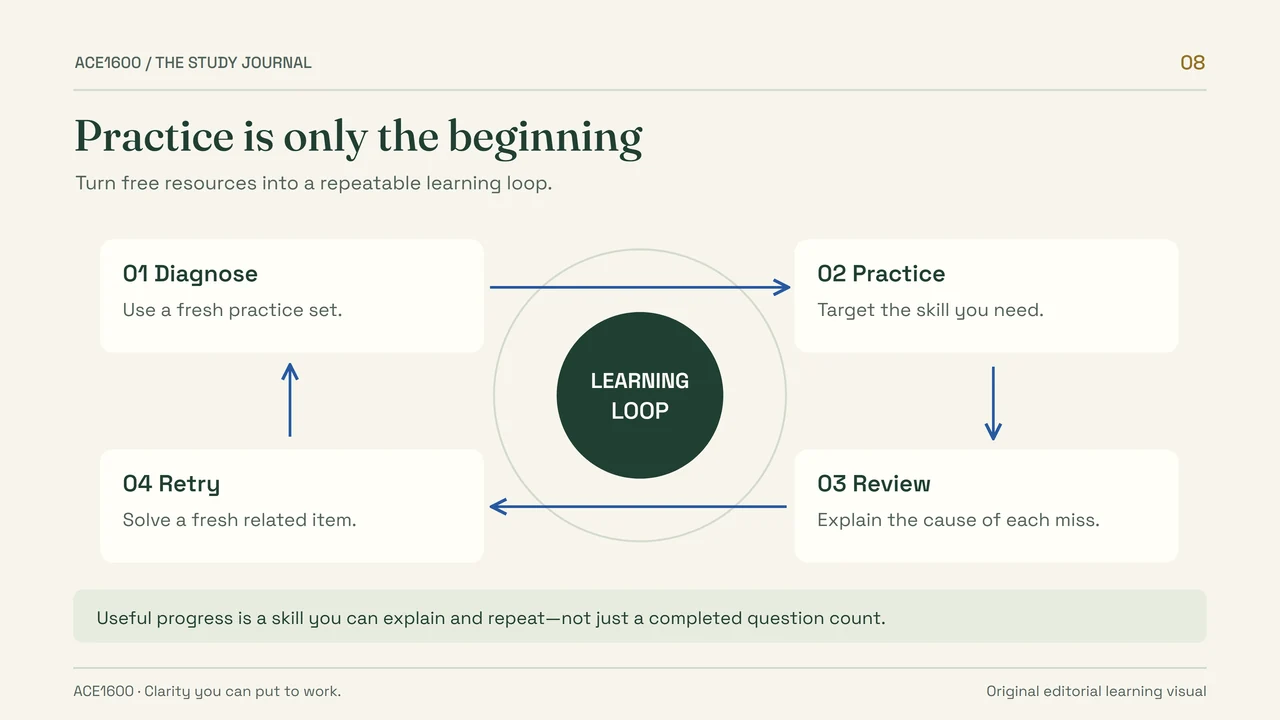
Read the visual as text
- Diagnose with a fresh practice set.
- Practice the skill the evidence shows you need.
- Review the reason for each wrong, guessed or slow answer.
- Retry a fresh related question to check whether the method transfers.
1. Give each free resource a job
Bluebook provides full-length digital practice tests. My Practice holds the resulting scores and answer review; its Tailored Practice feature supplies targeted questions based on performance. The Student Question Bank lets you select questions using filters, while Official SAT Prep on Khan Academy provides lessons and practice. The resources serve different stages of preparation rather than competing to be your only tab. [1][2][3][4]
Choose the resource for the next task
- BluebookRehearse
Take a full-length practice test with the digital testing interface.
- My PracticeInspect
Review a completed test and find Tailored Practice from the results.
- Student Question BankSelect
Choose official questions by section, domain, skill, and difficulty.
- Khan AcademyLearn
Use lessons and leveled practice to work on a concept.
Decide what you are trying to find out before choosing a resource. If the question is whether you can sustain attention across a full test, another five-question quiz will not answer it. If the question is how to solve a system of equations, another full test may only confirm that you still need instruction.
Keep one simple record outside the resource itself. A notebook page or a small document is enough. Include the skill, the problem reference, the issue, and the next action. That record gives continuity when you move from a test explanation to a lesson and then to new practice.
2. Make a practice score interpretable
Before a full test, write down the conditions you intend to use. Choose a fresh test, allow a complete appointment, and prepare the device and materials you expect to use. Put answer aids out of reach. If you are following approved accommodations, use the relevant practice settings and distinguish that setup from standard timing.
Bluebook full-length practice is timed, but allows some flexibility that the real administration does not, including moving forward to the next section early. The brief test preview is untimed and provides no score or answer feedback. [1] Use the preview for interface familiarity and a full test for a broader checkpoint; do not treat their results as interchangeable.
If a session is interrupted, write that down without trying to make the result look cleaner than it is. “Paused after Reading and Writing because the room became unavailable” explains what happened. It does not make the work useless. It simply limits how confidently you can use that attempt as evidence of performance in one uninterrupted sitting.
Also record whether you recognized questions. Previously seen material remains useful for learning, especially when you reconstruct the reasoning, but memory changes the task. Label that attempt as review. Preserve some unfamiliar material for later checkpoints so that you can examine whether the skill carries beyond the questions you already remember.
The same distinction matters in short sets. A result earned with hints answers a different question from an independent result. Both can belong in your notes. Clear labels prevent an accidental comparison between supported learning and unsupported performance.
3. Capture your reasoning before reading the solution
Immediately after a practice appointment, note which questions felt uncertain and why, while you can still remember your approach. You do not need to reconstruct every second. A few words such as “could not choose an equation” or “two answers seemed equally supported” preserve information that the correct answer alone cannot reveal.
When practical, attempt an unresolved problem once more without the clock or the explanation. This is a diagnostic step within your review: you are distinguishing a concept gap from a timing or execution problem. Stop when you can identify the missing idea. Repeatedly guessing without new understanding adds little to the diagnosis.
Original example: finding the first incorrect step
A student solves 3(x + 4) = 27 and writes 3x + 4 = 27. After subtracting 4 and dividing by 3, the student gets 23/3. The arithmetic after the first line is internally consistent, but the distribution step changed the equation.
A correct route is to divide both sides by 3 first: x + 4 = 9, so x = 5. Another route distributes to 3x + 12 = 27 and reaches the same answer. Substituting 5 into the original equation gives 27, which checks the solution.
The review entry should identify distribution across parentheses, rather than “calculation mistake.” The next exercise can compare a(b + c) with ab + ac using different numbers, followed by a new equation. That exercise addresses the failure point directly.
After reading the official explanation, close it and reconstruct the argument in your own words. Do not aim to reproduce the author’s wording. Explain why the first step is allowed and how each later step answers the question. If a step still seems magical, that is the part to take to a lesson or a teacher.
4. Build an error log that leads to action
An error log is a planning device. Its purpose is to tell you what to do next, not to create a beautifully formatted collection of disappointments. Keep entries short and describe behavior you can observe. “Careless,” “bad timing,” and “did not understand” can be starting labels, but each needs enough detail to support a useful action.
| Observed issue | Useful diagnosis | Next action |
|---|---|---|
| Solved for x, but the question asked for 2x | Lost track of the requested quantity | Circle the requested expression and substitute the solved value before answering |
| Chose an answer stronger than the passage | Did not check the scope of the claim | Compare words such as “some,” “all,” and “may” against the evidence |
| Could solve untimed, but used many steps | Selected an inefficient representation | Compare a valid algebraic route with a table or graph on a fresh example |
| Remembered the answer but not the method | Recognition replaced independent reasoning | Use a different problem and explain each step without notes |
Allow a question to have more than one issue. Perhaps unfamiliar vocabulary slowed your first reading, and then you chose a claim that was too broad. Pick one issue to address first while keeping the other in view. Forcing a complicated attempt into one neat category can hide the part that actually needs instruction.
Include correct answers when the process was unreliable. A guess that happened to be right is worth reviewing. So is a solution that involved several unjustified steps or took so long that it displaced other questions. Conversely, a valid alternative method does not become wrong merely because the published explanation used a different route.
Use a status such as “needs explanation,” “can solve independently,” or “checked on a fresh example.” These labels describe evidence rather than declaring permanent mastery. If the same issue returns, reopen it. A study record should make changing your mind easy when new work shows that a skill still needs attention.
5. Choose a small set that tests the repair
Once the error is specific, choose practice that requires the repaired decision. The Student Question Bank filters include section, domain, skill, and difficulty. College Board also publishes guidance on selecting difficulty using the domain information in your score report. [3][5] Use those tools as starting points, then inspect whether the selected questions match the issue you identified.
For a new method, begin with a small untimed set. Work before revealing answers and keep enough written reasoning to review afterward. If every question goes wrong at the same step, pause the set and revisit that step. Continuing through many more questions without new instruction may produce a longer error list without clarifying the concept.
When the first set goes well, change one feature. Use less familiar numbers, a different context, or an equation presented as a graph. Then change the surrounding mix of questions. These changes help you see whether you learned the method or only recognized the surface pattern of the examples.
Original example: extend a linear relationship
Suppose you have practiced finding the total cost from C = 8n + 15. A useful next problem might give a total of 71 and ask for n. Solving 71 = 8n + 15 gives n = 7. Another might ask what 15 represents: the cost when n is zero, or the fixed charge in this model.
The representation is the same, but the requested task changes. Explain the unit of each quantity and why the operation answers the new question. Avoid treating every problem containing the same numbers as an invitation to repeat the previous calculation.
If you need instruction, Khan Academy offers a matching review course for each official SAT practice test, accessible through My Practice, and links from explanations to relevant lessons. [4] Use the lesson to resolve the specific uncertainty, then return to an independent attempt.
6. Review Reading and Writing with visible evidence
For Reading and Writing, an explanation such as “the correct choice sounds better” rarely gives you a dependable next step. Name the task first. If it is an evidence question, identify the statement that supports the answer. If it is sentence conventions, identify the sentence structure. If it is a transition, state how the ideas relate.
Original example: a claim that goes too far
Consider this invented passage: “In a survey of 80 visitors to a community garden, 52 said they had come primarily to relax. The remaining visitors gave other reasons, including gardening advice and children’s activities.”
The passage supports the statement that most surveyed visitors named relaxation as their primary reason: 52 is more than half of 80. It does not establish that most residents of the city use the garden to relax, because the described group consists of surveyed visitors. It also does not establish that the garden causes lower stress; the passage reports reasons for visiting, not a causal experiment.
A useful review note is “I expanded the claim beyond the surveyed group.” A fresh exercise should ask you to compare the population described in a passage with the population named in an answer. Memorizing that the original answer was choice B would not repair the reasoning.
Review rejected answers carefully enough to identify their actual fault. An option may contradict the passage, describe something the passage never establishes, or answer a different question. Use those descriptions as observations about that option. Do not turn them into a rule that any answer with strong language must be wrong; strong language can be justified when the text supports it.
For a conventions question, write the relevant sentence structure beside the correction. For instance, determine whether both sides of a proposed boundary are complete sentences before selecting punctuation. A list of punctuation names is less useful than a worked example showing the subject, verb, and relationship between the clauses.
7. Check whether the method survives a different day
End a review session by scheduling a later check. On that later day, attempt a fresh question without opening the log first. The purpose is practical: you want to know whether the method is available when it is no longer sitting immediately beside an explanation. The exact gap in this routine is adjustable rather than a scientifically validated SAT timetable.
From one missed answer to a useful next attempt
- AttemptYour reasoning
Solve independently and preserve the first meaningful steps.
- InspectA clear issue
Find the earliest unsupported decision or missing idea.
- RepairAn explained method
Use instruction, then reconstruct the solution without copying.
- RecheckFresh evidence
Try another problem later and update the next practice task.
A successful recheck should involve a reason you can explain, not merely the right final answer. If you still need a hint, record that support and continue learning. If the new context causes trouble, compare what stayed the same mathematically or logically and what changed in the presentation.
Return to a full-length test when you have done enough focused work to ask a meaningful new question about performance. That may be whether a recurring error has reduced, whether you can select methods in a mixed environment, or whether your pacing adjustment holds through a full section. Taking another test simply because the score is available can leave too little time to act on the information.
Keep score interpretation modest. Digital SAT scoring considers more than a raw count of correct answers, so do not convert a short practice set into a predicted SAT score. [6] A small set can tell you something useful about a skill without becoming a complete forecast of test day.
8. Use a weekly review to keep the work manageable
Once a week, read the last few entries and choose the next two priorities. Look for issues that recur across different questions, a previously difficult skill that now seems more dependable, and any topic that still lacks a clear explanation. You do not need to repair every error simultaneously. Decide which work will make the next sessions more productive.
For a family or tutor check-in, bring three items: one example of independent work, one unresolved question, and the next planned practice task. The student should explain the reasoning rather than present only a score. A parent can help protect a quiet appointment, find a teacher who can clarify a concept, or notice that school deadlines require a lighter week.
Keep feedback specific and proportionate. “You remembered to check the requested quantity on these two new problems” describes evidence. “You have solved your entire Math problem” goes beyond it. The same restraint applies when a session goes poorly: a difficult evening is information about that evening, not a permanent description of the student.
You can use this routine with limited time. In a short session, review one problem carefully, write the reason for the error, and choose the next question. In a longer session, work through a small set and compare patterns. The useful unit is a completed learning decision, which can be smaller than a full chapter or another test.
Sources & further reading
Rules and policies were checked on September 17, 2026. Follow the linked official pages for changes. Study plans and worked examples are A1600 editorial guidance.
- Full-Length Digital Practice Tests on Bluebook (opens in a new tab)College Board
- My Practice 101 (opens in a new tab)College Board
- How to Use the Student Question Bank (opens in a new tab)College Board
- How to Use Khan Academy (opens in a new tab)College Board
- Additional Tips for the Student Question Bank (opens in a new tab)College Board
- How Are Scores Calculated? (opens in a new tab)College Board