
In this guide
The final week is a good time to reduce uncertainty. You can make your device ready, confirm the route, rehearse a few important decisions, and review mistakes that are still within reach. You do not need to reinvent your entire preparation plan because the test is close.
What makes sense now depends on what you have already done. A student with several recent full-length tests needs a different week from a student opening Bluebook for the first time. This guide gives you a sequence to adapt, not a mandatory daily workload or a promise of a particular score.
Testing rules and technical guidance below were checked on September 17, 2026. Follow the current official instructions and your admission ticket. All practice examples are original editorial examples, not official SAT questions. The aim is to arrive with a small set of useful habits and the practical requirements handled.
Read the visual as text
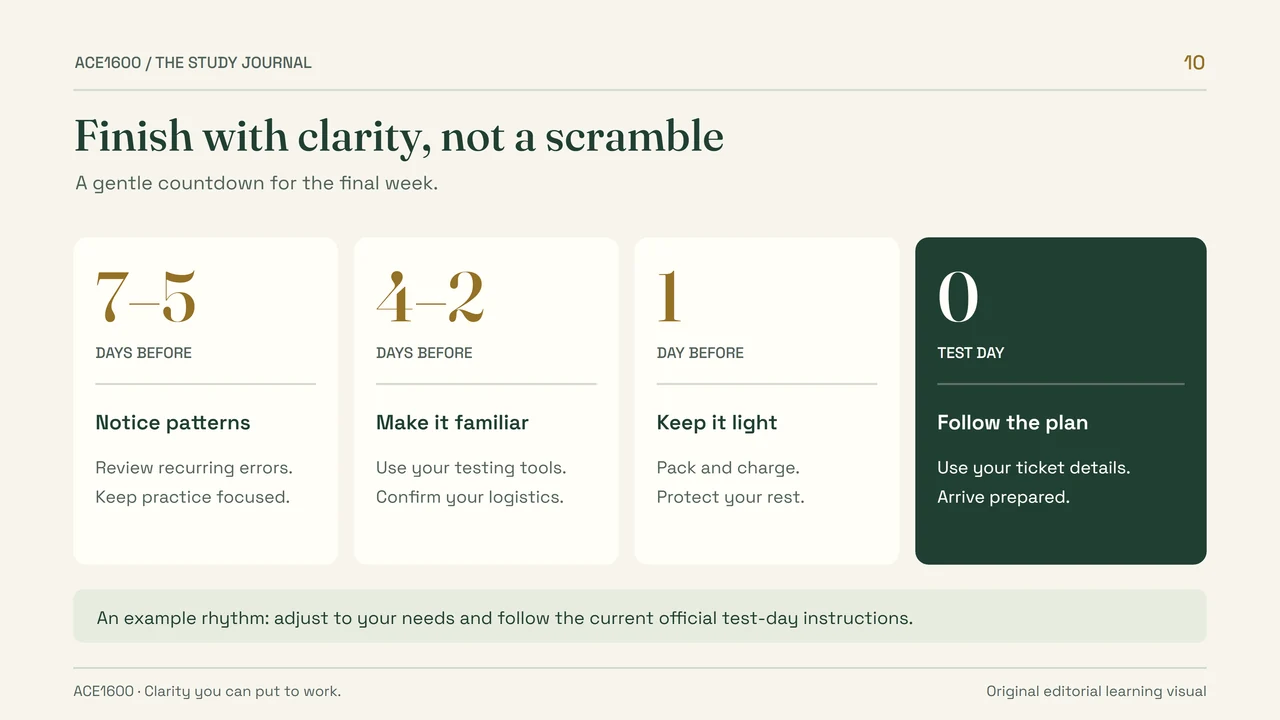
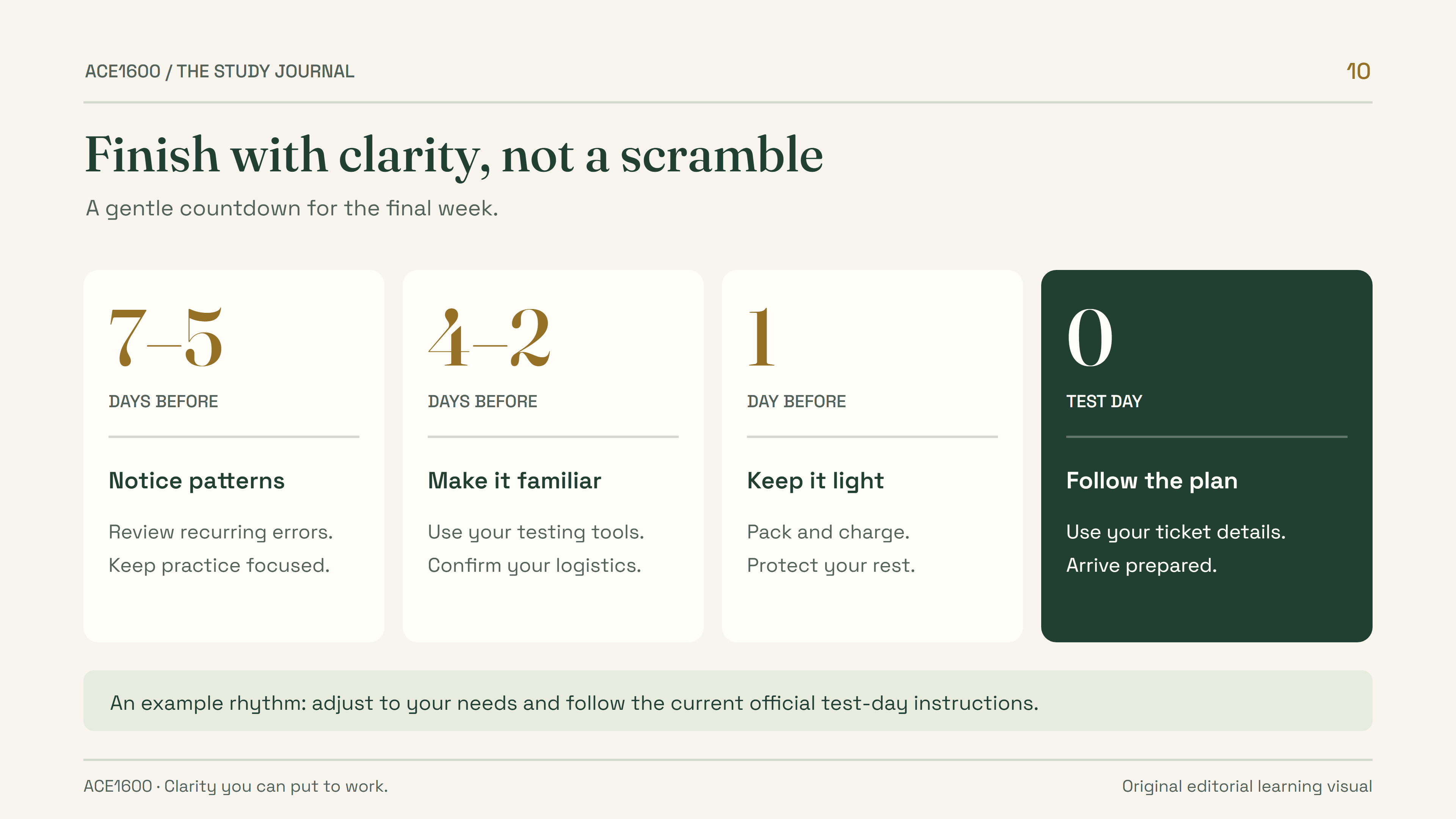
- Seven to five days before: review patterns and recurring errors.
- Four to two days before: become familiar with tools and confirm logistics.
- The day before: keep review light, pack, charge and protect rest.
- On test day: follow your admission ticket and official instructions.
1. Seven days out: choose a short list of priorities
Begin with your most recent practice work. Look for errors that happened more than once and that you can describe specifically: choosing an unsupported inference, confusing a sentence boundary, forgetting a unit conversion, or solving for a different quantity from the one requested. Choose two or three priorities rather than trying to review every possible topic.
Also list practical uncertainties. Can you sign in to Bluebook on the device you will bring? Is your physical ID acceptable for the testing country? Do you know how to get to the center and when to arrive? A short administrative task may have more immediate value than another hour of unfocused practice.
An adaptable final-week sequence
- Days 7–6
Identify a few learning priorities and resolve major logistical questions.
- Days 5–3
Complete exam setup and do focused practice with deliberate review.
- Day 2
Confirm your route, ID, device, permitted calculator, and packing.
- Day 1
Keep review light enough to finish at a reasonable time.
- Test morning
Follow your ticket's arrival instructions and use familiar routines.
Make the workload realistic. School does not disappear during the final week, and adding an ambitious schedule can create unfinished tasks that make preparation feel worse. Write down what you will do and when you will stop. If a session is interrupted, resume the highest-value task rather than trying to recover every planned minute.
2. Decide whether another full-length test has a clear purpose
A full-length test is useful when it answers a question you still have: whether you understand the app, how your pacing holds across modules, or whether a recently practiced skill transfers to a mixed test. It is less useful when you take it only because the calendar says a final test is expected.
If you have not completed a current official digital practice test, doing one early in the week can reveal important interface and timing issues. Leave time afterward to review it. Bluebook's scored full-length practice tests are different from its brief, untimed test preview, which does not provide score or answer feedback. Results are available for review in My Practice. [2]
If you have already taken several recent tests, a shorter mixed set may serve you better. Use it to practice choosing methods, reading the requested quantity, and moving on from a difficult item. The right choice depends on the information you need and the time you can devote to reviewing the work.
Avoid interpreting a repeated test as a fresh readiness estimate. Recognizing previously seen questions can change both accuracy and speed. A repeated item can still be useful for checking whether you understand its reasoning, but record that it is familiar. Otherwise, a higher score may tell you less than you think.
Do not make the final evening depend on the outcome of a long practice exam. If you choose a full-length test, place it early enough that an unexpected result can become a manageable review plan. A lower practice score is information about that attempt, not a forecast that every test-day question will go badly.
3. Review the cause of a mistake, then try again independently
An answer explanation can feel obvious once it is in front of you. That feeling is not the same as being able to solve a new problem without help. Close the explanation, write the key reasoning in your own words, and attempt a related question. This exposes whether the gap was filled or merely made familiar.
Research on retrieval practice found that students who tested their recall of studied prose retained more on delayed tests than students who repeatedly studied it. That experiment was not an SAT score-gain study. Its useful implication here is modest: include attempts to retrieve or apply an idea, rather than relying only on rereading. [3]
Original editorial example: finding the actual algebra error
Suppose you solve 5(2x − 3) = 35 and write 10x − 3 = 35. The error occurred during distribution, before the later equation-solving steps. The 5 must multiply both terms, giving 10x − 15 = 35.
Then 10x = 50 and x = 5. Check in the original equation: 5(2 × 5 − 3) = 5 × 7 = 35.
A useful review note is “Multiply every term inside the parentheses.” A less useful note is “Be more careful at Math.” Now try a different expression with parentheses and check the distribution before continuing.
Use the same approach in Reading and Writing. If you chose a transition that sounded natural but contradicted the relationship, write the relationship first: contrast, continuation, cause, or example. If you made an inference beyond the passage, identify the exact evidence the correct answer requires. The review note should tell you what to do next time.
Keep the final list short enough to revisit. Ten precise reminders you understand are more usable than fifty pages of copied explanations. Return to a few items on a later day without reading your earlier solution first. If the method still fails, simplify the practice and rebuild the missing step.
4. Rehearse decisions about time, not only speed
The standard SAT has two 32-minute Reading and Writing modules and two 35-minute Math modules. There is a 10-minute break between the sections. You can navigate within the current module, but once a module is completed you cannot return to it. Approved accommodations can change the timing or breaks. [4][5]
Practice noticing when you are no longer making progress. If you have read a question repeatedly without developing a plan, mark it for review and move on when that is appropriate. The goal is to preserve a chance to answer other questions and return with the remaining time, rather than letting one item consume attention indefinitely.
Bluebook provides a timer, marking for review, an option eliminator, and a question menu. You can hide the timer until five minutes remain, when an alert appears. Try these controls before test day and decide which habits help you stay aware of time without checking it after every sentence. [6]
Use the end of a practice module to rehearse a final scan: unanswered questions, marked questions where you have a plausible next step, and answers where you may have entered the wrong quantity. College Board advises serious test takers that guessing is generally preferable to leaving a question blank, especially after eliminating options. Avoid turning uncertainty into a reason to leave preventable blanks. [7]
Do not infer your score or adaptive route from how difficult a module feels. The test uses performance across modules, and individual questions vary. During the exam, the actionable task is the question in front of you. Guessing a future score uses time without improving that answer.
5. Complete Bluebook setup before the final evening
College Board instructs students testing on their own or school-provided device to complete exam setup in Bluebook 1–5 days before test day. Sign in with your College Board account and obtain the admission ticket. A printed ticket is preferred. For a College Board loaned device, setup and ticket generation happen at the center; follow the earlier arrival instructions. [1][5]
Confirm that your device meets the current technical requirements. Supported categories include Windows and Mac devices, iPads, and school-managed Chromebooks. A mobile phone or personal Chromebook is not an approved alternative. Exact operating-system versions can change, so use the current requirements rather than an old screenshot or a friend's experience. [8]
Check account access now. Make sure you know the credentials you will need and can actually sign in. If a school manages your device, resolve installation, update, or Wi-Fi restrictions with the person who has permission to change them. The testing center is a poor place to discover that you cannot adjust a required setting.
A College Board device loan requires a request at least 30 days before the test. If you are already in the final week, do not assume you can simply request one at the center. Follow up on an existing arrangement or use College Board's official support process to understand your options. [9]
Charge the device and check that it holds a charge. Pack an allowed charging cable or portable charger if available; an outlet is not guaranteed. Avoid experimenting with major software changes just before testing without checking the official guidance. The priority is a supported, working setup that you have already used. [5][8]
6. Build the packing list from current rules
Inspect the physical ID you plan to bring. College Board requires acceptable original identification, and the name and photograph must satisfy its rules. Country-specific requirements matter. An admission ticket, a phone photograph of an ID, or a familiar school card is not automatically a valid substitute. [10]
For students testing in India, the current policy accepts a valid passport and specified Aadhaar formats, including an original government-issued Aadhaar letter or PVC card. Printouts, copies, screenshots, and e-cards are not accepted. Read the full India-specific section if you use Aadhaar, and address uncertainty before test morning. [10]
Pack, verify, and leave out
- Pack
Prepared charged device, current ticket, accepted physical ID, and pens or pencils.
- Verify
Calculator eligibility, account access, charging equipment, and the arrival location.
- Follow storage rules
Phones and other prohibited devices must be handled as instructed, including during breaks.
If you bring a handheld calculator, check it against the current SAT policy. CAS calculators are prohibited, and stored documents and programs with algebra functionality must be removed. Bluebook already includes Desmos graphing and scientific options. Use a permitted tool you have practiced with rather than buying or borrowing an unfamiliar calculator at the last moment. [11]
Pens or pencils are for scratch work; the testing staff provides scratch paper. Follow the official guidance for snacks, drinks, permitted equipment, and any approved accommodations. Put essential items in one place the day before, then check them against the list. Avoid relying on a hurried memory scan as you leave. [1][12]
7. Make the day before manageable
Choose a small review task with a clear ending: revisit your error reminders, solve a handful of representative problems, or review a few grammar decisions. Stop when that task is complete. An open-ended search for everything you might still be missing can turn a useful review into a long and unsettling evening.
Keep ordinary routines as familiar as possible. Plan meals, travel, and a reasonable stopping time for work. If you feel nervous, identify whether there is a concrete problem to solve, such as an unprinted ticket, or simply uncertainty about the test. Handle the concrete problem; you do not need to eliminate every nervous feeling before you can sit the exam.
Confirm the route, travel time, entrance, and arrival instructions. College Board's sample schedule is approximate; your ticket is the relevant guide. Check Bluebook, email, and official center-change information for updates. If someone is taking you, share the address and timing with them rather than assuming they remember a previous conversation. [5]
Then pack and charge. A final look at your list should end the preparation cycle for the evening. You may still have topics to learn, but the immediate goal is to arrive able to use the preparation you already have.
8. On test morning, follow the next instruction
Arrive according to your ticket and the instructions for your testing arrangement. Students using a loaned device may have an earlier arrival requirement. Give yourself time to find the room and follow check-in procedures. Once there, let the staff guide seating, connection, and the test start. [5]
If something technical goes wrong, raise your hand and alert the proctor. Do not open another application or use your phone to troubleshoot independently. The rules for prohibited devices apply during the testing administration, including breaks. Follow the staff's instructions even if the solution seems obvious to you. [5][12]
During a difficult moment, return to a specific action: define a variable, identify the passage evidence, eliminate an unsupported answer, or mark the question and move on. You do not need to know how the whole test is going to take the next useful step. A question that feels difficult is not a verdict on your preparation.
Use the scheduled break according to the instructions. When the test ends, follow the submission and dismissal process. If answers do not submit successfully, tell the proctor and follow College Board's resubmission guidance. Do not assume that closing the device or leaving immediately will solve a submission problem. [12]
9. If the week does not go to plan, preserve the essentials
A school deadline, family responsibility, or disrupted study session may change the week. Reorder the remaining work instead of trying to compress every missed activity into one night. Protect accepted ID, a working device, required setup, arrival planning, and a few focused review priorities.
If a result worries you, describe it accurately. “I missed several unit conversions in this set” is specific and actionable. “I have forgotten all of Math” is much broader than the evidence. Use the same discipline when a practice set goes well: recognize what worked without treating it as a guaranteed test-day outcome.
After the exam, wait for the official result before making a new score-based plan. You can note general process lessons, such as whether you managed time or found your equipment comfortable, without reconstructing protected test content. Then use the actual score report, application deadlines, and available time to decide what comes next. The final week is one part of preparation, and one test is one source of information.
Sources & further reading
Rules and policies were checked on September 17, 2026. Follow the linked official pages for changes. Study plans and worked examples are A1600 editorial guidance.
- What to Bring on SAT Test Day (opens in a new tab)College Board
- Full-Length Digital Practice Tests on Bluebook (opens in a new tab)College Board
- Test-Enhanced Learning: Taking Memory Tests Improves Long-Term Retention (opens in a new tab)Roediger and Karpicke; Psychological Science, March 2006
- How the SAT Is Structured (opens in a new tab)College Board
- What to Expect on Test Day (opens in a new tab)College Board
- Bluebook Testing Tools (opens in a new tab)College Board
- How Are Scores Calculated? (opens in a new tab)College Board
- Approved Devices (opens in a new tab)College Board
- SAT Dates and Deadlines (opens in a new tab)College Board
- SAT ID Requirements (opens in a new tab)College Board
- SAT Suite of Assessments Calculator Policy (opens in a new tab)College Board
- SAT Testing Rules, revised May 19, 2026 (opens in a new tab)College Board