
In this guide
A study calendar can look impressive and still fail on its first Tuesday. It may assume two free hours after school, ask you to cover subjects you already know, or schedule another full test before you have understood the previous one. A useful calendar starts with your available time and changes when your work reveals a different need.
The eight-week plan below is an original A1600 planning example, not a College Board prescription or a formula for gaining a particular number of points. It combines a small weekly routine with three opportunities to examine full-test performance. You can reduce the workload, extend a phase, or replace a topic after reviewing your own work. The point is to make each session answer a clear question about what you can do independently.
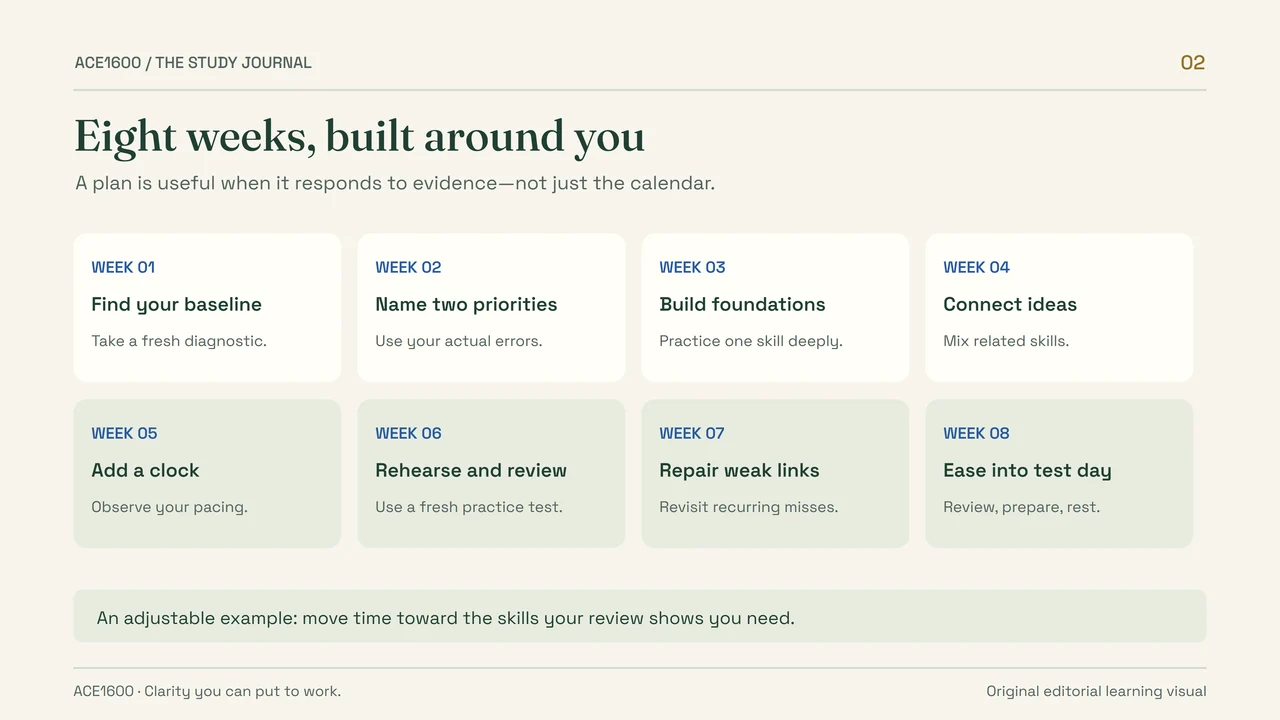
Read the visual as text
- Week 1: take a fresh diagnostic. Week 2: identify two priorities.
- Weeks 3–4: build foundations and connect related skills.
- Weeks 5–6: practice pacing, then rehearse and review.
- Week 7: repair recurring weaknesses. Week 8: review, prepare and rest.
- Adjust this example to school commitments and your review evidence.
1. Set the destination and the constraints
Begin with three pieces of information: your intended test date, a fresh or clearly documented practice result, and the weekly time you can protect. If you have not taken a practice test, the first week creates that baseline. College Board’s planning guidance similarly starts from identifying strengths and areas to improve, and recommends leaving learning time between full-length practice tests when possible. [1]
An eight-week window is a planning choice. It is not evidence that every student needs eight weeks or can reach every target in that time. A student rebuilding foundational algebra may need a longer runway than a student who knows the material but wants to improve execution. Keep a score target if it helps, then translate it into behaviors you can observe in this week’s work.
Original example: translating a broad goal
“Improve Math” does not tell Priya what to do after school. Her diagnostic review shows that she sets up percentage problems incorrectly and reads graph intersections confidently. Her first goal becomes: write the correct base quantity and multiplier for a percentage change before calculating.
For Reading and Writing, she often chooses transitions by tone. Her second goal becomes: state the relationship between two ideas before viewing the choices. These goals are small enough to rehearse and specific enough to check. They can change when a new set reveals a different issue.
Add school examinations, travel, activities, and application work before filling the calendar. Students in different Indian boards or U.S. schools will have different pressure points. Plan around your actual calendar rather than an assumed national timetable.
2. Build one repeatable week
The ordinary week in this example contains four 35-minute sessions and one 60-minute session: 200 minutes, or three hours and twenty minutes. Put them on specific days with a place to work. Leave the remaining days available for rest, school deadlines, or rescheduling. A session is complete when you finish its learning task, not when you open every resource you have saved.
A sample 200-minute study week
- Learn one Math skill35 minutes
Read a short explanation and work through a fresh example.
- Learn one Reading & Writing skill35 minutes
Identify the rule or reasoning task and apply it independently.
- Practice and explain35 minutes
Attempt selected questions and investigate the difficult steps.
- Revisit earlier work35 minutes
Return without notes and check whether the method is available.
- Mixed set and weekly review60 minutes
Choose methods across topics and decide next week’s priorities.
Within a 35-minute learning session, a possible division is five minutes to recall what you already know, ten minutes to examine an explanation, fifteen minutes to try questions, and five minutes to record the next step. Treat those numbers as scaffolding. A concept that is genuinely new may deserve most of the session, while a familiar concept may need only a short reminder.
Full-test weeks use a different budget. Protect one complete testing appointment, including the scheduled break, and a separate review session. Replace ordinary practice sessions to make room. Adding a full test on top of an already full week can produce a calendar that looks disciplined but is difficult to maintain.
3. Week one: find the first two priorities
Explore Bluebook before your diagnostic if the app is unfamiliar. Its preview is untimed and unscored; the full-length practice tests are scored. Choose an unused full test, use appropriate timing and any relevant approved accommodations, and record interruptions or assistance. These notes make the baseline interpretable. [2]
During review, examine incorrect answers, correct guesses, and questions that consumed time without a clear plan. Do not force every problem into a single explanation such as “careless.” Write what actually happened: you divided by the final value instead of the original value, missed a contrast in the passage, or kept manipulating an equation without rereading what it asked for.
Then choose two priorities, preferably narrow skills that appeared in more than one difficulty or context. One may be Math and one Reading and Writing, but an even split is not mandatory. If one section clearly needs more foundation work, spend more time there while keeping a short maintenance session for the other.
| Observation | Working explanation | Next session |
|---|---|---|
| Percentage answers use the wrong denominator | The original whole is not identified before calculating | Label original and final quantities on several fresh examples |
| Two transitions feel equally plausible | The relationship between ideas is not stated first | Write “contrast,” “result,” or “addition,” then test it against the sentences |
| A correct graph answer takes several attempts | The requested coordinate is unclear | Read the question aloud and label which coordinate answers it |
Keep this note small enough to use during a session. A long archive is less useful than one page that helps you decide what to practice next. Save unresolved questions for a teacher, peer tutor, or another explanation rather than copying a solution you still cannot explain.
4. Weeks two and three: make the method dependable
Use these weeks to build the reasoning behind your two priorities. Official SAT Prep on Khan Academy includes lessons and practice at Foundations, Medium, and Advanced levels. Choose the level that lets you understand the method and attempt it independently; difficulty labels are a resource for selecting work, not a judgment about your ability. [3]
Follow a worked example with a fresh attempt. Cover the explanation, write a first step, and continue until you either finish or identify the exact point where you need help. If you cannot begin, return to the prerequisite. If you can begin but repeatedly make the same transformation error, practice that transformation in a simpler setting before adding more complex wording.
Original example: percentage changes have a base
A quantity starts at 100, rises by 20%, and then falls by 20%. The first change gives 100 × 1.20 = 120. The second change uses 120 as its base, so the final quantity is 120 × 0.80 = 96. The changes do not cancel because their base quantities differ.
A useful follow-up changes the numbers and asks you to explain the base before calculating. For example, 200 rising by 10% and then falling by 10% becomes 198. If you can describe why, you have more evidence of understanding than if you simply remember the first answer was 96.
In week three, revisit the same skills after other work has intervened. Include a few older topics in the weekend set so that you must choose a method rather than repeat the previous one automatically. Keep untimed work available when reasoning is still unstable; adding a clock does not explain an unfamiliar concept.
Use the Student Question Bank to select practice by section, domain, skill, and difficulty. Those filters let you build a small, purposeful set. You do not need to complete every question in a category before moving on, nor does completing a category certify that every related problem is mastered. [4]
5. Week four: check transfer with a fresh test
Take a second unused full-length practice test early enough in the week to review it. Recreate your intended testing routine and record any departures from it. This checkpoint asks whether the skills you practiced appear when the questions are unfamiliar and mixed with other material. It also gives you another view of your timing.
My Practice lets you inspect answers and explanations after a Bluebook test and offers Tailored Practice based on performance. Use that information alongside your own notes. A suggested question set can help you select material, but you still need to determine whether an error came from understanding, execution, reading the request, or running out of time. [5]
Compare like with like where possible. A repeated test taken with pauses is not a clean comparison with a fresh test completed in one sitting. A total score can also hide a useful change: perhaps your previous percentage errors have disappeared while an unfamiliar geometry gap has become visible. Record both the improvement and the newly exposed work.
How the checkpoint changes the plan
- Cannot explain itReturn to instruction
Review the concept or prerequisite before adding speed.
- Can explain, cannot reproducePractice independently
Remove the solution and attempt a fresh problem.
- Accurate but slowCompare methods
Find the unnecessary work and test a clearer route.
- Accurate across contextsMaintain
Keep occasional mixed practice while another skill becomes a priority.
Finish the week by choosing the next two priorities. Keeping the same priorities is reasonable if the underlying issue persists. Changing them is reasonable if the evidence has changed. The calendar is a record of decisions, not a promise that every skill will improve on the original schedule.
6. Weeks five and six: add selection and pacing
During week five, combine familiar skills in short sets. In Math, include problems that require different representations. In Reading and Writing, mix evidence, transitions, and sentence conventions. Before solving, name the task. The additional challenge is selecting an approach when the heading no longer tells you which method to use.
Introduce time limits only after choosing a purpose for them. A timed set might test whether you can stop rereading a passage once you have identified decisive evidence. Another might test whether you can recognize that graphing is unnecessary for a direct equation. Record the specific behavior as well as the number correct, and review any rushed errors.
Original example: fixing a pacing problem
Alex reports that every Math set feels rushed. His written work shows repeated expansion of expressions even when the question asks for a value that can be found by substitution. The next session compares both routes on a few fresh problems. He checks that the shorter route is valid and explains why.
This gives him a concrete pacing adjustment. Simply telling himself to “go faster” could encourage skipped reading and new errors. The more useful goal is to remove a particular unnecessary step while preserving the check that the answer matches the question.
Take the third fresh full-length practice test in week six, roughly two weeks after the week-four checkpoint. College Board recommends spacing full tests by at least two weeks when the schedule allows, and taking one at least two weeks before test day when possible. [1] Keep time afterward for the errors that still deserve attention.
You do not owe the calendar an extra test if you are exhausted or have not reviewed the previous one. Move the appointment and preserve its purpose. A documented change is more useful than a score from a session that no longer resembles the conditions you intended to measure.
7. Week seven: consolidate the remaining work
Use the third test to narrow your final priorities. Choose recurring issues that you can meaningfully address with the time remaining. Continue occasional practice on reliable skills, but avoid spending most of the week collecting easy completions. Equally, do not let one unusually difficult question displace every ordinary task you still need to handle accurately.
Prepare a short personal reference from memory, then correct it. It might include how to identify the original quantity in a percentage problem, how to distinguish an independent clause from a dependent one, and how to check which coordinate a graph question requests. This is study material for preparation, not a document to bring into the test.
For each entry, attach a fresh example that you can solve without looking at the reminder. If your note says “read carefully,” rewrite it as an observable action such as “underline the quantity requested before calculating.” If it says “watch punctuation,” replace it with the sentence structure you actually need to inspect.
Ask for help selectively. A useful message to a teacher includes your attempted solution and the point you cannot justify. “I get from this equation to this line, but I do not understand why division changes the restriction” is easier to answer than “Please explain algebra.” For a reading question, show the evidence you chose and explain why it seemed to support your answer.
8. Week eight: make the final week workable
Keep the final week focused on familiar practice, a small number of unresolved issues, and practical readiness. A dramatic change of strategy now needs a good reason. If your current approach works reliably, preserve it. If a particular habit keeps producing errors, rehearse one precise correction rather than replacing your whole routine.
For SAT Weekend, follow the current Bluebook exam-setup instructions and confirm your actual arrival time and location on the admission ticket. Check official updates as test day approaches. [6] Resolve identification, device, charging, and travel arrangements early enough that another person can help if needed.
Eight weeks, four purposes
- Week 1Understand
Establish a baseline and choose two precise priorities.
- Weeks 2–3Build
Learn methods, attempt independently, and revisit them.
- Weeks 4–6Check and adapt
Use fresh tests and mixed practice to revise the work.
- Weeks 7–8Consolidate
Address recurring issues and complete practical preparation.
If you miss a session, reschedule its most useful task rather than copying the entire missed list into tomorrow. If a school exam consumes a week, keep a short maintenance routine and reconsider the remaining priorities. Catch-up work should fit the new calendar. There is no benefit in maintaining a fictional schedule that everyone knows is impossible.
Sources & further reading
Rules and policies were checked on September 17, 2026. Follow the linked official pages for changes. Study plans and worked examples are A1600 editorial guidance.
- Build Your Study Plan (opens in a new tab)College Board
- Full-Length Digital Practice Tests on Bluebook (opens in a new tab)College Board
- How to Use Khan Academy (opens in a new tab)College Board
- How to Use the Student Question Bank (opens in a new tab)College Board
- My Practice 101 (opens in a new tab)College Board
- What to Expect on Test Day (opens in a new tab)College Board