
In this guide
The first difficult part of SAT preparation is often working out what you are preparing for. You hear about adaptive modules, a built-in calculator, practice scores, and different college policies, sometimes in the same conversation. Before building a study schedule, it helps to separate the test itself from the many decisions surrounding it.
This guide is a starting map for students and families in the United States, India, and elsewhere. We will walk through the standard digital SAT, explain what the format means for your practice, and finish with a manageable first week. The teaching examples and suggested routines are original A1600 examples. They illustrate how to think; they are not official SAT questions or promises about future scores.
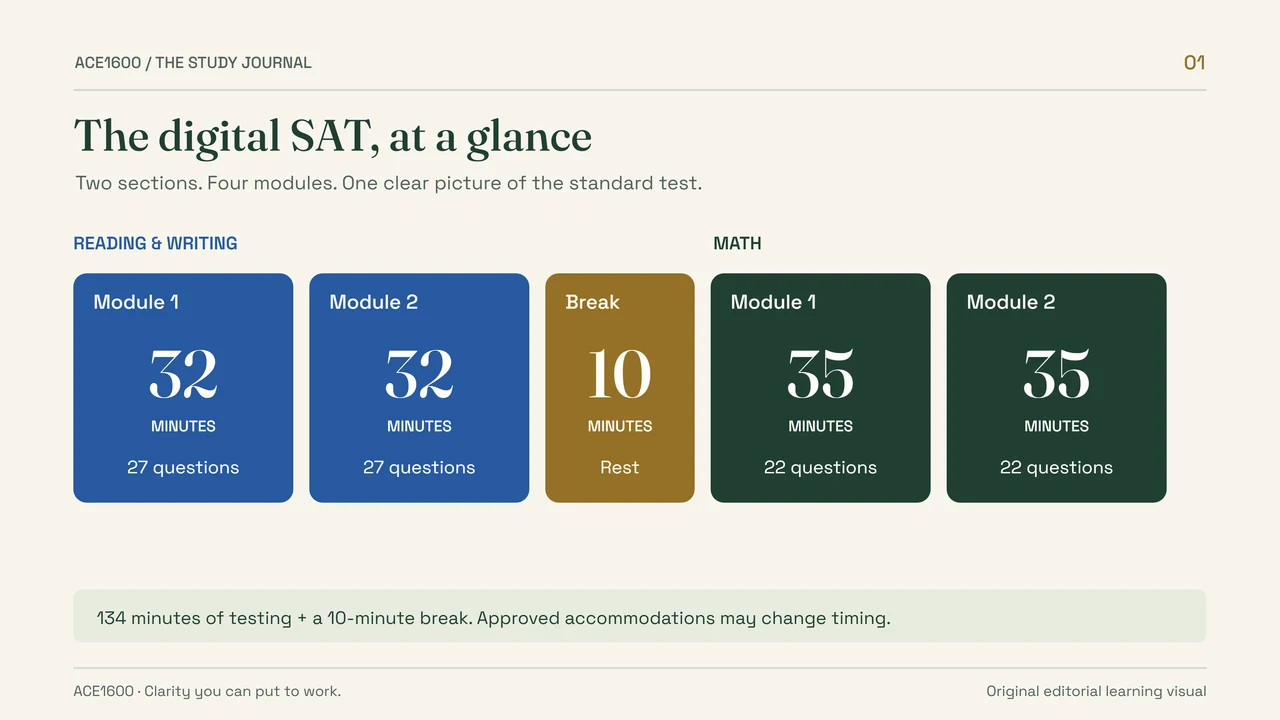
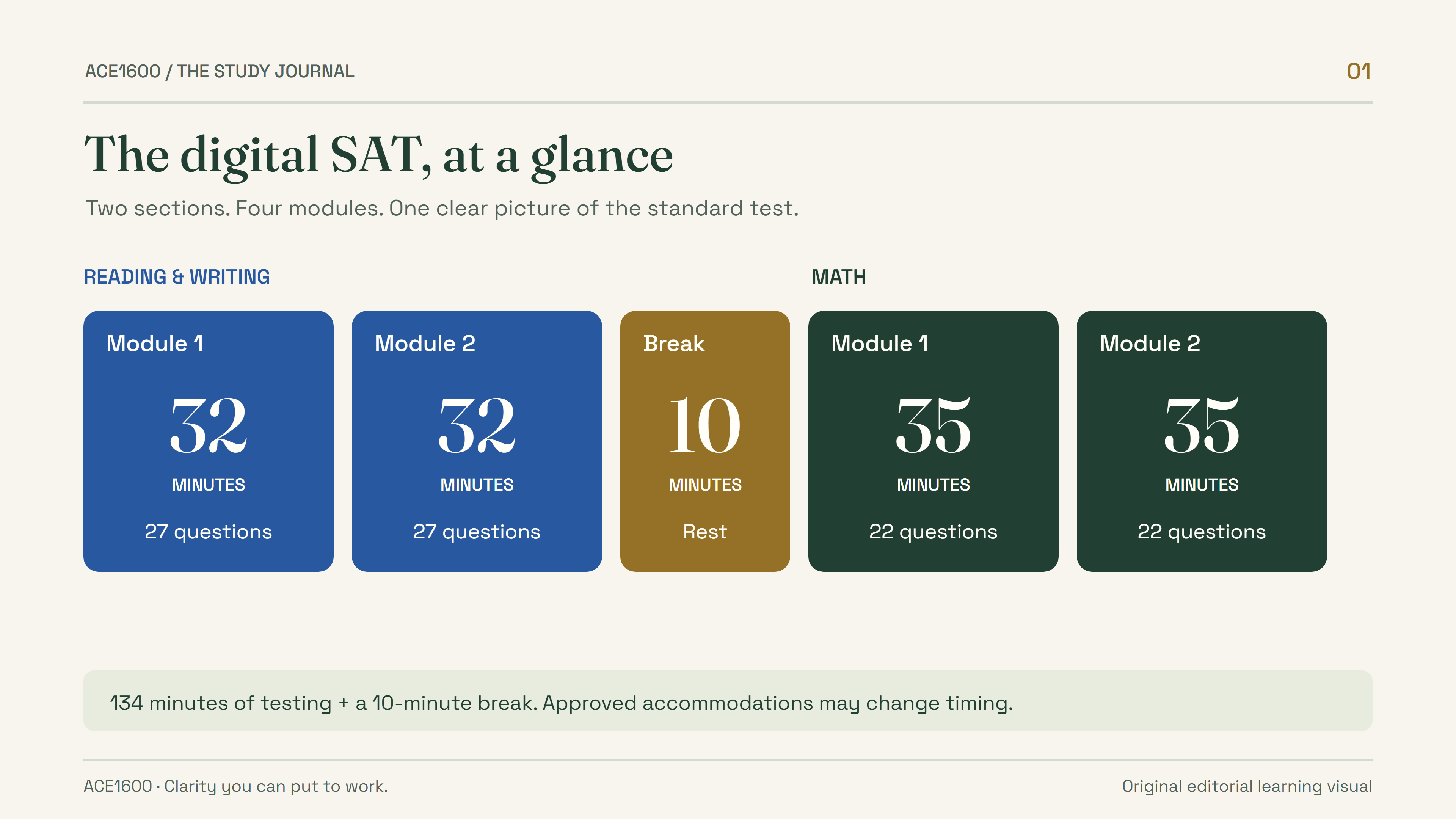
Read the visual as text
- Reading and Writing has two 32-minute modules with 27 questions each.
- A scheduled 10-minute break separates the sections.
- Math has two 35-minute modules with 22 questions each.
- Standard testing time is 134 minutes; approved accommodations may change timing.
1. Get a clear picture of the test
The standard SAT includes Reading and Writing, with 54 questions in 64 minutes, followed by Math, with 44 questions in 70 minutes. Each section has two equal-length modules. A 10-minute break separates the sections. That means 134 minutes of testing, or two hours and fourteen minutes, before adding the break and check-in procedures. Approved accommodations can change an individual student’s schedule. [1]
Your standard testing route
- Reading & Writing 132 min
27 questions in the first module.
- Reading & Writing 232 min
27 questions in the second module.
- Scheduled break10 min
Between the two sections.
- Math 135 min
22 questions in the first module.
- Math 235 min
22 questions in the second module.
Use that map to plan a realistic rehearsal. A practice appointment that allows only two hours is already too short for the standard test. Leave time to get settled and record a few observations afterward. If your family shares a device or a quiet room, booking the space matters as much as downloading the app.
Timing is a budget for a module, not an instruction to spend an identical number of seconds on every question. A direct grammar decision and a dense evidence question can demand different amounts of work. Likewise, one math question may take a single equation while another needs a diagram and a check. During early practice, notice that variation before designing a pacing rule.
2. Understand adaptation without trying to outguess it
The SAT adapts between modules. Performance on the first module of a section determines which second-module difficulty route you receive. It does not replace the next question every time you click an answer. Both modules contribute to your section result. The first module contains a mix of difficulty levels, so encountering an unfamiliar problem there is expected. [1][2]
A question that feels difficult is a poor measuring instrument for your overall performance. Perhaps it uses a topic you have not reviewed, a sentence structure you dislike, or numbers that make a familiar process look unusual. Another student can have a different experience with the same material. Treat the feeling as a cue to choose a method, not as evidence that your entire test has gone well or badly.
Original example: a difficult start to module two
Imagine that the first two questions in your second Math module involve functions, your least comfortable topic. You start thinking, “This must mean something about my score.” That thought supplies no equation, no useful diagram, and no additional time.
A better next action is concrete: identify the requested quantity, write what the function notation means, and see whether you have a workable first step. If you remain stuck, make the best response you can, mark the question for review, and continue within the module. Your decisions can stay steady even when your confidence temporarily changes.
Students can move among questions in the current module until it ends, but cannot return to a completed module. Practice using the review screen while the module is still open. Do not save a first-module question for the end of the whole section; that opportunity will no longer exist. [3]
3. Recognize what Reading and Writing asks you to do
Reading and Writing uses short passages or passage pairs, each followed by one multiple-choice question. Its four domains are Information and Ideas, Craft and Structure, Expression of Ideas, and Standard English Conventions. These cover understanding and evaluating evidence, words and text structure, effective expression, and the mechanics of written English. [4]
Translate the domain names into actions. An evidence question asks you to connect a claim to support. A vocabulary question asks which meaning fits this sentence. A transition question asks how ideas relate. A punctuation question asks how the sentence is built. The habit of naming the job can stop you from applying the same vague “read carefully” instruction to very different tasks.
Original example: relationship before transition
Consider two sentences: “The library expanded its weekend opening hours. Weekend attendance remained unchanged.” Before considering a transition, describe the relationship in plain language. The second fact contrasts with the increase someone might expect after the first.
A contrast transition such as “however” could express that relationship. A result transition such as “therefore” would suggest that unchanged attendance followed as an expected consequence. The useful skill is identifying the connection before being distracted by an answer choice that merely sounds formal.
For students who use several languages, separate language familiarity from evidence checking. You may understand every word and still choose an answer that makes a stronger claim than the passage supports. Conversely, an unfamiliar word does not always prevent you from understanding the sentence’s main relationship. In your review notes, record which of those problems actually occurred so the next practice session addresses it.
Avoid treating outside knowledge as a substitute for the supplied text. In an original passage about a town’s transport survey, an answer must match that survey’s evidence, even if you know an interesting fact about public transport elsewhere. Ask what the text establishes, what it only suggests, and what it never discusses.
4. See Math as relationships, representations, and checks
SAT Math covers Algebra, Advanced Math, Problem-Solving and Data Analysis, and Geometry and Trigonometry. Questions can ask you to choose an answer or enter a response. Calculator use is permitted throughout the Math section, but permission is not a requirement to use one for every calculation. [1][5][6]
Start by identifying the relationship in a problem. Are two quantities changing at a constant rate? Are you comparing a part with a whole? Does a graph show an intersection, a maximum, or a starting value? These questions connect the words to a mathematical representation. Only then decide whether algebra, a table, a graph, or a numerical calculation gives the clearest route.
Original example: a fee with two parts
A club pays a fixed room charge of 24 dollars plus 6 dollars for each participant. If the total is 90 dollars, how many participants are there? Let n represent the number of participants. The relationship is 24 + 6n = 90. Subtracting 24 gives 6n = 66, so n = 11.
Check the interpretation as well as the arithmetic. Eleven participants cost 66 dollars, and the room adds 24, giving 90. The answer is a count of people. If the question instead asked for the variable portion of the fee, the requested answer would be 66 dollars. Solving accurately does not replace reading the final question.
A useful practice note names the earliest step that went wrong. “Forgot to remove the fixed fee before dividing” identifies a repair. “Bad at word problems” is too broad to guide one. Students who have already studied advanced school mathematics may still benefit from this translation work: knowing a method and recognizing when to use it are separate parts of solving.
5. Make the screen familiar before it becomes timed
Bluebook’s untimed test preview lets you explore the interface; it does not return a score or answer feedback. Full-length practice tests provide a scored experience. Use the preview first so that learning where a button lives does not compete with understanding a question during your initial diagnostic. [7]
Build a short tool rehearsal around actual actions. Mark a question for review, locate it again, remove an answer choice, adjust the display to a comfortable size, and open the Math reference information. Choose annotation habits that help you see a relationship. Highlighting almost an entire passage creates more visual noise without telling you which detail matters.
The embedded Desmos calculator offers graphing and scientific options. If you plan to bring a handheld calculator, check College Board’s current policy: devices with built-in computer algebra system functionality are prohibited. Practice with the permitted calculator you intend to use. Do not assume that a device allowed in a school class or another exam is automatically permitted on the SAT. [6]
Give each tool a specific job
- Mark for reviewReturn
Keep track of an unresolved question inside the current module.
- Scratch paperRepresent
Write an equation, label a diagram, or preserve a calculation.
- CalculatorCompute or inspect
Evaluate a calculation or examine a graph after choosing the right relationship.
- Answer reviewCheck
Look for omissions and revisit questions with a concrete next step.
When you discover a tool you like, test it on several ordinary practice problems. A method that works only after watching someone else demonstrate the exact question is not yet a dependable habit. Try it again without the demonstration, and notice where you still need instructions.
6. Read a score as evidence, not a label
The SAT total scale runs from 400 to 1600. Digital scoring considers characteristics of the questions and your response pattern; it is not a universal conversion in which each missed question removes the same number of points. Two students with the same number correct can receive different results. College Board advises students making a serious attempt to guess rather than leave a question blank, especially after eliminating choices. [2]
Your first practice result has a narrow purpose: deciding where to start. Record the conditions alongside the score. Did you finish in one sitting? Had you seen some questions before? Did you look up a formula? Those details change what you can reasonably infer. An assisted practice session can teach something useful, but it should not be presented as a fresh timed baseline.
Look below the total. Two students can share a total while needing very different next steps. One might need foundational algebra and already handle sentence structure well. Another might understand most math content but lose time on long reading questions. A single score target does not tell either student which exercise to do on Tuesday afternoon.
For families, a helpful conversation begins with “Which task would make next week easier?” A question like “Why are you not at your target yet?” offers much less direction after one diagnostic. Ask the student to show one solved problem, one unresolved problem, and one proposed practice priority. That makes the discussion concrete without turning every session into a judgment about ability.
7. Turn a first attempt into a first week
Begin with a small sequence you can actually complete. Choose a quiet appointment for a fresh Bluebook test, use the appropriate timing, and put away answer aids. Afterward, take a break before doing detailed review. My Practice provides your results and explanations, along with Tailored Practice generated from your performance. It also links to matching Khan Academy practice-test review courses. [8]
A suggested first-week sequence
- ExploreFirst session
Try the preview and write down any interface questions.
- MeasureQuiet appointment
Take one fresh practice test under clearly recorded conditions.
- ExplainNext session
Review errors, guesses, and correct answers that took too long.
- ChooseRest of the week
Work on two specific skills and revisit them independently.
Choose priorities small enough to practice directly. “Linear equations with fractions” and “joining complete sentences” are more useful than “Math” and “English.” Start with a lesson if you cannot explain the underlying method. Then attempt a few questions independently and examine the first point where your reasoning diverges from a valid solution.
Reserve a later session for another attempt without the explanation open. You are checking whether the method is available when the support disappears. If you recognize the original answer, use a different question that requires the same skill. Remembering an answer and being able to solve a new problem are different achievements worth recording honestly.
8. Keep preparation and test-day planning connected
Alongside academic practice, create a separate checklist for registration, identification, device readiness, and travel. Follow the current official instructions for your administration and location. A family in Bengaluru and a student testing through a U.S. school may need different logistical arrangements even though they are preparing for the same underlying Reading and Writing and Math skills.
For SAT Weekend, College Board directs students to complete exam setup in Bluebook before testing and to confirm the arrival time on their admission ticket. Check the official test-day page as the date approaches, including updates about the testing location. Do not assume that a practice login by itself completes exam setup. [3]
Put school assessments and other commitments on the same calendar as SAT practice. A reasonable plan changes when a major school deadline appears. Reducing a week to two focused sessions is often a more workable choice than scheduling seven sessions you know you cannot attend. What matters for the next decision is an accurate account of what you practiced and what remains uncertain.
Sources & further reading
Rules and policies were checked on September 17, 2026. Follow the linked official pages for changes. Study plans and worked examples are A1600 editorial guidance.
- How the SAT Is Structured (opens in a new tab)College Board
- How Are Scores Calculated? (opens in a new tab)College Board
- What to Expect on Test Day (opens in a new tab)College Board
- The Reading and Writing Section (opens in a new tab)College Board
- The Math Section: Overview (opens in a new tab)College Board
- SAT Suite of Assessments Calculator Policy (opens in a new tab)College Board
- Full-Length Digital Practice Tests on Bluebook (opens in a new tab)College Board
- My Practice 101 (opens in a new tab)College Board