
In this guide
You finish the first Math module. The next screen opens, and the first problem looks surprisingly straightforward. Does that mean you did badly? A few questions later, an unfamiliar expression appears. Does that mean you are now doing well? This kind of running commentary can consume the attention you need for the problem in front of you.
Adaptive testing is worth understanding once, clearly. It is much less useful to keep interpreting it during the exam. The productive question is not “Which route am I on?” but “What does this question ask, and what is my best next step?” This guide explains the design, separates facts from common myths, and turns that understanding into a practice routine.
The strategies and short scenarios below are ACE1600 editorial teaching examples. They are not descriptions of secret scoring thresholds, and they cannot predict a score from a handful of answers.
Read the visual as text
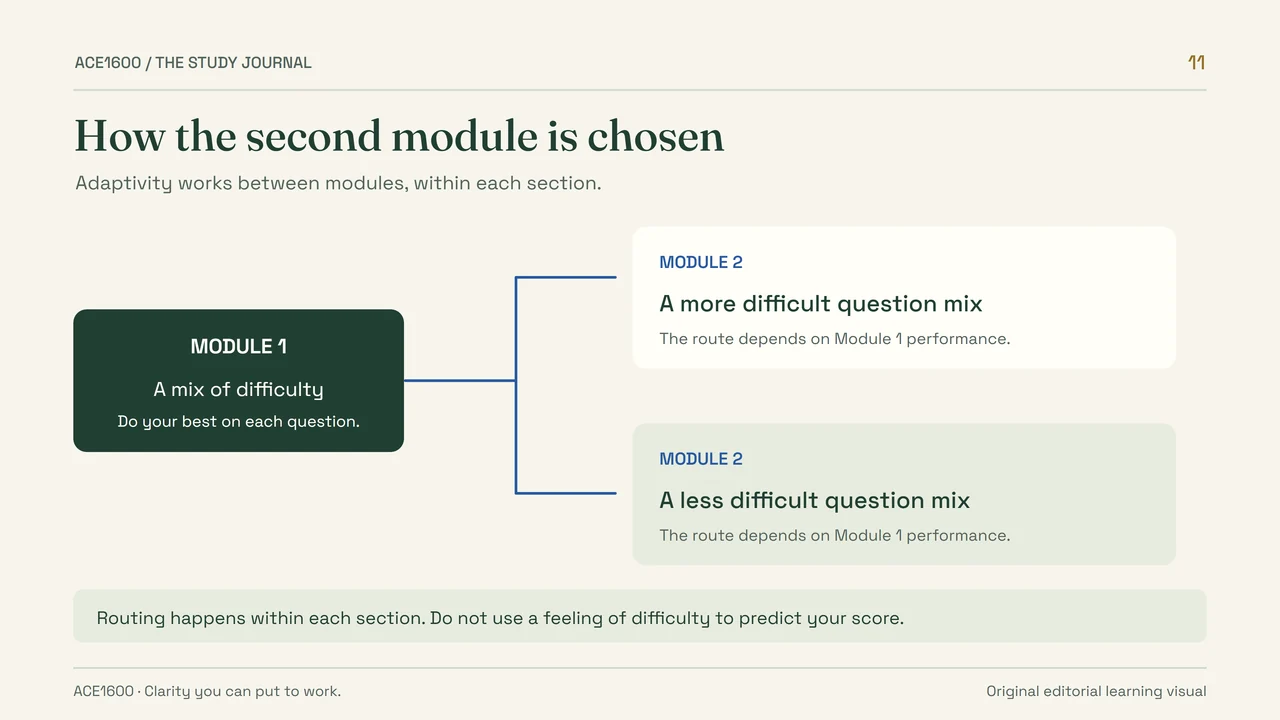
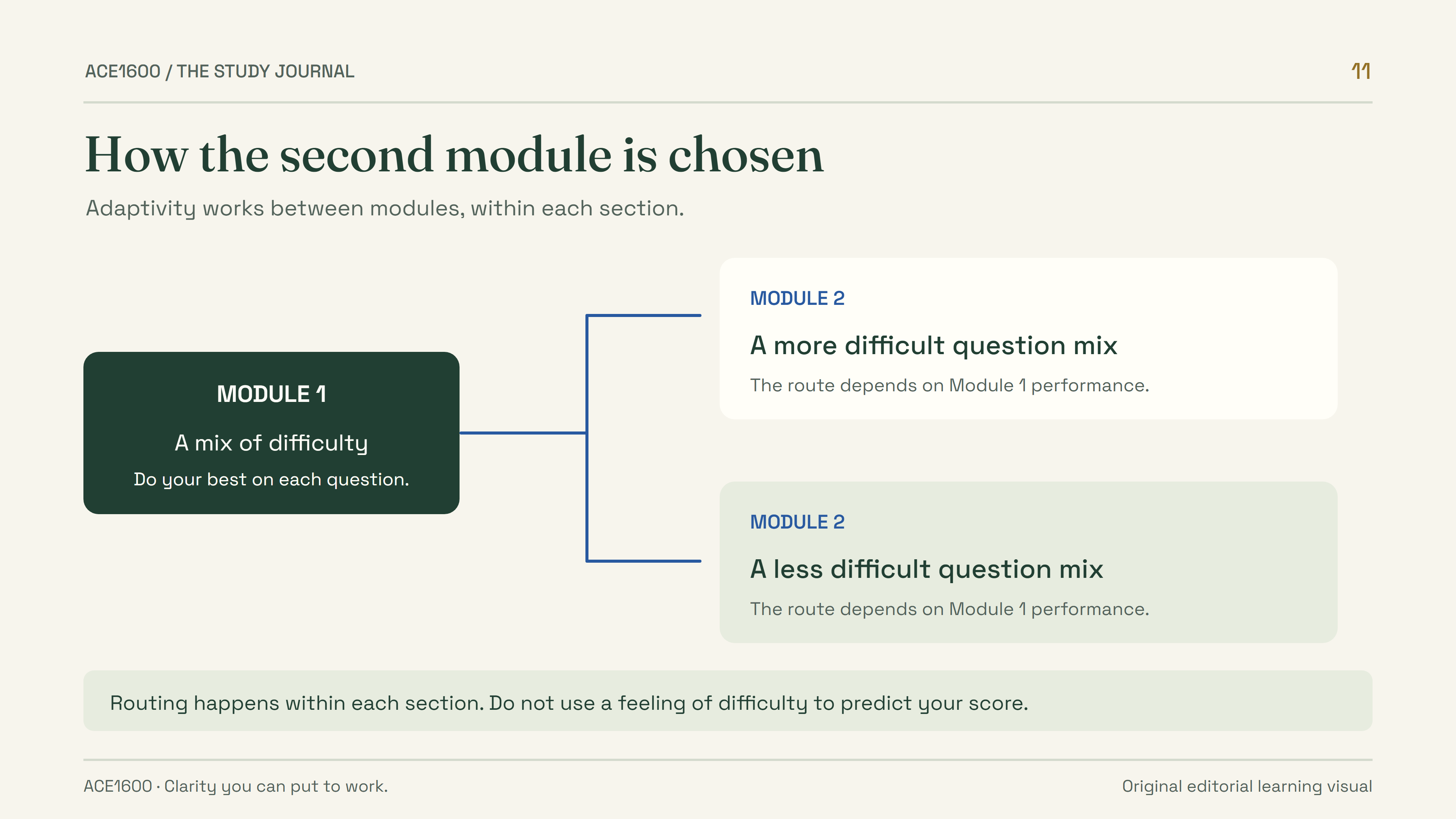
- The first module of each section contains a mixture of easier and harder questions.
- Performance in Module 1 determines the difficulty mix in Module 2.
- The second module can be a more difficult or less difficult question mix.
- Focus on the current question; perceived difficulty cannot reliably tell you your score.
1. Understand the change that actually happens
Each SAT section has two modules. Your performance in the first helps determine the difficulty mix in the second. Reading and Writing has two 32-minute modules; Math has two 35-minute modules under standard timing. The adaptation happens within each section. [1]
That design is different from a system that selects a new question immediately after every response. You can work through the questions available in your current module without assuming that your latest answer has rewritten the next screen. Learning this distinction should remove an unnecessary layer of decision-making: there is no reason to alter an answer just to influence what appears next.
The adaptive pathway
- First moduleMixed difficulty
Work carefully through the questions available in this module.
- RoutingBetween modules
Performance in the first module informs the second module’s difficulty mix.
- Second moduleA new mixed set
Continue solving the questions you receive; difficulty still varies.
- Section resultBoth modules
Your responses across the section contribute to the result.
Think of the design as a way of gathering useful evidence about a range of skills. It is not a conversation in which the test praises or criticizes you with each new screen. That framing matters because people often treat a difficult-looking problem as a verdict. A dense paragraph or unfamiliar diagram is only a task to inspect. Its appearance does not tell you whether your previous answer was correct.
During preparation, distinguish official design information from internet speculation. A precise-sounding claim about a fixed number of mistakes can still be unsupported. If advice depends on knowing an unpublished routing threshold, it is not a dependable plan for your test day.
2. Replace score myths with useful limits
College Board explains that section scores use responses from both modules and characteristics of the questions. Consequently, the same number of correct responses can produce different section scores. Its guidance also recommends attempting every question rather than leaving blanks. [2]
The important practical limit is that you cannot turn your memory of a module into a reliable score calculator. You may not remember every choice, and a feeling of certainty is not proof that an answer was right. A social-media table that maps “three mistakes” to an exact score can create false confidence or unnecessary worry. Use your reported results when they are available.
| Assumption | A more useful response |
|---|---|
| “An easy opening question reveals my route.” | Solve it carefully. One question cannot summarize the whole module. |
| “I should rush the second module because the first already decided everything.” | Keep working; responses in both modules matter. |
| “I can calculate my score from the mistakes I remember.” | Wait for the score report and use practice evidence to plan the next steps. |
This does not mean that accuracy in the first module is unimportant. It means that the right response is ordinary good test taking: understand the task, avoid preventable errors, and use the available time well. Overprotecting one question can harm that goal if it leaves several other questions unread. Accuracy and coverage have to work together.
When a friend asks which module you think you received, you can simply say that you focused on the questions. Comparing impressions after an exam rarely produces actionable evidence. Two students may find the same topic very different because their preparation differs. A familiar quadratic can feel easier than an unfamiliar vocabulary word even when their formal difficulty classifications suggest otherwise.
3. Separate difficulty from unfamiliarity
A problem can feel difficult for several reasons. You may lack the underlying skill. You may know the skill but fail to recognize its presentation. You may understand the method while making the arithmetic unnecessarily complicated. Or you may be tired and misread a small instruction. These are different learning problems, and “the hard module” does not diagnose any of them.
Original example: a familiar equation wearing different clothes
Suppose a question gives 3(2x − 5) + 4 = 25 and asks for 2x − 5. Expanding immediately is possible: 6x − 11 = 25, so x = 6 and 2x − 5 = 7.
A shorter route names the expression u = 2x − 5. Then 3u + 4 = 25, so u = 7. The unfamiliar appearance did not require a new mathematical skill; it required noticing the requested quantity.
If you initially struggled, record “solved for x when the question asked for an expression.” That observation tells you what to practice. Recording only “hard algebra” does not.
The same distinction appears in Reading and Writing. You might understand every word but lose track of a contrast between two claims. You might also understand the contrast while not knowing one answer choice. The first issue calls for work on relationships between ideas; the second calls for precise vocabulary in context.
After a practice session, explain where the first uncertainty occurred. Was it the meaning of a word, the choice of equation, a sign change, or the decision to move on? The earliest identifiable break is often more useful than the last visible error. It gives your next study session a small, concrete target.
4. Create a reset routine between modules
A reset routine should be short enough to use without becoming another task. At the next module, relax your grip, take one ordinary breath, and read the new question from the beginning. The goal is to stop carrying an argument about the previous module into the new one. It is a preparation habit, not a special scoring technique.
What deserves your attention?
- ObservableUseful
The instruction, the evidence, your working, and the time remaining.
- UncertainUnhelpful during testing
A guessed route, a predicted score, or another student’s remembered experience.
- Next actionSpecific
Choose a method, eliminate an unsupported option, or mark the item for review.
Prepare one sentence that redirects you: “I need the best answer to this question.” It is more practical than telling yourself to feel confident, because confidence cannot always be summoned on command. You can, however, underline the requested quantity or identify the sentence that supports a claim. An observable action gives attention somewhere useful to go.
Original scenario: the first question looks too easy
A student sees a direct substitution question at the start of a second Math module and begins thinking that the first module went badly. She rereads it four times because she assumes there must be a trap.
A better response is to substitute once, check the requested value, and move on. If the result is straightforward, it can remain straightforward. Suspicion alone is not a reason to spend more time.
Practice the reset after both comfortable and uncomfortable modules. If you use it only after a bad experience, you may start associating the routine with failure. A consistent transition makes it a normal part of the process, like placing your scratch work where you can read it.
5. Use adaptive practice for the right purpose
Official digital practice tests are available in Bluebook. Use an unused test when you need to rehearse the complete testing experience. [3] Your purpose should be stated before you begin: perhaps to test a pacing routine, practice the interface, or establish a current baseline. A test with no review time reserved often produces little more than a number.
Keep the conditions reasonably comparable. Note interruptions, extra breaks, outside assistance, or material you recognized. These details do not make the session worthless; they change what you can infer from it. A completed practice exam with repeated questions is useful rehearsal, but its score should not be treated as fresh evidence of unfamiliar problem solving.
After the test, choose one module to review deeply. For each uncertain item, try it again before reading the explanation. Compare your original method with the method you can now explain. The gap between the two is the learning opportunity. If the explanation merely feels familiar, close it and reconstruct the reasoning on a blank page.
Do not repeatedly restart a practice exam until you like the route you receive. That turns preparation into a search for reassurance. Instead, complete the attempt, identify a recurring weakness, and use targeted work to address it. A future unused practice test can then show how those changes behave under a full set of conditions.
The College Board study-plan guidance can help you choose resources and organize preparation. [4] Your personal plan should still fit schoolwork, your test date, and the evidence from your own attempts. A schedule is a working document, not a requirement to finish every resource you can find.
6. Review the decisions, not the imagined route
Build a review page with three columns: what happened, why it happened, and what you will try next. Keep entries short enough to revisit. “I panicked” describes an experience; “I reread the same sentence without naming its claim” describes a behavior you can change. Both can be true, but the second helps design practice.
Original review entry: a rushed root question
What happened: I found x = −3 and x = 5 but entered −3 when the question asked for the positive solution.
Why it happened: I stopped after solving the equation and did not return to the wording of the task.
Next action: On the next five equation problems, write the requested object beside the working before solving. Afterward, check whether the answer matches that object.
Also review correct answers that depended on luck or an unverified shortcut. If you guessed between two choices, you still need to explain what separates them. If you used a calculator but entered the wrong expression and happened to select the correct option, the score alone will not reveal the problem.
Choose a small number of changes. Trying to fix vocabulary, punctuation, graphing, pacing, and test anxiety in one session makes it difficult to see which intervention helped. A narrow experiment—such as checking the target quantity on every algebra item—can be evaluated clearly the next time you practice.
7. Try a practical, route-free practice session
Begin with a brief statement of purpose: “Today I am practicing accurate decisions when a question looks unfamiliar.” Select a small mixed set that includes both comfortable and less comfortable material. Work without trying to classify every question as easy or hard. Label the step that slowed you down only after the attempt.
- Before starting, write one process goal that you can observe, such as checking the exact requested quantity.
- While working, notice speculative thoughts about scores or routes and redirect yourself to an action on the current item.
- Afterward, re-solve two uncertain questions before opening their explanations.
- Write one correction rule in your own words and use it on a fresh example.
- At the next session, test whether the correction still works without looking at the rule.
If a difficult item consumes most of the session, ask whether the missing step is a prerequisite. You may need to work on factoring before a complex quadratic application, or on distinguishing claims before evaluating evidence. Returning to a prerequisite is a strategic choice because it addresses the reason you stalled.
Progress here is not a promise that every second module will feel comfortable. It is the ability to keep working productively when the experience changes. You understand the adaptive design, you know the limits of score speculation, and you have a way to return your attention to the next solvable step.
Sources & further reading
Rules and policies were checked on October 4, 2026. Follow the linked official pages for changes. Study plans and worked examples are A1600 editorial guidance.
- How the SAT Is Structured (opens in a new tab)College Board
- How Are Scores Calculated? (opens in a new tab)College Board
- Full-Length Digital Practice Tests on Bluebook (opens in a new tab)College Board
- Build Your Study Plan (opens in a new tab)College Board