
In this guide
You open your score report, see a number, and immediately wonder whether it is good enough. A friend has a higher score. A video says everyone needs 1500. A college website seems to say something different. The problem is that those comparisons answer different questions.
A useful SAT target starts with what you want the score to do. You may need to meet an application requirement, add evidence of academic preparation, pursue a particular scholarship, or decide whether another test is worth the time. The same score can play different roles at different universities.
This guide helps you build a target for your own list. The college policies below were checked on September 17, 2026. Our imaginary students and colleges are teaching examples, not admissions predictions. Have your prospective college list and a recent practice score nearby; you can leave with a practical decision sheet.
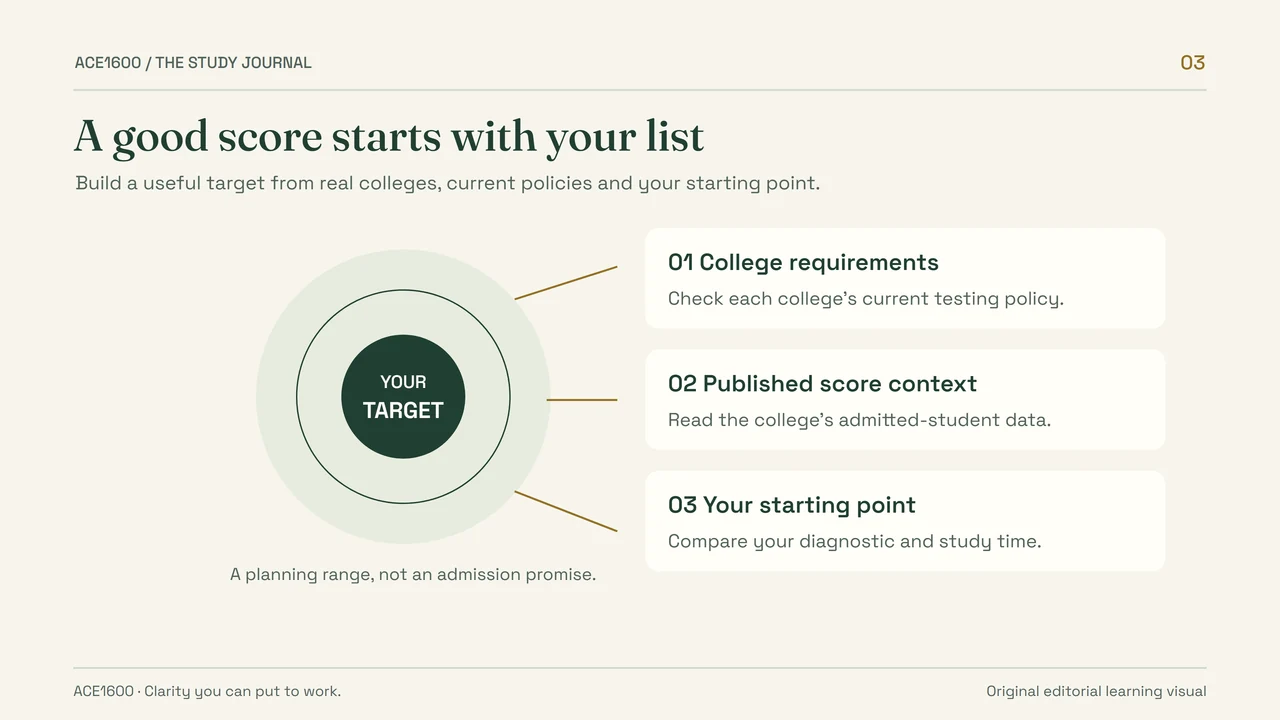
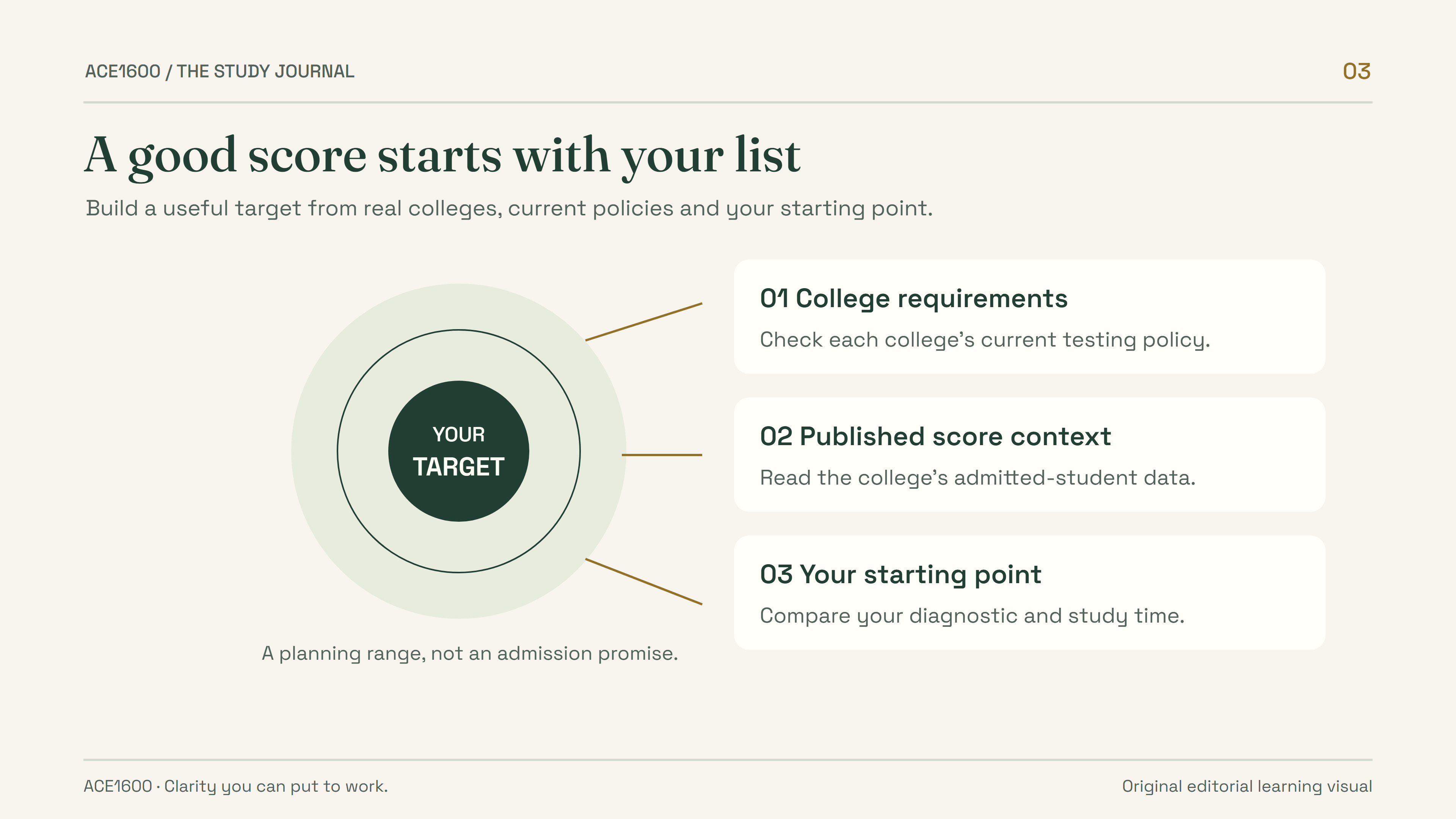
Read the visual as text
- Check the current testing policy of every college on your list.
- Use each college’s own published score information for context.
- Compare your diagnostic with your available preparation time.
- Treat your target as a planning range, not a guarantee of admission.
1. Give the score a job before giving it a target
The SAT total ranges from 400 to 1600 and combines Reading and Writing and Math, each scored from 200 to 800. Your report may also show a score range and percentile comparisons. These describe performance in different ways; none is a judgment of your value or a complete description of your academic ability. [1]
Start with a plain sentence: I am taking the SAT because… Finish it with something specific. Perhaps two universities on your list require a test. Perhaps a scholarship publishes a minimum score. Perhaps you want to show the progress you have made since an earlier attempt. A clear purpose prevents a number chosen by somebody else from controlling your schedule.
Separate three ideas: a requirement you must satisfy, a target you would like to reach, and a result you can reasonably work toward before a deadline. They may be different. A college can require the SAT without publishing a minimum score. A scholarship can publish a threshold without promising an award to every student who reaches it.
One score, two different next steps
Imagine Anika and Mateo both have a 1380. Anika's remaining applications include universities that require testing, while Mateo's list currently contains only institutions that do not consider SAT scores for admission.
Anika needs to check how her score fits the requirements and context of each application. Mateo should first confirm whether another purpose, such as course placement, makes testing useful. Their identical score does not imply an identical preparation plan.
2. Check the policy for your entry year
Write the year you hope to begin university at the top of your sheet. Application cycles and enrollment years are easy to confuse: applying during 2026–27 commonly means enrolling in fall 2027. A policy announcement about the following cycle may not apply to you. Read the admissions page itself, including any exceptions for your applicant category.
As checked on September 17, 2026, Yale requires first-year and transfer applicants to include SAT or ACT scores. Its previous policy allowing AP or IB results to fulfill that testing requirement is no longer the current rule. Yale's international page also makes clear that international applicants follow the same standardized-testing requirement. [3]
Princeton remains test optional for first-year and transfer applicants seeking fall 2027 enrollment. It says SAT or ACT scores will be required for fall 2028 enrollment, beginning with the 2027–28 admission cycle, with a stated exception for active military applicants. The enrollment year matters here. [4]
The University of California says SAT and ACT results are not considered in admission or scholarship decisions. Its application guidance explains that scores can have other uses, including certain eligibility requirements or placement after enrollment. That is different from an optional submission that an admissions reader can evaluate. [5]
Three policies, three planning questions
- RequiredYale
Which accepted test will I submit, and will the result arrive by the required deadline?
- Optional for this yearPrinceton, fall 2027
What does the college say about submitting scores, and how does my result fit my application?
- Not consideredUC admission
Does this test serve another verified purpose, or should I spend that time elsewhere?
3. Read score ranges without turning them into odds
College Board recommends choosing a target in relation to the colleges you want to attend. A useful starting point is a university's own admissions profile or Common Data Set. Record the year, the score range, and the group being described. A table for enrolled first-year students is not a table for every applicant, and an older profile may reflect a different testing policy. [2]
A middle-50% range usually runs from the 25th to the 75th percentile within the stated reporting group. Roughly a quarter of that group lies below the lower endpoint and a quarter above the upper endpoint. It does not mean someone with a score in the range has a 50% chance of admission. The range describes results among a group; it is not a prediction for a new applicant.
Check whether the figures cover score submitters and what proportion of students submitted scores. During an optional period, students choosing to submit may differ from students who do not. Also distinguish a total-score range from separate Math and Reading/Writing ranges. Adding two section endpoints may create a combined number that the college never reported.
An imaginary college profile
Fictional Harbor College reports a middle-50% total-score range of 1280–1440 among enrolled students who submitted SAT results. Leena has 1360. Her score lies inside that reported range.
That observation is useful and limited. It does not establish that Harbor is a safe admission option, that 1440 is a cutoff, or that Leena has the same background and application strengths as the students in the profile. She should record the range and continue evaluating the whole college.
4. Build one decision sheet for your actual list
Open a document or spreadsheet with one row per institution. For each row, include enrollment year, applicant category, testing policy, published score information, source date, deadline, and an unresolved-question column. If a university has no useful range, leave that cell blank rather than filling it with a number from a forum.
Add practical details that can change your next action. Does the institution accept self-reported results initially? Does it superscore the SAT? Does it request all testing results or specify which ones to report? Does a particular scholarship have its own application, deadline, residency condition, or test requirement? Read the relevant university instructions rather than assuming the rule at one institution applies everywhere.
| College | Verified policy / range | My next action |
|---|---|---|
| Harbor College | Required; 1280–1440 among SAT submitters | Confirm reporting method and deadline |
| Meadow University | Optional; no current range found | Read submission guidance; leave range blank |
| Cedar Institute | Scholarship has separate conditions | Check eligibility and award selection rules |
For an Indian student considering universities both at home and abroad, create separate rows rather than one category called SAT colleges. College Board's India acceptance table is a discovery aid, but it explicitly advises checking the institution's own current policy, including department differences. A university accepting the SAT for one program does not establish acceptance for every program. [9]
If a detail remains unclear after reading the page, write a narrow question for the admissions office: I plan to apply for this program and entry year; does this testing rule apply to my applicant category? Keep the answer with its date. That is more useful than asking whether your score is good enough in isolation.
5. Choose a working target and a section plan
Once the policy sheet is complete, choose a working target that serves your list. You can aim toward the higher part of a relevant published range if that is a useful stretch, but do not turn the 75th percentile into a universal requirement. Some applicants need more basic skill development; others already have a result that supports their testing purpose.
Use a recent, fully timed official practice test to establish a starting point. College Board provides digital practice in Bluebook and feedback through My Practice. A test taken with pauses, explanations open, or familiar questions may be useful for learning, but it is not a clean baseline for planning a future timed performance. [7]
Turning a total target into a study decision
Fictional student Rohan has 650 Reading and Writing plus 710 Math, totaling 1360. He chooses 1420 as a working target after reviewing his own college sheet. One possible combination is 690 plus 730; another is 670 plus 750.
The arithmetic does not tell him which combination is achievable. His error review does. If he repeatedly misses sentence boundaries and percent-change questions, those are concrete practice tasks. He should not spend equal time on every topic simply because the test has two sections.
Create two kinds of targets. Your outcome target is the score you hope to reach. Your process targets are things you control this week: explain five missed grammar questions, translate six word problems correctly, or complete a timed set without rushing the final items. Process targets make the plan usable even when score gains arrive unevenly.
From college purpose to next week's work
- Purpose
Identify where the SAT result will actually be used.
- Working target
Choose a useful goal after checking current policies and context.
- Baseline
Take a realistic official practice test and review the section results.
- Weekly action
Practice the specific skills behind repeated errors, then reassess.
6. Keep superscores and scholarships in their own columns
A superscore combines the strongest section results across test dates when an institution's policy permits that approach. It does not create a new single-day test result. If your best Reading/Writing and Math scores came from different administrations, keep the original dates and section scores visible so you can follow each college's reporting instructions accurately.
A simple superscore calculation
On one date, fictional student Maya earns 680 Reading and Writing and 730 Math: 1410 total. On another, she earns 710 and 700: also 1410.
At an institution that accepts this SAT superscoring method, the strongest sections combine to 710 + 730 = 1440. Her two actual test totals remain 1410. She must still follow that institution's instructions on which results to report or send; a calculation does not establish a college's policy.
Scholarship rules need equally careful reading. College Board's India Scholars Program describes registration discounts separately from university scholarships. Its scholarship guidance includes an SAT score of at least 1300, income eligibility, admission requirements, and selection by participating universities. A qualifying score opens an eligibility question; it does not promise an award. [6]
Avoid treating the SAT as a general scholarship coupon. For every award, record the actual eligibility conditions, the deadline, whether another application is needed, and whether the award is automatic or competitive. Parents can help with this research without turning every practice result into a discussion about money. The student still needs room to learn from errors calmly.
7. Decide whether another attempt has a clear purpose
Before registering again, ask three questions. Would a higher score change a meaningful application decision? Do you know which skills or habits need improvement? Is there enough time to practice those skills while protecting schoolwork and application deadlines? A retake is easier to justify when all three answers are specific.
Compare opportunity costs honestly. Another preparation cycle may involve registration fees, travel, family coordination, and several weekends of work. A student with unfinished essays or slipping classroom performance may need a different priority from a student with clear weak areas and a comfortable deadline. The useful question is what this next attempt adds to your whole plan.
Set a checkpoint rather than relying on one exciting practice result. After a few weeks of targeted work, take a fresh official practice test under consistent conditions. Look at the pattern of errors as well as the total. If the same confusion persists, more tests alone may not solve it. You may need a clearer explanation, slower practice, or feedback from a teacher.
Check the official test calendar alongside each college's score deadline. Registration and score-reporting deadlines are different, and travel or device arrangements can require extra lead time. Do not assume the last test before an application deadline will automatically fit every institution's requirements. [8]
8. Use the next thirty minutes to make the target yours
Spend ten minutes listing the universities and programs you are seriously considering. Include an entry year and the reason each one interests you beyond its reputation. Then spend ten minutes opening official admissions pages and recording the testing rule for each row. You do not need to complete the entire college search today.
Use the final ten minutes to write down your latest credible baseline, one provisional score target, and the next skill you will practice. If you have not taken a realistic practice test yet, scheduling that test is the action. If the college list is still uncertain, label the target provisional. A useful plan can change when better information arrives.
For families, agree on a short weekly conversation about the plan rather than a daily interrogation about points. Ask what the student understands now that they did not understand last week. Keep track of deadlines together. Let the score report supply evidence for decisions without allowing it to become the only story about the student's progress.
You are finished for today when you can explain why your target matters, where the policy information came from, and what you will do next. That is a stronger starting point than chasing the highest number in your group chat. Your target should help you make choices, and your choices should leave space for the rest of your education.
Sources & further reading
Rules and policies were checked on September 17, 2026. Follow the linked official pages for changes. Study plans and worked examples are A1600 editorial guidance.
- What Do My Scores Mean? (opens in a new tab)College Board
- Setting a Target Score (opens in a new tab)College Board
- Standardized Testing (opens in a new tab)Yale Undergraduate Admissions
- Standardized Testing (opens in a new tab)Princeton Admission
- Filling Out the Application: Test Scores (opens in a new tab)University of California
- India Scholars Program (opens in a new tab)College Board
- Practice and Preparation (opens in a new tab)College Board
- SAT Dates and Deadlines (opens in a new tab)College Board
- SAT Acceptance in India (opens in a new tab)College Board