
In this guide
A word problem can feel harder than the algebra it contains. You may know how to solve a linear equation yet hesitate when the unknown is hidden inside a membership charge, a percentage change, or a description of two quantities. The missing step is often translation: deciding what the variables mean and how the quantities relate.
The SAT Math specifications include algebra, advanced math, data analysis, geometry, and trigonometry. Linear equations and systems sit alongside nonlinear relationships, percentages, rates, and units. Preparing for these topics means practicing both the calculation and the interpretation. A correct number attached to the wrong quantity is still the wrong answer. [1]
This guide uses a repeatable process and several original editorial examples. They are teaching problems, not official SAT items. Work through each one before reading the solution if you can. Then explain why the equation matches the situation; that explanation will help more than memorizing the final number.
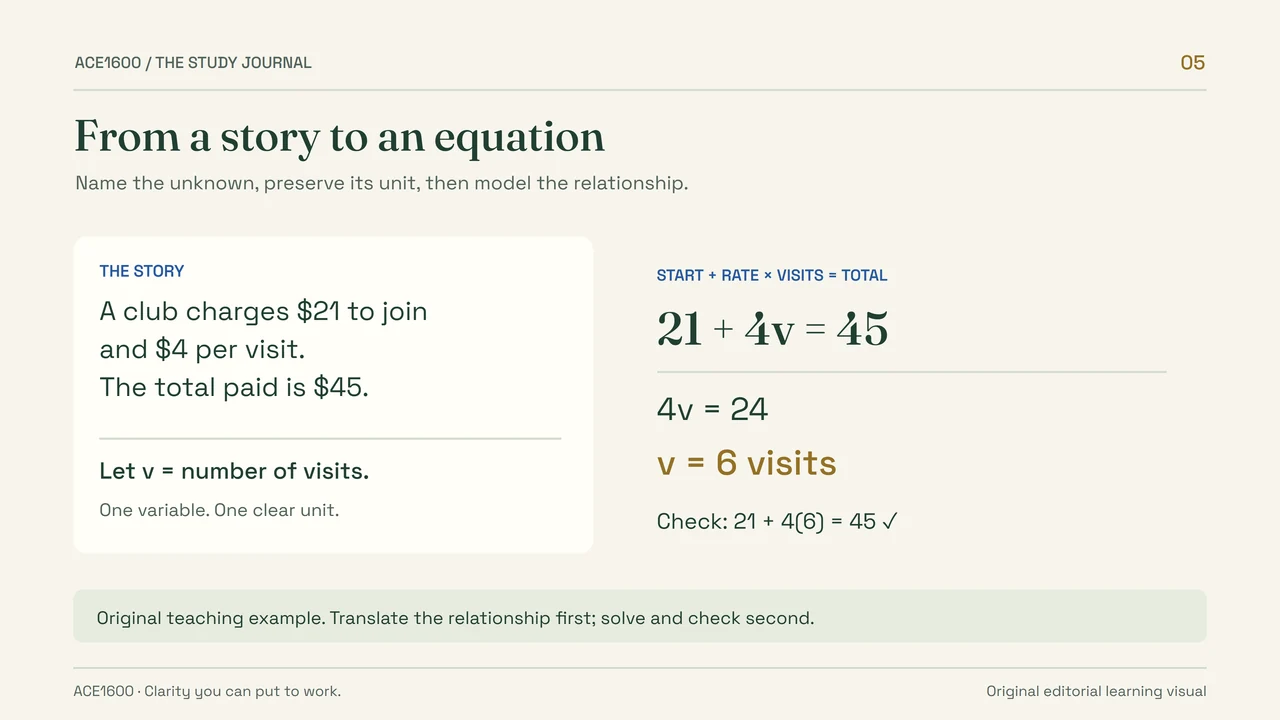
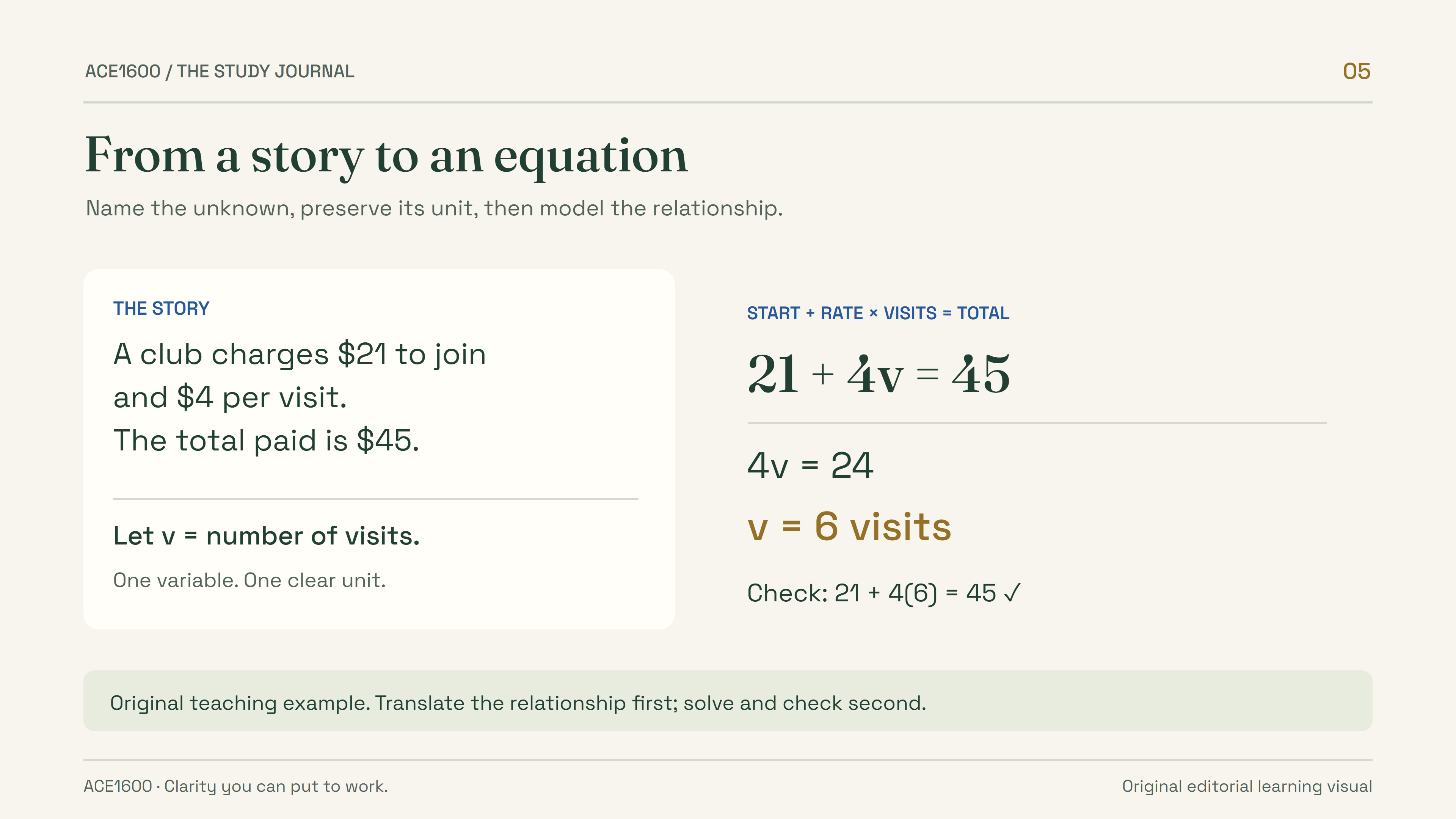
Read the visual as text
- Original example: a club charges $21 to join plus $4 per visit; total cost is $45.
- Let v represent the number of visits.
- The model is 21 + 4v = 45. Subtract 21 to get 4v = 24.
- Divide by 4: v = 6 visits. Check: 21 + 4(6) = 45.
1. Start with quantities, not keywords
Words such as “more,” “each,” and “total” can help, but a keyword shortcut is unreliable without context. “Five more than twice a number” means 2x + 5. “Twice a number that is five greater than x” means 2(x + 5). The relationships differ even though most of the words are the same.
Read once for the situation and again for the requested quantity. Give the unknown a name: “Let v be the number of visits,” or “Let p be the price in dollars per item.” Identify the known values, including their units. Then state the relationship in ordinary language before replacing it with symbols.
A translation routine for word problems
- Define
Name the unknown and its unit.
- Relate
Describe how the quantities connect.
- Represent
Write an equation, inequality, table, or diagram.
- Solve and check
Find candidates, then test the original conditions.
A small diagram or two-column table is often worthwhile. It reduces the work your memory must carry and reveals whether you are combining comparable quantities. You cannot add a cost in dollars directly to a number of hours; you need a rate that connects them. This is also a useful way to catch a model error before doing any algebra.
2. Separate a starting amount from a repeated charge
Many linear models contain a fixed component and a changing component. A joining fee, initial distance, or starting balance belongs in one part of the expression. The amount added per visit, hour, or unit belongs in another. Make sure the repeated charge is multiplied by the number of repetitions.
Original editorial example: a workshop pass
A workshop program charges an $80 registration fee plus $12 for each session attended. A participant pays $224 in total. How many sessions did the participant attend?
Let s be the number of sessions. Total cost equals registration fee plus session charges, so 80 + 12s = 224. Subtract 80 from both sides: 12s = 144. Divide by 12 to obtain s = 12.
Check in the situation: 12 sessions cost $144, and the registration adds $80, producing $224. Dividing 224 by 12 would incorrectly treat the registration charge as session spending.
An equation describes equality. A budget question may need an inequality instead. If the same program allows a participant to spend at most $200, write 80 + 12s ≤ 200. Solving gives s ≤ 10. Because sessions come in whole numbers, the greatest permitted count is 10.
Changing the budget to $205 gives s ≤ 125/12, or approximately 10.42. The greatest whole number of sessions is still 10. Rounding to the nearest integer happens to work here, but it is not the principle: you need a whole number that stays within the budget. For a minimum-capacity question, the direction of that final decision may reverse.
3. Let units guide rate and conversion problems
A rate connects two different kinds of quantity: kilometers per hour, dollars per item, liters per minute, or grams per cubic centimeter. Write the units alongside the calculation. When the units do not simplify to the requested unit, pause and reconsider the operation or conversion.
Original editorial example: a timed ride
A cyclist travels at a constant 18 kilometers per hour for 40 minutes. How far does the cyclist travel? The rate is per hour, so first convert 40 minutes to 40/60 = 2/3 hour.
Distance equals rate multiplied by time: 18 × 2/3 = 12 kilometers. In unit form, kilometers/hour multiplied by hours leaves kilometers.
A calculation of 18 × 40 = 720 would combine an hourly rate with minutes without converting. The arithmetic is correct, but the model is not.
You can convert the rate instead: 18 kilometers per hour is 0.3 kilometers per minute, and 0.3 × 40 = 12. Both approaches work. Choose the version with convenient numbers and keep track of the conversion rather than switching units silently halfway through.
Also ask whether a rate is constant. A single multiplication is justified in this example because the problem explicitly says so. If two parts of a journey have different speeds, calculate their distances or times separately before combining them. An average of two speeds is not automatically the average speed for the entire journey; the time and distance spent at each speed matter.
For scale factors, check the dimension. Doubling a length doubles that length, but the area of a similar figure grows by a factor of four. A square centimeter is an area unit, not another spelling of a centimeter. Units help distinguish superficially similar questions.
4. Identify the base before applying a percentage
A percentage is always a percentage of something. That reference amount is the base. When you miss the base, you can apply the right percentage operation to the wrong number. Write “percentage of which amount?” next to the question if you find yourself guessing.
Original editorial example: a discount followed by a charge
A jacket has a listed price of $80. A store applies a 25% discount, then adds a hypothetical 10% charge to the discounted price. What is the final cost?
The discounted price is 80 × 0.75 = $60. The charge is 10% of $60, so the final cost is 60 × 1.10 = $66.
The combined multiplier is 0.75 × 1.10 = 0.825. That means the final price is 82.5% of the original, a net decrease of 17.5%. Subtracting 25% and adding 10% as if both used the same base would give the wrong result.
For a reverse-percentage question, divide by the multiplier. If $66 is the final amount after a 10% increase, the earlier amount is 66/1.10 = $60. Subtracting 10% of 66 gives $59.40, which reverses the wrong relationship.
Keep percentage points separate from percentage change. An increase from 20% to 25% is an increase of 5 percentage points. Relative to the original 20%, it is a 25% increase because 5/20 = 0.25. Read whether a question describes a change in a rate or asks for a relative increase in a quantity.
During practice, write the multiplier before calculating: a 15% increase uses 1.15, while a 15% decrease uses 0.85. That small habit makes the base and direction explicit and leaves a clear trail to review if your answer is incorrect.
5. Use systems when two conditions share two unknowns
A system becomes useful when the same unknowns must satisfy more than one condition. Ticket counts and ticket revenue are a classic example: one equation tracks how many tickets exist, while another tracks their dollar value. The units explain why you need both equations.
Original editorial example: event tickets
An event sells 35 tickets. Adult tickets cost $12 and child tickets cost $8. Total revenue is $348. How many child tickets were sold?
Let a be adult tickets and c be child tickets. The count equation is a + c = 35. The revenue equation is 12a + 8c = 348. Multiply the first equation by 8 to obtain 8a + 8c = 280.
Subtracting gives 4a = 68, so a = 17. Then c = 35 − 17 = 18. Check the revenue: 12(17) + 8(18) = 204 + 144 = 348. The question asks for child tickets, so the answer is 18.
The same reasoning can be expressed without formal elimination. If all 35 tickets were child tickets, revenue would be $280. The actual revenue is $68 higher. Each adult ticket adds $4 above that baseline, so there must be 68/4 = 17 adult tickets. This is the same structure in a different representation.
If you prefer graphing, use consistent variable meanings and inspect the intersection. Still check that the coordinates represent nonnegative whole-number counts and identify which coordinate answers the question. Practice selecting a method that feels clear and efficient instead of assuming that every system demands the same sequence of steps.
6. Recognize when the relationship is nonlinear
A model is not linear simply because its story sounds familiar. Products of changing quantities can create a quadratic. If the length and width of a rectangle both depend on x, multiplying them generally produces an x² term. Keep that product intact rather than adding the dimensions.
Original editorial example: a rectangular garden
A rectangular garden has a length 3 meters greater than its width and an area of 54 square meters. What is its width? Let the width be w meters; the length is w + 3 meters.
The area equation is w(w + 3) = 54, giving w² + 3w − 54 = 0. Factor: (w + 9)(w − 6) = 0. The mathematical candidates are w = −9 and w = 6.
A width must be positive in this situation, so the width is 6 meters and the length is 9 meters. Check both conditions: 9 is 3 greater than 6, and 6 × 9 = 54.
The negative solution is not a calculation error. It is a solution of the equation that does not meet the contextual restriction. Making that distinction helps you explain why a candidate is rejected instead of treating negative values as automatically invalid in every problem. Negative temperatures, changes, or coordinates can be perfectly meaningful elsewhere.
If factoring is not convenient, another valid method may be better. A graph can locate intersections, and a quadratic formula can produce roots. Choose deliberately, then check the result in the original statement. A correct solution to an incorrectly modeled equation cannot rescue the translation step.
7. Understand what a coefficient or expression represents
Some algebra questions ask for an expression, a coefficient, or an interpretation rather than a numerical solution. In these problems, it helps to build the model in pieces and label what each piece represents. A coefficient can carry a rate; a constant can represent an initial amount; a product can combine price and quantity.
Original editorial example: revenue from a price model
A seller models the number of items sold as q = 60 − 2p, where p is the price in dollars and q is the item count. Revenue is price multiplied by quantity, so R(p) = p(60 − 2p) = 60p − 2p².
Completing the square gives R(p) = −2(p − 15)² + 450. Under this model, the maximum revenue is $450 at a price of $15. At that price, the predicted quantity is 60 − 30 = 30 items, and 15 × 30 = 450.
The expression 60 − 2p describes quantity, not revenue. If the question requests revenue, stopping after writing that expression would leave out the price multiplier.
Treat the result as a conclusion within the stated mathematical model. This fictional example does not establish what a real business should charge. In test questions, the assumptions define the task; in real data, assumptions would need evidence. Keeping those boundaries clear also helps with questions that ask what a model can and cannot support.
8. Check the answer at three different levels
A useful final check is more specific than “look over your work.” Check arithmetic, meaning, and restrictions separately. This lets you catch a number that came from a correct calculation but answers the wrong question.
A result can fail in different ways
- Arithmetic
Does substitution satisfy the equation?
- Meaning
Is this the requested quantity, with the right unit?
- Restrictions
Does it satisfy a budget, domain, sign, or whole-number condition?
Estimate before accepting an answer. In the workshop example, the $80 fixed charge leaves $144 for sessions, so a result of 100 sessions is impossible at $12 each. In the garden example, a width of 6 centimeters cannot match an area given in square meters without conversion. A rough range can expose an error faster than repeating the whole solution.
If a multiple-choice answer differs from yours, do not immediately force your work toward the nearest choice. Recheck what was requested. A distractor may represent an intermediate result, such as the adult-ticket count when the question asks for children. For a response you enter yourself, reread the entry instructions and avoid adding a unit or other text unless the interface requests it.
9. Review mistakes by cause, then mix the skills
After a practice set, sort errors into translation, method, execution, and interpretation. If you wrote the wrong equation, another page of correctly solving equations will not address the main issue. If your model was sound but you lost a negative sign, focus on the algebraic step where that happened.
Where algebra sits within SAT Math
- Algebra35%
Linear equations, functions, inequalities, and systems.
- Advanced Math35%
Equivalent expressions and nonlinear relationships.
- Problem-Solving and Data Analysis15%
Rates, percentages, data, and statistical reasoning.
- Geometry and Trigonometry15%
Lengths, areas, volumes, shapes, and trigonometry.
College Board's Student Question Bank lets you target a section, domain, skill, and difficulty. Use those filters to build a short set around a demonstrated gap. Full-length Bluebook practice then tests whether you can recognize and use skills under timing conditions. Review answers in My Practice rather than treating the total score as the only useful result. [2]
Once you can perform methods individually, include mixed sets so you must decide which method applies. A 2015 study of seventh-grade mathematics found benefits from interleaved practice compared with blocked assignments. That is evidence about a classroom learning design, not a promise of SAT point gains; it supports trying mixed review after initial learning. [3]
Finish each review with one actionable note: “Define the percentage base,” “Convert minutes before multiplying,” or “Answer the child count.” Revisit a similar problem later without copying your previous steps. College Board's study-planning guidance likewise connects diagnostics with targeted practice. Build your next session around what the work revealed, and adjust the plan as your needs change. [4]
Sources & further reading
Rules and policies were checked on September 17, 2026. Follow the linked official pages for changes. Study plans and worked examples are A1600 editorial guidance.
- Math Specifications (opens in a new tab)College Board
- Full-Length Digital Practice Tests on Bluebook (opens in a new tab)College Board
- Interleaved Practice Improves Mathematics Learning: authors' study summary (opens in a new tab)Rohrer, Dedrick and Stershic; University of South Florida
- Build Your Study Plan (opens in a new tab)College Board