
In this guide
A quadratic expression can describe the same curve in several ways. One version makes its roots easy to see. Another reveals the vertex. A third makes the constant term and algebraic structure convenient. Much of the work is choosing the version that answers the question with the least unnecessary manipulation.
College Board includes quadratic equations and nonlinear functions within Advanced Math. [1] This guide focuses on the relationships behind the notation: what a zero means, how the axis of symmetry works, and when a graph or an algebraic rewrite is useful.
Every worked problem below is an original ACE1600 teaching example. Try each setup yourself before reading the solution. The aim is to connect representations well enough that a differently worded question still feels recognizable.
Read the visual as text
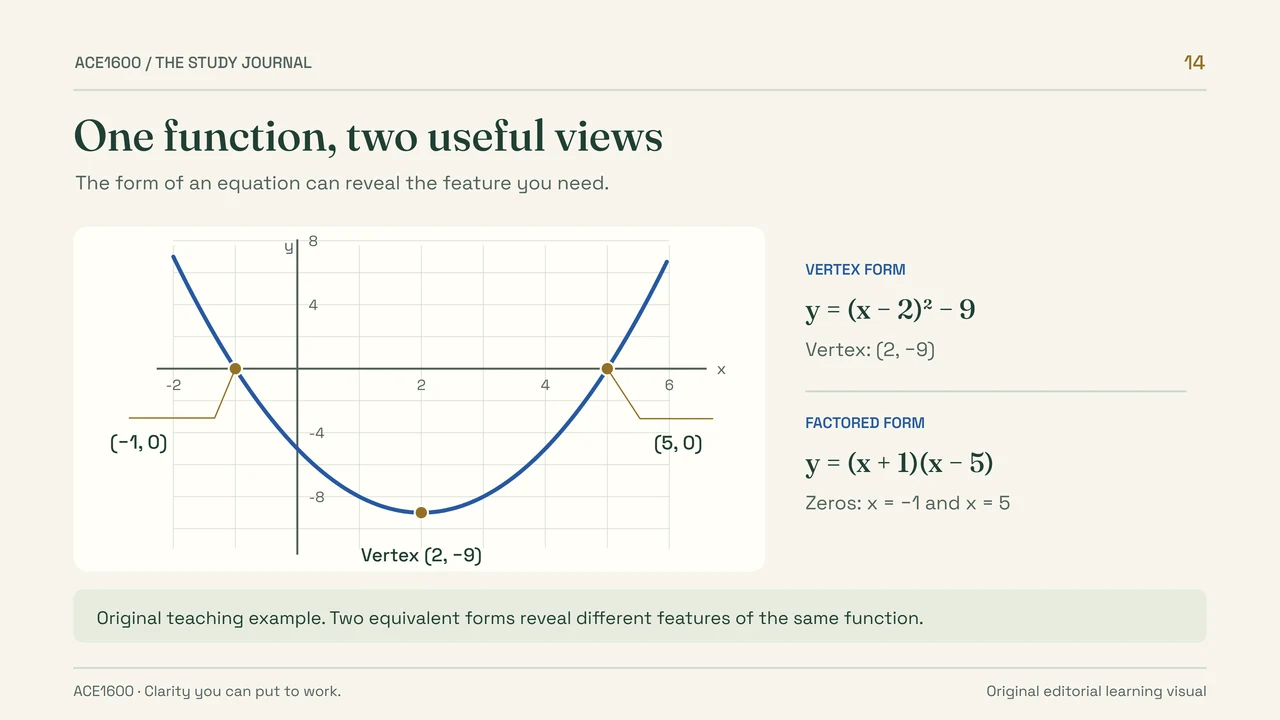
- Original example: y = (x − 2)² − 9 has vertex (2, −9).
- Expanding and factoring gives y = (x + 1)(x − 5).
- The zeros are x = −1 and x = 5, so the graph crosses at (−1, 0) and (5, 0).
- The parabola opens upward; each form highlights different features of the same function.
1. Read three forms as three views of one relationship
Start with y = x² − 4x − 5. Factoring gives y = (x − 5)(x + 1). Completing the square gives y = (x − 2)² − 9. These are equivalent expressions: substituting any particular x-value produces the same y-value in all three. The curve has not changed; the visible information has.
| Form | Example | What is easy to read |
|---|---|---|
| Standard: ax² + bx + c | x² − 4x − 5 | The y-intercept is c = −5. |
| Factored: a(x − r)(x − s) | (x − 5)(x + 1) | The roots are 5 and −1. |
| Vertex: a(x − h)² + k | (x − 2)² − 9 | The vertex is (2, −9). |
Before expanding or factoring, ask what the problem actually wants. If it asks for the minimum value of (x − 2)² − 9, expansion hides the most useful feature. Since a square cannot be negative, the smallest value is −9. If it asks for the zeros of (x − 5)(x + 1), expansion creates extra work.
Check equivalence with structure as well as substitution. Expanding (x − 2)² − 9 gives x² − 4x + 4 − 9, which simplifies to x² − 4x − 5. One substituted value can catch an error, but matching at one point does not prove two expressions are equal for every x. Algebraic expansion supplies that proof.
The leading coefficient also matters. Multiplying the entire expression by a nonzero constant preserves the roots but changes many y-values. For example, 2(x − 5)(x + 1) has the same two roots, while its vertex value is −18 rather than −9.
2. Treat roots as solutions to a zero equation
A root of f(x) is an x-value for which f(x) = 0. On the graph of y = f(x), roots appear where the curve meets the x-axis. The x-axis condition is y = 0, which is why solving the equation and locating the intercepts describe the same event.
Original example: read the factors carefully
For f(x) = 3(x + 4)(x − 2), solve 3(x + 4)(x − 2) = 0. A product is zero when at least one factor is zero, so x + 4 = 0 or x − 2 = 0.
The roots are x = −4 and x = 2. The factor x + 4 produces a negative root; the sign inside the factor is not the root itself.
If the question asks for the sum of the roots, the answer is −2. If it asks for the positive root, the answer is 2. Finding both roots is a step toward answering the task, not always the final response.
The zero-product rule requires a product equal to zero. If (x − 2)(x + 5) = 12, you cannot simply set each factor to zero. Move everything to one side or use another method. Expanding gives x² + 3x − 22 = 0, which is a different equation from the one obtained by ignoring the 12.
Repeated roots also deserve attention. The equation (x − 3)² = 0 has one distinct real solution, x = 3. Its graph touches the x-axis at the vertex rather than crossing through it. Meanwhile, (x − 3)² + 2 = 0 has no real solution because the left side is at least 2 for every real x.
When an answer must be entered rather than selected, follow the displayed response instructions and provide the requested quantity. College Board maintains guidance for student-produced responses. [2] Do not assume that listing every intermediate result is the right final entry.
3. Connect the vertex to symmetry and extreme values
One parabola, three useful landmarks
- Left root(−1, 0)
The function equals zero here.
- Vertex(2, −9)
The minimum value is −9, reached when x = 2.
- Right root(5, 0)
The second x-intercept is equally far from x = 2.
For y = (x − 2)² − 9, the vertex occurs when the squared term is zero: x = 2, giving y = −9. Points equally far to either side of x = 2 have the same y-value. At x = 1 and x = 3, the square equals 1, so y = −8 in both cases.
This symmetry explains why the axis sits halfway between two real roots. The roots −1 and 5 have midpoint (−1 + 5)/2 = 2. That is the vertex’s x-coordinate, not its y-coordinate. To find the vertex value, substitute x = 2 into the function. Confusing these two coordinates is a common source of otherwise avoidable errors.
Original example: a maximum instead of a minimum
Let g(x) = −2(x + 1)² + 18. The squared term is nonnegative, so −2(x + 1)² is nonpositive. Therefore the greatest possible value of g is 18.
That maximum occurs at x = −1, making the vertex (−1, 18). The graph opens downward because its leading coefficient is negative.
If the task asks where the maximum occurs, answer −1. If it asks for the maximum value, answer 18. If it asks for the vertex, both coordinates matter.
For standard form ax² + bx + c with a ≠ 0, the vertex’s x-coordinate is −b/(2a). Substitute that value to obtain the y-coordinate. Use this formula when it is convenient, but keep the geometry in view: the vertex is the turning point, and the sign of a determines whether it is a minimum or maximum over all real x.
4. Rewrite only as much as the question needs
Completing the square is useful when a quadratic is given in standard form but the problem asks about its vertex or minimum. With a leading coefficient of 1, take half of the x-coefficient, square it, and balance the adjustment. The balance is essential: you are rewriting the expression, not changing its value.
Original example: expose a minimum
For q(x) = x² + 6x + 14, half of 6 is 3, and 3² = 9. Write x² + 6x + 14 = (x² + 6x + 9) + 5 = (x + 3)² + 5.
The minimum value is 5, reached at x = −3. The function has no real roots because it never reaches zero.
Check the rewrite at x = 0: both forms give 14. Expanding (x + 3)² + 5 also recovers the original expression, confirming equivalence for every x.
With a leading coefficient other than 1, factor it from the quadratic and linear terms first. For 2x² − 12x + 7, write 2(x² − 6x) + 7 = 2[(x − 3)² − 9] + 7 = 2(x − 3)² − 11. The factor 2 multiplies the adjustment as well as the square.
Let the requested feature choose the method
- Asked for zerosUse factors or solve
Set the function equal to zero and find valid x-values.
- Asked for an extremeExpose the vertex
Use vertex form, complete the square, or evaluate at −b/(2a).
- Asked for an interceptUse the axis condition
For the y-intercept substitute x = 0; for x-intercepts set y = 0.
- Asked for an equivalent formVerify the rewrite
Expand carefully and compare coefficients.
Not every quadratic factors neatly over integers. If a simple factorization does not appear, avoid spending the whole problem hunting for one. The quadratic formula or a suitable graph can be more direct. Method flexibility comes from understanding what each representation gives you.
5. Interpret a quadratic in its situation
In a model, the variable’s meaning and permitted values matter as much as the algebra. A time cannot always be negative, a count may need to be a whole number, and a model may be intended only for a stated interval. Solve first, then check which solutions belong to the situation.
Original example: a rectangular display
A rectangular display has width w meters and length 12 − w meters. Its area is A(w) = w(12 − w) = −w² + 12w, with 0 < w < 12.
Completing the square gives A(w) = −(w − 6)² + 36. The maximum area is 36 square meters, achieved when w = 6 and the length is also 6.
The algebraic expression exists for values outside the stated interval, but a negative length would not describe this display. The model’s physical conditions remain part of the solution.
A related question could ask when the area is 27. Solve w(12 − w) = 27, giving w² − 12w + 27 = 0 and (w − 3)(w − 9) = 0. The widths 3 and 9 both work; they interchange the rectangle’s two side lengths. The task wording determines whether both values are relevant.
Distinguish a coefficient from a measurement. In A(w) = −w² + 12w, the coefficient 12 contributes to the relationship, but it is not the maximum area. A question about the meaning of a value requires connecting it to the variables rather than selecting a prominent number in the formula.
Include units in the final statement. A vertex may pair meters with square meters, or seconds with meters, depending on the model. Treating both coordinates as the same kind of quantity can conceal a misunderstanding even when the numbers are correct.
6. Use a graph to check a claim, not replace the question
Bluebook includes Desmos calculator options, and College Board’s current policy explains the rules for calculators. [3] For a quadratic, graphing can help locate roots, inspect a vertex, or compare two expressions. It is most useful when you know what feature you are looking for before entering the equation.
Check your input carefully: parentheses, negative signs, and exponents change the graph. The expressions −(x − 2)² and (−x − 2)² do not describe the same curve. If a graph contradicts a simple substitution, inspect the entry before assuming the mathematics is wrong.
The viewing window can also mislead. A curve may appear to have no roots because its intercepts are outside the current window. A nearly tangent curve may make two close intersections difficult to distinguish visually. Adjust the window and use algebra when the question asks for an exact relationship or a parameter condition.
Original example: one real intersection
The equation x² − 6x + k = 0 has exactly one distinct real solution when its discriminant is zero: (−6)² − 4(1)(k) = 0.
Thus 36 − 4k = 0 and k = 9. The expression becomes (x − 3)², whose graph touches the x-axis at x = 3.
A graph supports the interpretation, but the algebra identifies the exact parameter. Testing several approximate values of k is less precise than using the condition directly.
Use technology as a second representation. If algebra gives roots at −1 and 5, a graph should reflect those intercepts. If it does not, find the disagreement. A check is valuable because it can expose an error, not because two screens of work automatically make an answer trustworthy.
7. Practice the same curve with different questions
Choose one quadratic and ask several questions about it. This helps you separate the function from the form in which a particular question presents it. For r(x) = 2(x − 4)² − 8, identify the vertex, the minimum value, the roots, and the y-intercept before checking the answers below.
Original practice set with explanations
The vertex is (4, −8), and the minimum value is −8. Those follow directly from vertex form and the positive leading coefficient.
For the roots, set 2(x − 4)² − 8 = 0. Then (x − 4)² = 4, so x − 4 = ±2. The roots are 2 and 6.
For the y-intercept, substitute x = 0: 2(−4)² − 8 = 24. Expanding gives r(x) = 2x² − 16x + 24, which confirms the constant term.
The roots have midpoint 4, consistent with the axis of symmetry. This check links the factored and vertex interpretations.
For further official practice, use the Student Question Bank’s skill filters. [4] Select a small set, explain why each chosen method fits the request, and review any item where you reached the right number for the wrong reason.
A useful stopping point is the ability to explain a quadratic in words: where it is zero, where it turns, which way it opens, and what those features mean in context. When those ideas are connected, the notation becomes a way of revealing information rather than a collection of formulas to memorize.
Sources & further reading
Rules and policies were checked on October 4, 2026. Follow the linked official pages for changes. Study plans and worked examples are A1600 editorial guidance.
- Advanced Math (opens in a new tab)College Board
- Student-Produced Responses (opens in a new tab)College Board
- SAT Suite of Assessments Calculator Policy (opens in a new tab)College Board
- How to Use the Student Question Bank (opens in a new tab)College Board