
In this guide
A page full of wrong answers is not automatically a learning tool. It becomes useful when it explains why the answers went wrong and what you will do differently. An SAT error log should make the next study session easier to choose, not become an elaborate record that you never open again.
The most effective entry is often short: the exact point where your reasoning broke, the correction you can use, and a later attempt that tests it. You can keep that record in a notebook, a document, or a simple spreadsheet. The format matters less than whether the entry changes your work.
This guide develops a small, practical system with original Math and Reading and Writing examples. The suggested retest intervals are editorial starting points, not a fixed learning schedule or a promise of score gains.
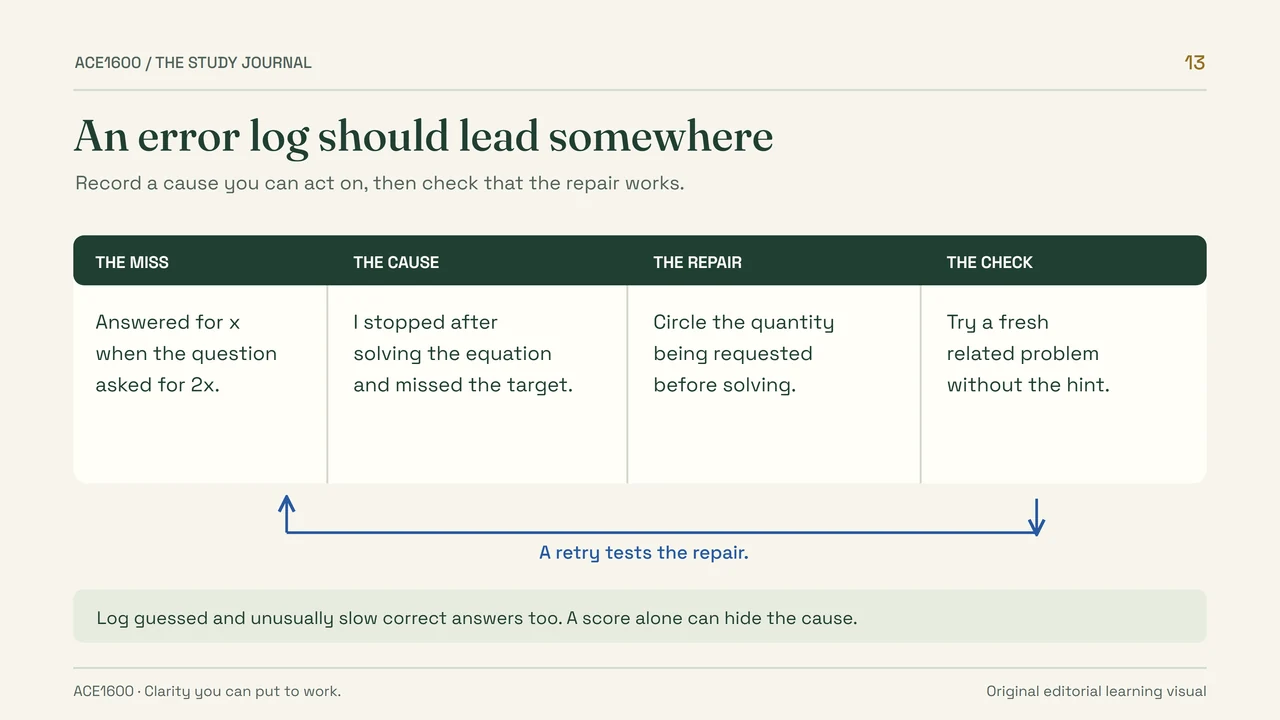
Read the visual as text
- Original example: solving for x when the question requests 2x.
- Cause: stopping after solving and overlooking the requested quantity.
- Repair: circle the requested quantity before solving.
- Check: try a fresh related problem without a hint.
- Include guessed or unusually slow correct answers, not only wrong answers.
1. Define what the log is supposed to do
Your log has three jobs: identify a cause, support a correction, and check whether the correction works later. It does not need to preserve every line of the original question. Store the question’s source and identifier so you can revisit it, then spend your writing time on your own reasoning.
For Bluebook practice tests, My Practice provides question-level review and answer explanations. [1] That gives you a reference point, but reading an explanation is only the beginning. You still need to compare it with what you actually did. Otherwise, the explanation may feel clear while your original habit remains unchanged.
The useful life of an error-log entry
- NoticeWrong or uncertain
Select an item where the result or reasoning needs attention.
- DiagnoseFirst broken step
Identify the misunderstanding, decision, or execution error.
- RepairA usable rule
Write what to do when the same feature appears again.
- RetestFresh evidence
Solve later without the explanation, then transfer to a new item.
Keep the log small enough to use. If a single set produces ten mistakes from the same missing prerequisite, you may need one detailed entry and a targeted lesson rather than ten nearly identical paragraphs. Group repeated causes while preserving enough references to see the pattern.
A log should also record what improved. When an old problem type becomes reliable, move it out of the urgent queue while leaving a brief note of the successful check. This makes the record a map of current work rather than a permanent list of failures.
2. Use a six-field template
Start with six fields: source, skill, original reasoning, cause, correction, and retest. The original-reasoning field is especially important. It prevents the official solution from replacing your memory of the decision that led to the error. Write this field before reading the explanation whenever possible.
| Field | What to record |
|---|---|
| Source | Test or set name and question identifier; avoid copying an entire protected item. |
| Skill | A useful narrow label, such as percent-change base or sentence boundaries. |
| My reasoning | The method or assumption you used at the time. |
| Cause | The first step that was unsupported or incorrect. |
| Correction | An action you can apply to another problem. |
| Retest | When you retried it, whether it was fresh, and what happened. |
Use plain language. “Confused the new amount with the original amount” is often more informative than a technical label you cannot explain. A teacher should be able to read the entry and understand the obstacle. More importantly, your future self should understand it after the original question is no longer familiar.
Keep the correction specific enough to execute. “Read carefully” is an intention. “Circle whether the question asks for a value, a difference, or a percentage” is an action. “Do more algebra” is broad. “Substitute the proposed solution into the original equation before accepting it” tells you what to do next.
You can add confidence or timing if they help identify a pattern, but do not collect data merely because a spreadsheet allows more columns. Every extra field should support a decision. If you never use a column during weekly review, simplify the system.
3. Distinguish knowledge, interpretation, and execution
A wrong answer can arise from different causes that require different repairs. A knowledge gap means you did not know the relevant concept or rule. An interpretation error means you knew the mathematics or language skill but represented the task incorrectly. An execution error means a sound method broke during arithmetic, copying, or answer entry.
These categories can overlap. If you consistently reverse an inequality when dividing by a positive number, you may be treating a conceptual rule as a memorized gesture. Calling it a slip will not solve the problem. Ask whether you can explain the rule and apply it to an unfamiliar example.
Original example: three students, one percentage problem
A price increases from 80 to 100. The percent increase is (100 − 80)/80 × 100 = 25%.
Student A divides 20 by 100 because she does not know which quantity is the base. Her repair is to identify the original amount and explain why the comparison uses it.
Student B writes 20/80 correctly but calculates 0.2. His repair concerns fraction or calculator execution.
Student C obtains 25% but enters 20 because he answers the numerical increase instead of the percentage. His repair is to compare the final entry with the exact requested quantity.
All three students missed the same teaching problem, but assigning them identical extra practice would ignore the cause. One needs a conceptual model, one needs execution practice, and one needs a final task check. Your log is valuable because it makes those differences visible.
College Board’s Student Question Bank can be filtered by skill and difficulty. [2] Use that capability after diagnosis. A narrow label helps select relevant practice; a vague label such as “Math is weak” produces a less focused next session.
4. Write corrections that survive a new question
A correction should explain a relationship, not preserve a remembered answer. If an entry says “the answer was 25%,” it will not help when the numbers change. If it says “divide the change by the original amount,” it can guide a fresh problem. Add a short explanation of why the rule applies.
Original example: a Reading and Writing inference
Teaching passage: “The community garden expanded its opening hours in April. Visitor numbers rose in May, when a nearby bus route also began serving the neighborhood.”
A student concludes that the longer opening hours alone caused the increase. The passage describes two changes, so that exclusive causal claim is stronger than the evidence.
Useful correction: separate an observed association from a claim that one factor caused the result. When several changes occurred, do not silently eliminate the alternatives.
A transfer question could use library attendance and a new event program. The details change; the need to control the strength of the conclusion remains.
For answer-choice questions, record why the tempting alternative fails. This is often more revealing than restating why the correct option works. Was the wrong choice too broad, too absolute, unrelated to the requested goal, or based on a reversed relationship? Naming the attraction helps you recognize it later.
Avoid turning these observations into mechanical rules such as “never choose an absolute word.” Sometimes a passage supports an absolute statement. The appropriate question is whether the wording is justified by the evidence. Your log should strengthen reasoning rather than create a new set of guessing habits.
When you cannot explain the correction in your own words, return to a lesson or ask for clarification. Official SAT Prep on Khan Academy includes lessons and practice at different levels. [3] Choose the level that repairs the gap, even if it feels less impressive than attempting the hardest items.
5. Build a retest that distinguishes memory from learning
Immediately repeating a question can confirm that you followed the explanation, but it is a weak test of independent understanding. Try a later attempt with the solution hidden. Then use a fresh question with the same underlying skill. The combination is more informative than either one alone.
A sample retest sequence
- TodayRepair
Explain the missing idea and solve one closely related example.
- In a few daysReconstruct
Retry the original item without looking at the solution.
- Later that weekTransfer
Use the idea on a fresh problem with different details.
- After another intervalMaintain
Include the skill in a mixed set where it is not announced in advance.
Mark a retest honestly. If you remembered the answer but could not reconstruct the method, label it “remembered.” If you used a hint, record the hint. These notes keep the log useful. They are not penalties; they prevent you from mistaking familiarity for a skill that will work independently.
A fresh question should change something meaningful. In a percentage problem, ask for the original amount instead of the new amount. In a transition problem, change a contrast to an example relationship. In a quadratic problem, ask for a vertex instead of a root. You are checking whether you understand the structure, not whether you recognize the surface.
If the retest fails, revise the diagnosis rather than copying the same correction again. Perhaps the missing prerequisite was earlier than you thought. Perhaps the rule was too vague. A failed retest is useful information because it tells you that the previous repair did not yet transfer.
6. Turn the log into next week’s plan
Once a week, look across the entries and select a small number of recurring causes. Count patterns rather than simply counting wrong answers. Five different topics may all reveal the same habit of answering the wrong requested quantity. Conversely, five errors in one topic may represent several distinct misunderstandings.
Separate urgent work from maintenance. An urgent item recurs, blocks several related skills, or remains unresolved after review. A maintenance item was repaired successfully but should return occasionally in mixed practice. This distinction keeps a single awkward problem from taking over every study session.
- Choose one prerequisite gap that explains several errors.
- Choose one process habit that appears across different topics.
- Keep one recently improved skill in a short maintenance set.
- Set aside questions that require clarification from a teacher rather than repeating an unsuccessful approach.
College Board’s study-plan resources offer a framework for organizing practice. [4] Use your log to supply the personal detail: what you need to learn, what you can already do, and what evidence will show progress. The schedule should follow the diagnosis rather than force every student through the same sequence.
Do not infer a score increase from the number of entries you close. A log measures the state of particular skills, and actual test performance depends on a broader set of conditions. Its value is that it makes preparation more deliberate and gives you a record of methods you can reproduce.
7. Start with three entries, then keep the system light
Take your most recent practice set and choose three items: one wrong answer, one correct guess, and one answer that took an unusually long time. This sample captures different kinds of weakness without requiring you to build a perfect system before you begin.
Original example: a useful first entry
Source: personal practice set, question 4. Skill: solving for an expression. My reasoning: expanded everything and solved for x.
Cause: I did not notice that 4x − 1 was the requested quantity in 3(4x − 1) = 21. Correction: name the repeated expression u, giving 3u = 21 and u = 7.
Retest: later solve 5(2t + 3) = 45 for 2t + 3. The answer is 9. Explain why finding t is unnecessary before marking the skill improved.
At the next session, open the log before selecting new work. If you never return to the entries, the system is serving as storage rather than instruction. Put the retest beside the next available study slot so the record leads naturally to action.
After two weeks, remove any fields or rituals that do not help. Keep the original reasoning, the cause, the correction, and the later evidence. A good error log does not need to look impressive. It needs to make a once-confusing task clearer when you meet it again.
Sources & further reading
Rules and policies were checked on October 4, 2026. Follow the linked official pages for changes. Study plans and worked examples are A1600 editorial guidance.
- My Practice 101 (opens in a new tab)College Board
- How to Use the Student Question Bank (opens in a new tab)College Board
- How to Use Khan Academy (opens in a new tab)College Board
- Build Your Study Plan (opens in a new tab)College Board