
In this guide
A comma can feel like a tiny decision until four answer choices differ only in punctuation. Reading them aloud again may not help. Your ear is trying to judge rhythm, while the question is asking whether the sentence's structure works.
The more useful approach is to identify the pieces of the sentence and decide how those pieces can connect. You do not need to memorize every exception in an enormous grammar book before making progress. You need a few dependable checks, then enough practice to recognize when each check applies.
On the digital SAT, Standard English Conventions questions assess sentence structure, usage, and punctuation. Transition questions belong to Expression of Ideas, a separate domain, although both require you to understand how ideas fit together. [1][2] This guide covers the distinction and uses original teaching examples throughout. Try explaining each correction before reading the answer.
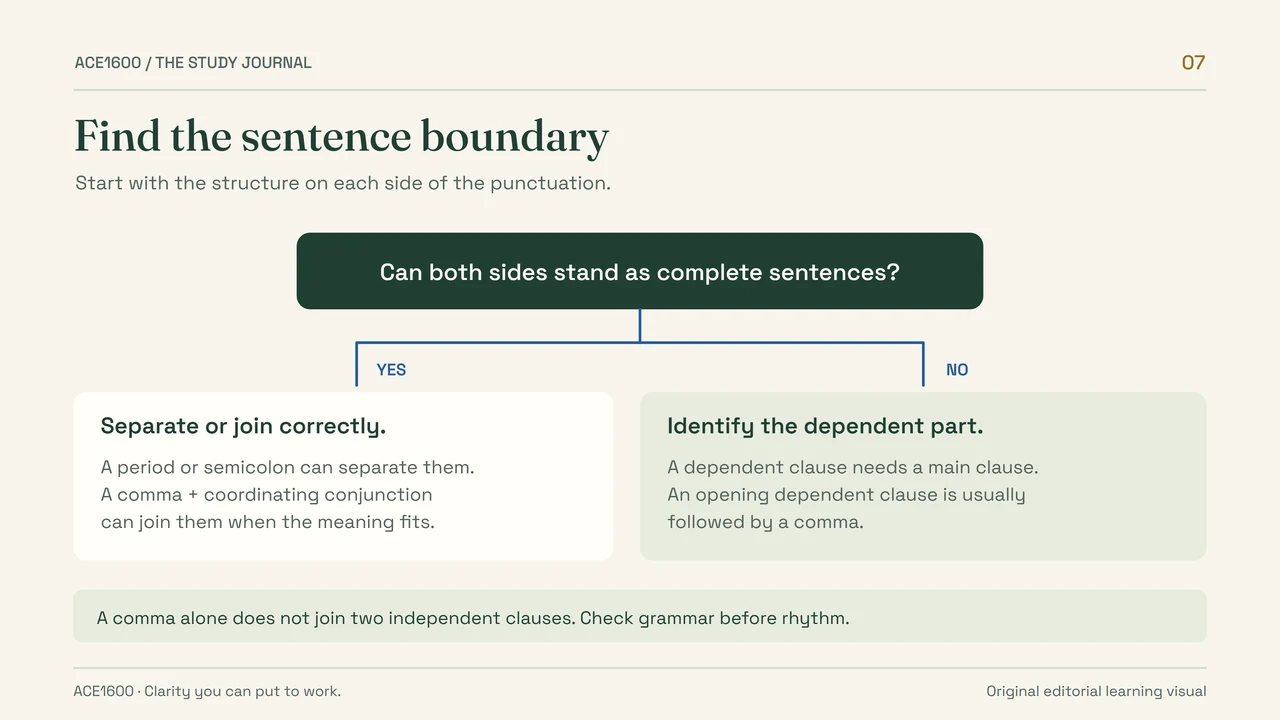
Read the visual as text
- Ask whether both sides are complete independent clauses.
- If yes, a period or semicolon can separate them.
- A comma plus an appropriate coordinating conjunction can join independent clauses.
- If a clause is dependent, identify the main clause it needs; an opening dependent clause is usually followed by a comma.
- A comma alone does not join two independent clauses.
1. Find the sentence's working parts
Start by locating who or what the sentence is about and the main action or state it expresses. The robot turns contains a subject, robot, and a complete main verb, turns. The robot turning toward the light does not yet tell us what the robot does as a complete statement. An -ing form can describe an action without functioning as the sentence's complete main verb.
An independent clause can stand as a sentence. A dependent clause cannot stand alone in the same way, even though it may contain a subject and a verb. Words such as because, although, and when can make a clause dependent: Because the robot turns leaves you waiting for the rest of the thought. Purdue OWL's clause guide provides a useful reference for this distinction. [3]
Original example: a sentence hidden inside a long phrase
Sentence: The collection of maps stored beside the library's entrance attracts visitors. The main subject is collection, and the main verb is attracts. The phrases about maps and location add information around that structure.
Now compare: The collection of maps stored beside the library's entrance. This is a fragment. Stored describes the maps or collection, but there is no complete main statement such as attracts visitors or was donated last year.
Length does not decide whether a sentence is complete. A long fragment can look substantial, while a short independent clause can already do its grammatical job.
During slow practice, lightly mark the subject and main verb, then temporarily set aside descriptions between them. Do not delete those descriptions from the meaning of the passage; use this only to see the structure more clearly. Once you can find the sentence's core, punctuation and agreement questions become easier to diagnose.
Before you touch the punctuation
- Find
Locate the main subject and complete main verb.
- Separate
Identify descriptions, introductory material, and additional clauses.
- Classify
Ask which pieces can stand alone and which depend on another piece.
- Connect
Choose punctuation or wording that fits both the structure and the meaning.
2. Connect two complete clauses correctly
Two independent clauses need an appropriate connection. A period separates them into two sentences. A semicolon can connect closely related independent clauses. A comma plus a coordinating conjunction, such as and or but, can also connect them. A comma by itself generally cannot perform that job in the standard sentence structures tested here. [3][4]
Original example: three valid versions
The rehearsal ended. The musicians packed their instruments.
The rehearsal ended; the musicians packed their instruments.
The rehearsal ended, and the musicians packed their instruments.
Each version has a complete statement on both sides. The period separates them, the semicolon joins related clauses, and the comma works with and. The rehearsal ended, the musicians packed their instruments instead creates a comma splice.
Check what follows a semicolon. A descriptive fragment cannot usually become a full second clause simply because a semicolon precedes it. The musicians packed their instruments; relieved after the rehearsal leaves relieved after the rehearsal without a subject and complete main verb of its own.
What can join these two complete statements?
- Periodended. The musicians
Creates two complete sentences.
- Semicolonended; the musicians
Joins two related independent clauses.
- Comma + andended, and the musicians
Uses a coordinating conjunction to connect the clauses.
- Comma aloneended, the musicians
Creates a comma splice in this example.
If two choices look equivalent, inspect their complete wording, capitalization, and surrounding sentence. Periods and semicolons can serve similar boundary functions; their appearance alone does not identify the answer.
3. Give every comma a reason
A comma is not simply a place where you would take a breath. Readers pause differently, and long subjects can sound as though they need a pause before the verb. In The results of the three preliminary trials support the hypothesis, a comma between trials and support would separate the subject from its verb without a grammatical reason.
Introductory dependent clauses are a common place for commas: Although the first model failed, the team continued testing. The introductory clause sets up a condition or contrast; the main clause completes the statement. A nonessential interruption can also be set off with a pair of commas when the main sentence continues afterward. [4]
Original example: close the interruption
Sentence: The observatory, which opened last year, hosts weekly tours. The main sentence is The observatory hosts weekly tours. The extra description begins after the first comma and ends at the second.
Removing only the second comma gives The observatory, which opened last year hosts weekly tours. That leaves the interruption improperly bounded. When you notice an opening comma around extra information, check where that information ends.
Essential information works differently. In Students who submitted the form received a confirmation, who submitted the form identifies which students are being discussed. Setting it off as an interruption changes the intended meaning. Ask whether the information identifies the noun or adds a side description about an already identified noun; the ability to remove words and leave a grammatical sentence is not the only test.
Original example: one subject, two actions
The team tested the sensor and recorded the results. One subject, team, performs both actions. There is no need for a comma merely because and appears.
Compare The team tested the sensor, and the technician recorded the results. Now each side has its own subject and verb. The comma plus and connects the independent clauses.
When reviewing a punctuation error, name the comma's proposed job. If you cannot say what it introduces, separates, or sets off, look more closely before keeping it.
4. Use colons and dashes with the right structure
A colon can introduce a list, explanation, or elaboration after a complete clause. The material after it may be a phrase or another clause, but the wording before it should already be complete in the pattern you are using. Do not insert a colon merely because a list is about to appear. [5]
Original example: a list with and without a colon
Correct: The kit contained three tools: a ruler, a compass, and a pencil. The words The kit contained three tools form a complete clause; the list explains which tools.
Also correct: The kit contained a ruler, a compass, and a pencil. Here, the items directly complete the verb contained, so a colon is unnecessary.
Incorrect in this structure: The kit contained: a ruler, a compass, and a pencil. The colon interrupts the direct connection between contained and the objects that complete it.
A dash can mark an emphatic explanation or set off an interruption. If a mid-sentence interruption opens with a dash and the main sentence resumes afterward, look for its closing boundary. The team's only navigation tool—a small compass—was damaged. The main sentence remains The team's only navigation tool was damaged.
Compare that with The team faced one problem—the compass was damaged. Here the dash introduces an explanation that runs to the end of the sentence. There is no resumed main sentence requiring another dash. Count the structural pieces instead of assuming every dash needs a partner.
Original example: what the colon explains
The timetable had one disadvantage: it left no break between sessions. The second clause explains the disadvantage named in the first.
The connection is more specific than two unrelated facts placed beside each other. When you choose a colon, verify both the complete setup and the explanatory relationship.
Punctuation can offer more than one valid way to express an idea in your own writing. On a multiple-choice question, evaluate the versions actually offered. Avoid claiming that a particular mark must always be the only possible correction.
5. Match the verb to the actual subject
Subject–verb agreement is about the grammatical subject, not the nearest noun. An intervening phrase can place a plural noun right before a verb even when the subject is singular. Purdue OWL's agreement guidance emphasizes separating the subject from those intervening descriptions. [6]
Original example: the tempting nearby noun
Choose the correct verb: The pattern of cracks in the two panels suggests / suggest a manufacturing problem.
Answer: suggests. The subject is pattern, which is singular. Cracks and panels appear in phrases describing that pattern; they do not control the main verb.
Now change the subject: The cracks in the panel suggest a manufacturing problem. The plural subject cracks requires suggest. The correct choice changes because the structure changes, not because one verb simply sounds more formal.
Useful trouble spots include each of, one of, and subjects followed by with or including. Each of the samples is labeled treats each as the subject. The technician, together with two assistants, is checking the labels still has technician as its singular subject. Read the exact construction rather than counting the people mentioned.
Some sentences place the subject after the verb. In There are three solutions, three solutions is the subject; there does not determine agreement. In There is one solution, the singular subject calls for is. Reordering the sentence mentally can help you see what is doing the grammatical work.
When practicing, write a short reason: singular pattern requires suggests. That is more useful than memorizing the original sentence. On the next question, the nouns may change completely, but the decision stays recognizable. Students accustomed to different varieties of English should use the conventions requested by the question while recognizing that everyday speech can follow other patterns.
6. Check time, reference, and who performs the action
Verb tense should fit the time relationship in the text. Do not automatically make every verb match its neighbor. A sentence can describe a past discovery and a present condition: The researchers identified the species in 2018, and it remains common today. The shift has a reason supplied by the meaning.
Original example: use the time clue
In 2022, the museum opens / opened its new gallery. Answer: opened. The explicit past date identifies a completed event.
Now compare The museum opened its new gallery in 2022 and hosts workshops there today. Opened and hosts express different time relationships. Forcing them into the same tense would change the intended meaning.
For pronouns, identify the noun being referred to and check that the reference is clear. A sentence mentioning two possible people may become ambiguous if it switches to she or he without enough context. For possessives and contractions, test the meaning directly: it's expands to it is or it has; its indicates possession.
Original example: possession or contraction?
The satellite adjusted its orbit. Orbit belongs to, or is associated with, the satellite; its is the possessive form.
It's moving into a new orbit expands to It is moving into a new orbit. Replacing its orbit with it is orbit would not make sense. Expansion gives you a concrete check.
An introductory action phrase also needs the right performer. After comparing the measurements, the engineer revised the model is clear: the engineer did the comparing. After comparing the measurements, the model was revised makes the model appear to perform the introductory action. Purdue OWL explains this problem as a dangling modifier. [7]
Fix the relationship by naming the actor or rewriting the introduction. After the engineer compared the measurements, the model was revised is grammatical because the introductory clause supplies its own actor. Meaning and structure work together; you are not just moving words until the sentence sounds smoother.
7. Choose the relationship before choosing the transition
Transition questions ask how ideas connect. Label the relationship before reading the options: addition, contrast, example, sequence, or consequence. A transition can be grammatically placed yet logically wrong. Conversely, a logical transition still needs correct punctuation when it connects the surrounding sentence structure. [2]
What relationship does the next idea express?
- AdditionMoreover
Adds another point in the same direction.
- ContrastHowever
Introduces a difference, limitation, or unexpected result.
- ExampleFor instance
Illustrates the preceding general statement.
- ConsequenceTherefore
Presents a result or conclusion supported by the preceding idea.
Original example: the relationship decides
The prototype was lighter than the earlier model. However / Therefore, it required more frequent repairs.
Answer: However. The second sentence introduces a drawback alongside the benefit of lower weight. The text does not establish that being lighter caused the repair requirement, so Therefore adds a causal connection that has not been supplied.
Do not confuse however with the coordinating conjunction but. The prototype was lighter, but it required more repairs uses a comma plus conjunction. The prototype was lighter; however, it required more repairs uses a semicolon between independent clauses, with however marking the contrast. A comma alone before however would not fix that boundary.
In your notes, write both the relationship and the structural check: contrast; two independent clauses. This separates two decisions that are easy to blur. It also explains why choosing the right transition word does not automatically make the entire sentence correct.
8. Turn the rules into a repeatable practice session
Begin with a small set from one skill, such as Boundaries or Form, Structure, and Sense. College Board's question-bank guide distinguishes those conventions skills, and Khan Academy's official SAT course provides lessons and practice for them. Use those labels to find focused work rather than collecting random worksheets. [2][8]
For each question, explain the decision in one line before checking the answer: two independent clauses need a boundary; singular subject takes a singular verb; the introductory action belongs to the engineer. If you cannot explain a correct answer, keep it in your review pile. A lucky choice does not yet demonstrate a reliable method.
After reviewing, create a short new sentence that uses the same pattern with different content. Turn a singular subject into a plural one. Move a dependent clause to the beginning. Replace a complete second clause with a descriptive phrase. Notice which punctuation or verb form must change. This checks understanding beyond recognition of a familiar example.
Then mix a few question types and add timing gradually. The useful challenge is recognizing which rule matters when the worksheet no longer announces it. Keep an error log with the rule, the tempting wrong choice, and the clue you missed. Review recurring patterns rather than writing a long diary about every question.
Grammar preparation becomes less mysterious when every mark and every verb has a job. You will still meet dense sentences and unfamiliar subjects. The method remains the same: find the structure, check the meaning, and choose the option that makes the pieces work together.
Sources & further reading
Rules and policies were checked on September 17, 2026. Follow the linked official pages for changes. Study plans and worked examples are A1600 editorial guidance.
- The Reading and Writing Section (opens in a new tab)College Board
- Student Question Bank: Reading and Writing Questions (opens in a new tab)College Board
- Identifying Independent and Dependent Clauses (opens in a new tab)Purdue OWL
- Extended Rules for Using Commas (opens in a new tab)Purdue OWL
- Punctuation Overview (opens in a new tab)Purdue OWL
- Making Subjects and Verbs Agree (opens in a new tab)Purdue OWL
- Dangling Modifiers and How To Correct Them (opens in a new tab)Purdue OWL
- Official SAT Reading and Writing Course (opens in a new tab)Khan Academy