
In this guide
Two answer choices can sound equally polished while doing different jobs. One signals a contrast, another a consequence. One summarizes an entire set of notes, while another selects the single comparison the question requested. In these tasks, good wording matters only after the relationship and purpose are right.
College Board places tasks about effective expression and rhetorical goals within Expression of Ideas. [1] Transitions ask how ideas connect; rhetorical synthesis asks how information should be used to accomplish a stated goal. They are related skills, but their decision processes are not identical.
The passages and notes below are original ACE1600 teaching examples. They are deliberately compact so you can inspect the reasoning behind each choice without relying on familiarity with a particular subject.
Read the visual as text
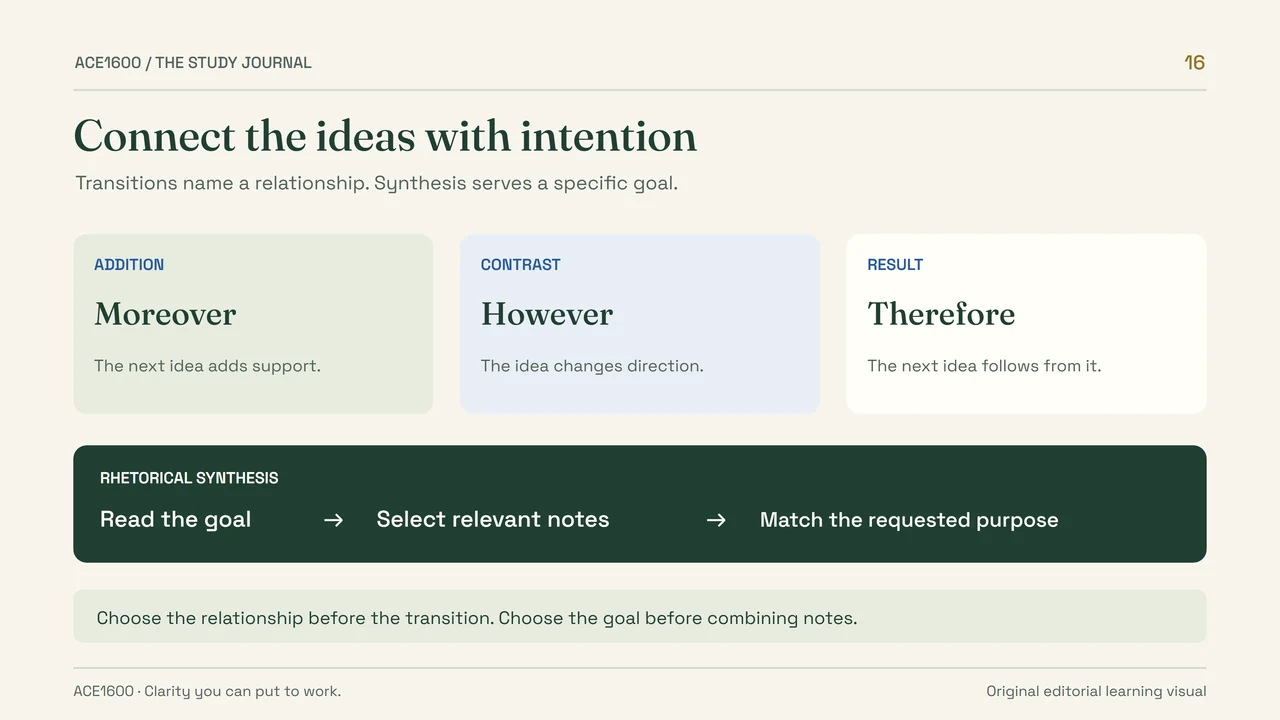
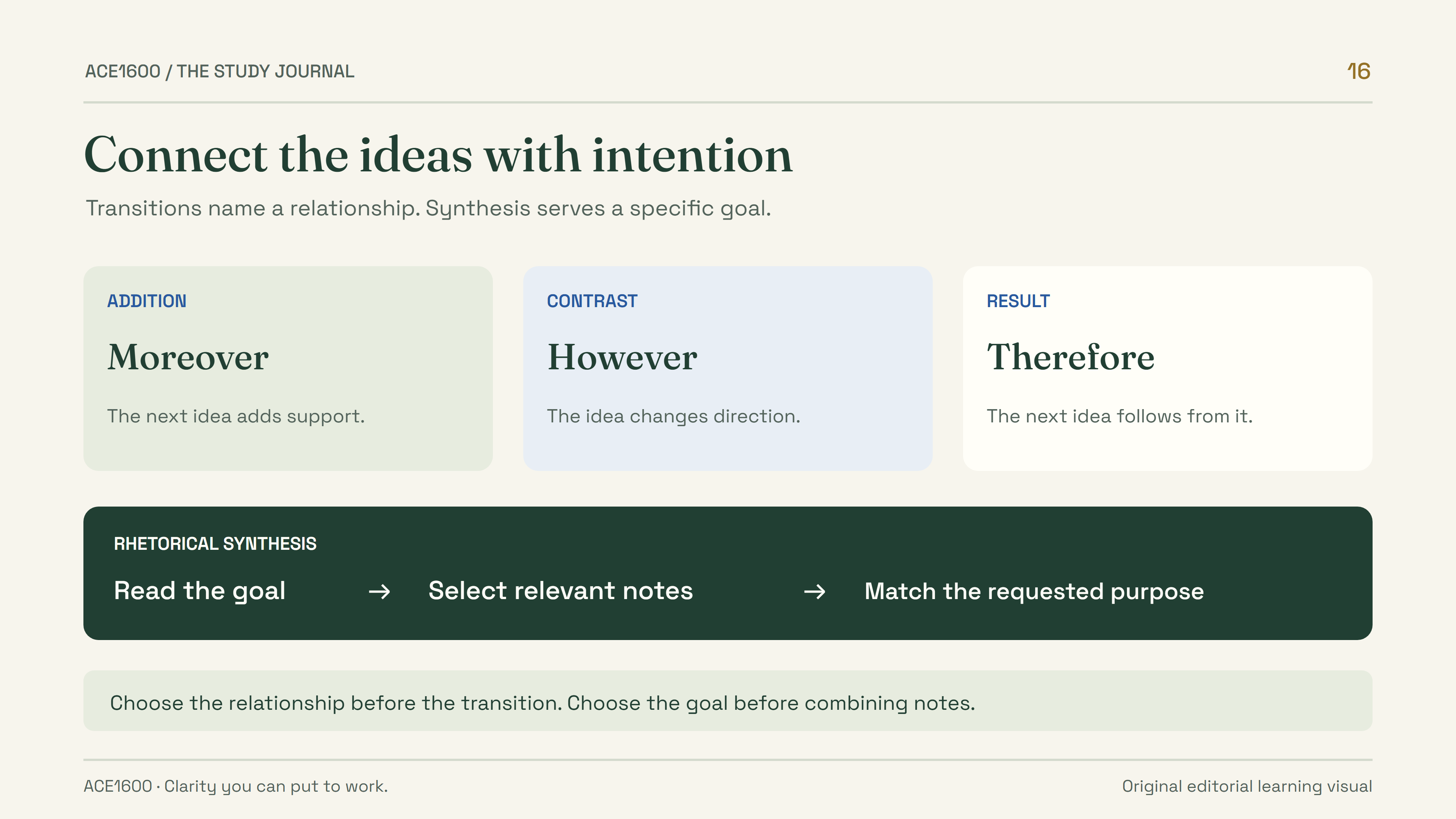
- An addition transition such as moreover signals added support.
- A contrast transition such as however signals a change of direction.
- A result transition such as therefore signals a consequence.
- For rhetorical synthesis, read the goal, select relevant notes and match the requested purpose.
1. Read the relationship before reading the transition list
A transition is a signal about the connection between ideas. To choose one, first summarize the statement before the blank and the statement after it. Then ask whether the second supports, illustrates, contrasts with, qualifies, or follows from the first. These descriptions are more useful than deciding which word sounds sophisticated.
From meaning to transition
- First ideaState it simply
Reduce the previous sentence to its central claim.
- Next ideaName its role
Identify what the following sentence adds or changes.
- RelationshipChoose the logic
Is it contrast, result, example, continuation, or qualification?
- TransitionCheck in context
Read the completed connection and verify that no extra claim has appeared.
For example, “the material is light” followed by “it is difficult to transport” creates an unexpected contrast. “The material is light” followed by “a large sheet weighs only a few grams” gives a specific illustration. The topic is similar in both pairs; the relationship is different.
Do not let a single keyword decide the answer. A sentence containing “different” does not always require “however.” It may be explaining several examples of a broader category. Read the claims on both sides of the blank and the role of the sentence in the paragraph.
College Board’s question-bank guide identifies transitions and rhetorical synthesis as separate skills. [2] That distinction is useful during review. If your errors come from identifying relationships, practice transitions. If your errors come from ignoring the question’s purpose, focus on synthesis goals rather than memorizing more linking words.
2. Distinguish contrast, result, and illustration
Original example: an unexpected result
Teaching passage: “The prototype used fewer moving parts than the earlier design. ___, repairs took longer because the remaining components were difficult to access.”
The second sentence complicates an expectation: fewer parts might suggest simpler repair, yet access made repairs slower. “Nevertheless” expresses that contrast.
“Therefore” would imply that fewer moving parts caused the longer repair time, which is not the relationship the passage establishes. “For example” would treat the repair problem as an illustration of fewer parts, and “Similarly” would signal a parallel that is absent.
Notice that the correct choice depends on the entire second claim, including the explanation about access. If you stop after “repairs took longer,” the contrast is visible, but the explanation confirms why the result should not be treated as a simple consequence of the first fact.
Original example: a consequence
Teaching passage: “The archive added detailed location tags to its digital images. ___, researchers could find pictures of a particular street without opening every file.”
“Consequently” fits because the tagging change enabled the more efficient search. A contrast word would misrepresent the second sentence as opposing the first.
The original teaching passage explicitly describes a functional consequence. In other texts, two events occurring in sequence may not be enough to establish cause, so always inspect the relationship rather than assuming it.
Build a small vocabulary of functions rather than a giant list of supposed synonyms. “For instance” introduces an example; “in other words” restates an idea; “moreover” adds supporting information; “instead” replaces an expected or proposed alternative. Words within the same broad group can still differ in precise use.
When two options seem close, replace each with a plain-language explanation. “Even so” means the next claim holds despite the previous one. “As a result” means the next claim follows from it. That paraphrase often reveals which relationship you are actually being asked to express.
3. Check the scope of the connection
The relevant relationship may involve more than the nearest two clauses. A paragraph can present a general idea, give an example, and then return to the general point. Read enough surrounding material to understand what the sentence is doing. A nearby word should not override the paragraph’s structure.
Original example: a general claim and one case
Teaching passage: “Several techniques can reduce unnecessary water use in public gardens. One city, for instance, schedules irrigation using soil-moisture sensors. The city also repairs leaking pipes promptly.”
The final sentence adds a second action by the same city. If a blank preceded it, a continuation such as “Additionally” would fit better than another signal that introduces the first example.
The paragraph remains an illustration of the broader claim, but the local connection between the two city actions is addition. Identifying both levels prevents a plausible but poorly placed transition.
Keep logic separate from punctuation. A transition may have the right meaning but require a different sentence structure in another kind of editing task. Here, begin with the requested skill and the answer choices. Do not turn every transition problem into a punctuation exercise when the forms are otherwise fixed.
| Function | Question to ask |
|---|---|
| Contrast | Does the next idea oppose or complicate an expectation? |
| Result | Does the next idea follow as a consequence? |
| Example | Does the next idea give a specific case of the previous claim? |
| Restatement | Does the next idea express essentially the same point more clearly? |
| Addition | Does the next idea contribute another compatible point? |
After choosing, reread the connection once. If the completed sentence now claims causation, opposition, or equivalence that the passage did not support, reconsider. A fluent sentence is not necessarily a logically accurate one.
4. In synthesis, let the stated goal select the notes
Rhetorical synthesis starts with a purpose: perhaps compare two items, introduce a topic, emphasize a shared feature, or explain a finding. Read that purpose before deciding which notes matter. An answer that includes more information is not automatically better. It can be accurate yet fail to do the requested job.
A goal-first synthesis routine
- GoalName the job
Compare, introduce, illustrate, explain, or emphasize.
- Relevant notesSelect evidence
Choose the facts needed for that job.
- Candidate sentenceTest completeness
Make sure the sentence includes every essential part of the goal.
- AccuracyCheck the limits
Reject invented causes, unsupported rankings, and altered quantities.
For a comparison, identify both subjects and the dimension being compared. For an introduction to an unfamiliar audience, include enough identifying context. For a similarity, locate a feature genuinely shared by both items. These are different criteria, so the same sentence may succeed at one goal and fail at another.
A useful scratch note is a short target such as “both materials + shared property” or “two locations + difference in size.” This reduces the chance that an interesting but irrelevant fact pulls you away from the instruction.
Do not assume that every note must appear. The notes are a source pool, not a checklist. A concise sentence that accurately accomplishes the goal can be better than an overloaded sentence that mentions dates, names, and measurements without a clear focus.
5. Work through a synthesis example from notes to sentence
- Original teaching notes: Aster Observatory opened in 2012.
- Aster Observatory’s main telescope has a 1.2-meter aperture.
- Beacon Observatory opened in 2018.
- Beacon Observatory’s main telescope has a 1.8-meter aperture.
- Both observatories offer public astronomy evenings.
Suppose the goal is to emphasize a similarity between the observatories’ public activities. The relevant note is that both offer public astronomy evenings. The aperture measurements and opening dates may be true, but they do not help establish the requested similarity in public activities.
Original example: match the goal precisely
Effective sentence: “Both Aster Observatory and Beacon Observatory offer public astronomy evenings.” It identifies both subjects and states their shared public activity.
True but off-goal sentence: “Beacon Observatory opened six years after Aster Observatory.” This compares dates rather than public activities.
Unsupported sentence: “Both observatories attract equally large audiences to their public astronomy evenings.” The notes provide no audience counts.
Incomplete sentence: “Aster Observatory offers public astronomy evenings.” This states an activity for only one subject and does not establish the shared feature.
Now change the goal: emphasize a difference between the main telescopes. A suitable sentence would state that Beacon’s 1.8-meter aperture is larger than Aster’s 1.2-meter aperture. The previously effective public-activities sentence is no longer the right response. The facts stayed the same; the writing task changed.
This is a useful practice technique. Reuse one small note set with several different goals and explain how your selection changes. It trains flexibility without requiring a new passage every time. It also reveals whether you are following the purpose or simply choosing the sentence you like most.
6. Recognize the attractive answers that do the wrong job
A synthesis distractor can be grammatically smooth and factually accurate while failing the goal. Read each option with two separate checks: “Is it supported?” and “Does it accomplish the requested purpose?” Passing only one is not enough.
Original example: avoid inventing an explanation
Teaching notes: A museum introduced evening opening hours in June. Attendance was higher in July than in May. The museum also opened a new exhibition in June.
If the goal is to describe the attendance change, a sentence can accurately state that attendance rose between May and July.
A sentence claiming that evening hours alone caused the increase adds an unsupported explanation. The notes mention another change, and they do not isolate the cause.
The error is not poor style. It is a stronger claim than the supplied evidence allows.
Watch for shifted quantities as well. A note about a percentage is not automatically a note about the total count. A note about one sample does not describe an entire population. A statement that something happened earlier does not establish that it was more effective. These distinctions matter even when the subject is unfamiliar.
Another common issue is missing context. If the stated audience has not heard of a person or project, an answer may need a brief identifying phrase. If the audience already knows the background and the goal is a narrow comparison, extra biography may be unnecessary. Read the audience condition as part of the task.
Use official skill-filtered practice to test these distinctions. The Student Question Bank can help you select relevant items. [3] After a set, write a one-line reason for rejecting the most tempting wrong choice. That reason is often more transferable than the correct answer alone.
7. Build a short routine that improves the actual skill
Alternate two kinds of practice. For transitions, hide the options and describe the relationship first. For synthesis, hide the options and draft a plain sentence that satisfies the goal. Your draft does not need elegant wording; it needs the correct logic and scope. Then compare it with the available choices.
Original quick exercise: predict before choosing
Transition pair: “The first survey reached only residents near the town center. The second included households in the surrounding villages.” If the paragraph is contrasting the surveys’ coverage, a phrase such as “By contrast” fits the intended relationship.
Synthesis notes: Project Cedar uses recycled paper. Project Willow uses recycled fabric. Both make display panels. Goal: emphasize a shared function. A suitable sentence is “Both Project Cedar and Project Willow produce display panels.”
In each case, explain the job of the sentence before considering whether its wording sounds polished.
If you repeatedly misidentify a relationship, return to simpler examples and label the claims. If you identify the relationship but do not know the transition word, study the word in several complete sentences. If you select accurate synthesis answers that miss the goal, practice writing the goal as a checklist before reading the options.
Official SAT Prep on Khan Academy offers lessons and practice to support this work. [4] Use explanations to check the precise distinction you missed, then try a fresh item without the explanation visible.
The durable skill is purposeful reading. A transition tells the reader how ideas connect; a synthesis sentence uses selected facts to do a defined job. When you can state that connection or job clearly, the answer choices become easier to evaluate for reasons you can defend.
Sources & further reading
Rules and policies were checked on October 4, 2026. Follow the linked official pages for changes. Study plans and worked examples are A1600 editorial guidance.