
In this guide
You can understand every sentence in an SAT passage and still choose the wrong answer. Often the mistake happens between understanding the text and deciding what the question actually permits you to claim. An answer sounds sensible, includes a familiar word, or resembles something you learned in school. That makes it tempting. It does not make it supported.
The digital SAT uses short passages or passage pairs followed by one multiple-choice question. Reading and Writing covers four content domains, including evidence, inference, vocabulary, rhetorical choices, and grammar. Shorter passages still require careful thinking; the useful habit is to connect each answer to a specific job and a specific piece of evidence. [1]
This guide gives you a method to practice, then tests it with original examples. All passages, people, and numerical data here were created for teaching. They are not recalled test questions or reports of real research. Try answering each example before reading its explanation.
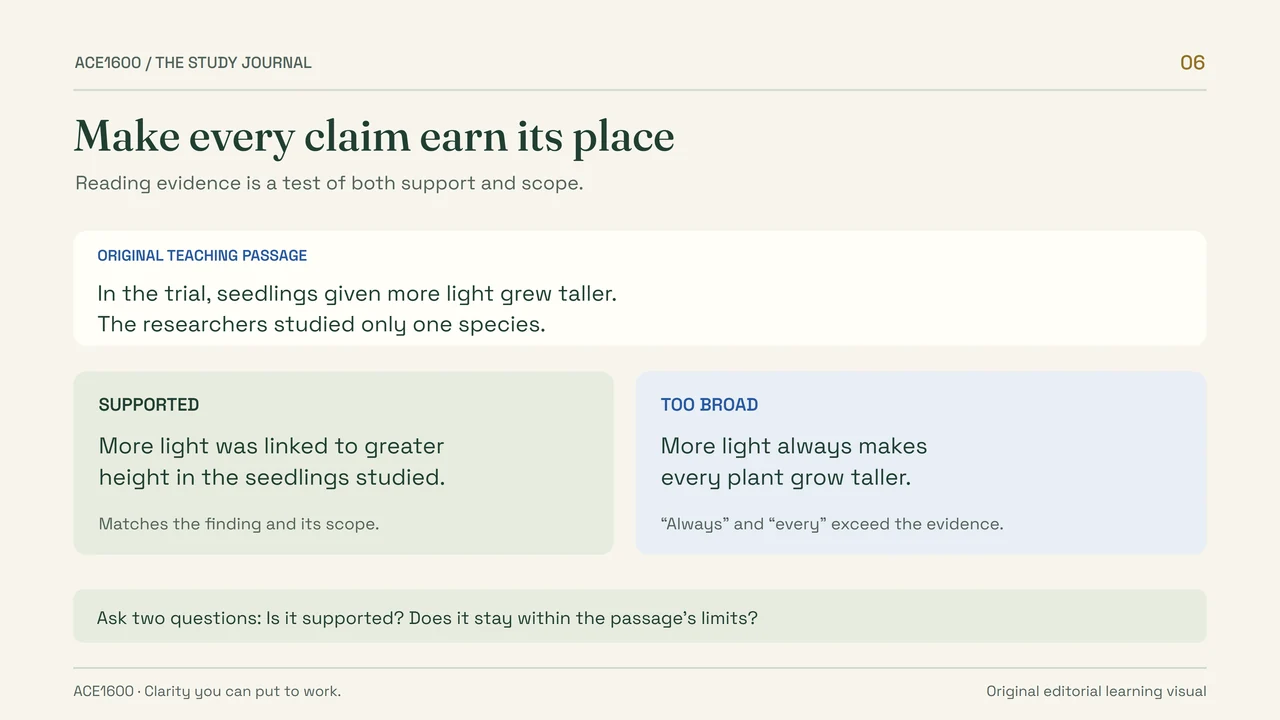
Read the visual as text
- Original passage: seedlings receiving more light grew taller in a trial involving one species.
- A supported inference stays with the seedlings studied.
- A claim about every plant or an effect that always occurs exceeds the passage.
- Check both factual support and the limits of the evidence.
1. Name the task in ordinary language
Before working through the answer choices, translate the question into a short instruction. Main idea becomes: summarize the important point. An inference becomes: finish the reasoning without adding a new assumption. A supporting-evidence question becomes: find the observation that would make this claim more convincing. A function question becomes: explain what this sentence does in the argument.
College Board's question-bank guide maps these tasks to skill names such as Central Ideas and Details, Command of Evidence, Inferences, Text Structure and Purpose, and Cross-Text Connections. Learning the labels helps you find practice later, but on the test your plain-language instruction matters more than remembering a category name. [2]
Reading the question first can be helpful because it gives you a purpose. It is not a rule that every student must use on every item. Test the order during practice and choose the approach that helps you understand accurately. Whichever order you use, do not let an attractive answer choice decide what the passage was about.
A four-step evidence check
- Task
What must the answer do: summarize, infer, support, explain a function, or compare?
- Meaning
What is the passage's claim, contrast, or result in plain language?
- Match
Which option performs the task using information the text actually supplies?
- Check
Did the option change the group, time period, cause, or level of certainty?
If you are stuck, return to the task instead of rereading every sentence with equal attention. Ask what you still need to know. Sometimes you need the author's conclusion. Sometimes you need only the contrast between two methods. A targeted reread is easier to manage than starting the whole problem again.
2. Separate the main point from a true detail
A main-idea answer needs to represent the passage's important movement, not merely repeat a fact that appears inside it. Look for the relationship between the beginning and the end. Does the text introduce a familiar view and qualify it? Describe a problem and a response? Present a result and explain why it matters?
Original example: a neighborhood archive
Passage: A neighborhood archive began by collecting official records of shop openings and closures. Later, volunteers recorded interviews with shopkeepers. The interviews rarely changed the dates in the records, but they revealed why businesses moved and how residents used them. The archive now presents both kinds of material together.
Question: Which statement best captures the main idea? A: Official records are generally unreliable. B: Interviews added a different kind of understanding to the archive's factual records. C: Most shopkeepers moved their businesses. D: The archive abandoned written documents.
Answer: B. The passage contrasts the dates supplied by records with the explanations supplied by interviews, then shows the materials being combined. B represents that relationship.
A invents a reliability problem. C turns the mention of business moves into an unsupported claim about most shopkeepers. D reverses the ending: both kinds of material remain. Even if a choice repeats a word from the text, its claim still needs checking.
Try predicting a short answer before inspecting the options: interviews added reasons and context. Your prediction does not need to match the eventual answer word for word. It gives you a stable meaning to compare against polished distractors. If no option fits, revisit your prediction rather than forcing a match.
A useful review exercise is to label each sentence's role: background, new method, result, conclusion. This is not something you need to write for every timed question. During slower practice, however, it teaches you to recognize which details support the central point and which details are simply setting the scene.
3. Make the smallest supported inference
An inference is a conclusion you can reach by connecting the information given. It is not a request to imagine what probably happens in the real world. Khan Academy's official SAT course separates inference practice from other reading skills, which makes it possible to practice this reasoning step directly. [3]
Pay attention to words that control certainty: some, all, may, must, usually, and only. Do not automatically eliminate strong words; a passage can support a strong claim. The question is whether this passage does. An answer fails when it becomes more certain, broader, or more causal than the evidence permits.
Original example: a seed collection
Passage: Researchers compared two storage methods for a collection of seeds. After six months, a larger proportion of seeds in the cool room germinated than seeds in the warm room. Both groups had come from the same initial collection. The team then transferred every germinated seed, and no ungerminated seeds, to planting trays. The researchers did not study other plant species.
Question: Which conclusion is supported? A: Every plant species requires cool storage. B: A larger proportion of the cool-room group was transferred to planting trays than of the warm-room group. C: Warm storage prevents all germination. D: Cool storage will remain superior for every storage duration.
Answer: B. Combine two premises: the cool-room group had a higher germination proportion, and precisely the germinated seeds were transferred. Therefore its transfer proportion was higher too. This conclusion stays within the groups and time period described. The passage does not supply other species, every duration, or zero germination in the warm room.
Notice that B does not need to explain a biological mechanism. The task asks what the findings support. Inventing a mechanism would add information, even if you remember something relevant from science class.
Keep the claim inside the evidence
- PopulationThis seed collection
No evidence about every plant species.
- TimeSix months
No evidence about every storage duration.
- OutcomeGermination and transfer proportions
No evidence about later growth, yield, or overall plant health.
In your error log, write the precise leap you made. I changed some into all is much more useful than I need to read carefully. It gives your next practice set a concrete focus.
4. Ask what evidence would actually support the claim
When a question asks which finding would support a conclusion, turn the conclusion into a relationship. If the claim is that a change benefited a particular group, relevant evidence should connect that change, that group, and the proposed benefit. A fact can be interesting without doing that job.
Original example: library opening hours
Passage: A library extended its weekday closing time from 6 p.m. to 8 p.m. Staff suggested that the change made it easier for local students with after-school activities to visit.
Question: Which observation would most directly support the staff's suggestion? A: The library bought new shelves. B: Several students with after-school activities reported that they could now visit after their activities ended. C: The library's building was painted last year. D: Many visitors preferred printed books.
Answer: B. The observation connects the relevant students, their schedule constraint, and the extra opening time. The other observations may be true in the imagined setting, but they do not address the suggested benefit.
This does not prove that later hours help every student or explain all changes in attendance. The question asks for supporting evidence, not proof of an unlimited conclusion.
Watch for answers that discuss the topic while missing the relationship. A choice about library popularity is not necessarily evidence about access for students whose activities end late. Similarly, a passage about a material's strength does not make every fact about that material relevant to a claim about its cost.
A good self-check is to complete the sentence: This evidence matters because… If the explanation requires inventing a missing event, motive, or comparison, pause. If you can connect the evidence directly to the stated claim, you have a more defensible answer. This habit is especially helpful when two choices both contain vocabulary from the passage.
5. Read the chart before telling a story about it
For a graph or table, identify the labels, units, categories, and time period first. Then read the specific values relevant to the question. A chart does not become easier because you describe every number; it becomes easier when you know which comparison the claim requires. College Board explicitly includes informational graphics within Reading and Writing evidence skills. [1]
Fictional workshop attendance
- Monday: design18 students
Attendance count for this workshop only.
- Wednesday: coding30 students
The largest of these three attendance counts.
- Friday: writing24 students
Six more attendees than Monday's workshop.
Original example: which statement fits?
Question: Which statement is supported by the chart? A: Coding was the most popular subject in the entire school. B: Wednesday's workshop had twelve more attendees than Monday's workshop. C: Seventy-two different students attended the workshops. D: Friday's workshop attracted twice as many students as Monday's.
Answer: B, because 30 − 18 = 12. A expands three events into a claim about the whole school. C assumes attendees never overlapped, even though the caption says overlap is possible. D is numerically wrong: 24 is not twice 18.
Adding the attendance counts gives 72 attendances, not necessarily 72 distinct people. This distinction matters whenever a graphic counts visits, responses, or events rather than unique individuals.
Be equally careful with cause. If a chart shows two things changing together, it does not automatically establish that one caused the other. Read the accompanying passage for information about the study or comparison. Sometimes the safest supported statement is simply that one quantity was higher during a stated period.
Before selecting an answer, say the comparison with its units: twelve more attendees, not twelve percent more. This small habit catches errors that otherwise survive a quick glance at a graph.
6. Keep two authors separate and vocabulary local
With paired texts, give each author a short position statement before looking for agreement or disagreement. Two authors can agree on an observation while disagreeing about its explanation. If you merge them into one general topic, an answer may sound relevant even though it belongs to only one author.
Original example: two views of a mural
Text 1: The new mural increased foot traffic near the station, suggesting that public art can draw visitors to overlooked streets. Text 2: Foot traffic rose after the mural appeared, but a new weekend market opened nearby at the same time. The mural's separate effect is therefore uncertain.
Question: What do both texts accept? A: The mural alone caused the increase. B: Foot traffic increased. C: The market had no effect. D: Public art never attracts visitors.
Answer: B. Both accept the observed increase. They differ in how confidently it can be attributed to the mural. Text 2 questions the explanation without denying the observation.
Vocabulary-in-context questions require a similar discipline: keep the meaning local. A familiar word can have a less familiar use. Read the surrounding sentence and identify its contrast, action, or tone. Predict a plain substitute before comparing options, then test that substitute in the sentence rather than relying on the word's most common definition.
Original example: a familiar word with a different job
Sentence: After several repairs failed, the engineer proposed a novel solution. Here, novel means new or original; it does not mean a long work of fiction.
The phrase proposed a solution and the contrast with failed repairs establish the relevant meaning. If the options include both a book-related definition and an originality-related definition, the sentence decides between them.
You do not need to memorize every possible definition to improve this skill. When you meet a useful new word during practice, save the sentence, your plain-language paraphrase, and one new sentence of your own. That connects vocabulary to usage instead of leaving it as an isolated translation.
7. Use timing and review to improve the decision
Good pacing does not mean reading every passage at the same speed. A brief vocabulary question and a dense comparison may require different amounts of work. During timed practice, notice where time goes: understanding the passage, interpreting the task, comparing choices, or repeatedly changing an answer without new evidence.
If you have narrowed the choice but remain stuck, identify the exact unresolved difference. Does one option say all while the other says some? Does one explain a cause while the other reports an observation? Return to the relevant sentence. If you still cannot resolve it promptly, make your best choice, flag the item, and return within the module if time allows.
After practice, review uncertain correct answers as well as incorrect ones. A lucky selection can hide the same misunderstanding as a wrong response. For each reviewed item, write the task, the supporting detail, the reason your tempting alternative fails, and one thing you will do differently. Keep the note short enough that you will actually reread it.
Use College Board's Student Question Bank filters to find the skill you are working on, and use official Bluebook practice tests when you want to rehearse the whole testing experience. Their roles are different: targeted sets help isolate a reasoning problem; full tests help you apply the method across changing question types and time pressure. [4][5]
8. Try a twenty-minute evidence session
Choose four or five questions from one reading skill. Spend the first few minutes solving them without racing. For each answer, point to the evidence or state the logical connection before checking the explanation. This is a training session, so the goal is a defensible decision rather than an impressive completion count.
Spend the next part reviewing only the uncertain decisions. Give each mistake a useful name: expanded population, invented cause, wrong author, inaccurate number, or true detail that misses the main point. Then redo one question with the options covered and explain what a correct answer would need to say.
Finish by writing one sentence about your next practice session. For example: I will check whether a claim describes a whole population or just the sample. Students studying in either India or the United States can use the same evidence routine; let your own mistakes determine the focus, rather than assumptions about your background.
Your aim is not to make every passage feel easy. It is to make your decisions easier to explain. When an answer is right, you should know what supports it. When it is wrong, you should know exactly where it went beyond the text. That is a skill you can practice one passage at a time.
Sources & further reading
Rules and policies were checked on September 17, 2026. Follow the linked official pages for changes. Study plans and worked examples are A1600 editorial guidance.
- The Reading and Writing Section (opens in a new tab)College Board
- Student Question Bank: Reading and Writing Questions (opens in a new tab)College Board
- Official SAT Reading and Writing Course (opens in a new tab)Khan Academy
- How to Use the Student Question Bank (opens in a new tab)College Board
- How to Use Bluebook Practice Tests (opens in a new tab)College Board