
In this guide
Preparing for the SAT in India involves two connected projects. One is academic: learning the tested skills and practicing under the right conditions. The other is logistical: deciding whether your intended colleges use the SAT, registering for a suitable date, preparing identification and a device, and sending scores in the form each institution expects.
Keep these projects together. A strong practice routine cannot fix an ID mismatch on test day, and a confirmed test booking does not tell you whether its score will arrive within a college's requirements. Start with your application purpose, then build a schedule that fits your school commitments and gives you room to solve practical problems.
This guide uses a policy snapshot checked on September 17, 2026. Fees, technical requirements, university policies, and test-center availability can change. Use the linked official pages when making a booking or submitting an application. Suggested planning routines are editorial guidance, and any examples are original teaching examples rather than official SAT questions.
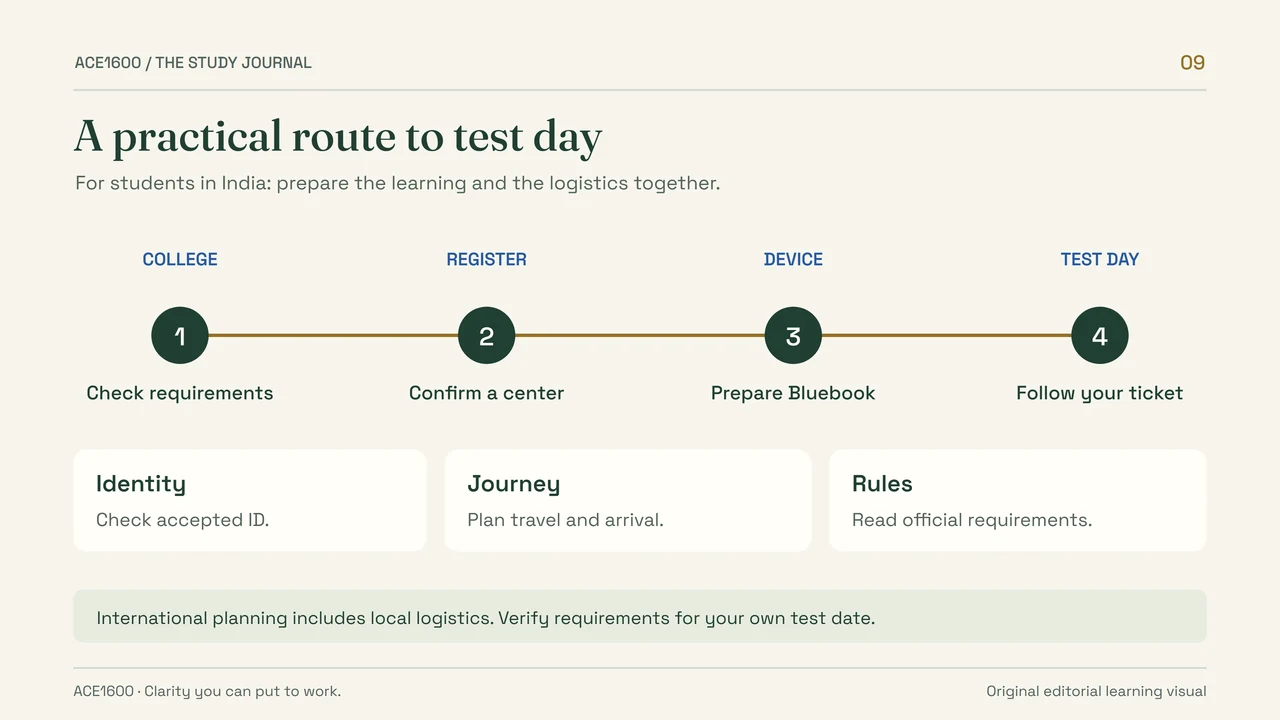
Read the visual as text
- Check each college’s current requirements.
- Register and confirm the available test center.
- Prepare a supported device and Bluebook according to current official instructions.
- Check accepted ID, your admission ticket, travel and arrival arrangements.
- Verify official requirements for your location and test date.
1. Decide what the SAT will do in your application plan
Begin with a short college list, even if it is provisional. For each institution, record the intended entry year, program, applicant category, testing policy, last acceptable test date, and score-submission instructions. A policy for one intake or one applicant group may not apply to another. Keep the source link and the date you checked it beside the note.
The differences are substantial. As checked for this guide, Yale's ordinary first-year and transfer applicants must submit SAT or ACT scores. Princeton is test optional for fall 2027 entry and requires SAT or ACT beginning with fall 2028 entry, subject to its stated exceptions. University of California campuses do not consider SAT or ACT scores for admission decisions or scholarships. These examples show why “U.S. universities require the SAT” is too broad. [7][8][9]
Three policy labels with different consequences
- Required
Plan to fulfill the stated testing requirement and submission rules.
- Optional
The institution permits an application without the score under its policy.
- Not considered
The score is excluded from the stated decision, even if other limited uses exist.
Indian university policies also vary. Ashoka's published process for the 2026 intake lists SAT and several other tests as optional, alongside separate academic and university-assessment requirements. Treat that as a dated institutional example, not a rule for every Indian university or future intake. Check the relevant institution before assuming an SAT score replaces its own assessment. [10]
2. Build the calendar backward from college deadlines
College Board's SAT Weekend dates and registration deadlines apply to both U.S. and international students. The published deadlines expire at 11:59 p.m. U.S. Eastern Time. Do not read them as 11:59 p.m. in India. Late registration is available worldwide with an additional fee, but it is better treated as a contingency than the foundation of your plan. [1]
Start with the last date a college will accept a test or score, according to its own instructions. Then choose a preferred test date that gives you time to receive the result, consider next steps, and complete any required score reporting. If you want a possible retake, check its feasibility before booking the first attempt. A second attempt is an option, not a guarantee of improvement.
Add school examinations, practical work, major projects, application writing, and travel to the same calendar. Students following CBSE, ISC, state boards, IB, or other curricula do not all share one workload pattern. Use your actual school schedule rather than a generic claim that Class XI or a particular holiday is always the best testing period.
An adjustable planning sequence
- Start planning
Check college policies, school commitments, a diagnostic, and available test dates.
- Before booking
Confirm ID details, device access, budget, and a workable center.
- At least 30 days ahead
Complete a College Board device request if you need to borrow a device.
- 1–5 days ahead
For your own or school device, complete Bluebook setup and obtain your ticket; loaned devices have test-day instructions.
A date appearing on the national schedule does not establish that a seat is available at your preferred center. Check availability during registration. If a more distant center is necessary, include travel time and an arrival margin in the decision rather than treating the exam as only its timed sections.
3. Check the India-specific ID rules before registering
Your admission ticket is not a substitute for acceptable identification. The name used in registration needs to match your acceptable ID, and the photograph must meet the stated requirements. Resolve differences in spelling or name format early, while there is time to follow College Board's correction process. Avoid entering an informal nickname because it is the name you usually use at school.
The current India-specific section accepts a valid passport and specified Aadhaar forms. It states that original government-issued Aadhaar letters and PVC cards are valid; printouts, copies, screenshots, and e-cards are not accepted. The page also contains other specific exceptions. Read the full India section and the general validity, photograph, and name conditions together. Do not assume that any document called an Aadhaar card qualifies. [2]
This is a meaningful correction to older passport-only advice. It is also different from saying that every school ID is acceptable in India. Generic ID examples elsewhere on a page must be read with the country-specific requirements. If you are unsure about the form of a document or a name discrepancy, use College Board's official support channel before test day.
Make a simple record of the legal name used on the registration, the ID you intend to bring, and any expiration date that applies. Check the actual physical document, not a phone photograph of it. Store it where you can retrieve it on test morning, and put it back there after any travel or other use.
For a student traveling between countries, recheck the rules for the place where the test will actually be taken. A document accepted in India may not satisfy another country's specific requirements. The relevant question is whether the document meets the testing-location policy, not whether it worked for a friend elsewhere.
4. Prepare a device that is approved and usable
Bluebook runs on supported Windows and Mac devices, iPads, and school-managed Chromebooks. Personal Chromebooks and mobile phones are not approved Bluebook testing devices. Supported operating-system versions and other technical requirements change, so check the current requirements for the device you will use. Owning a laptop is not the same as confirming that it is ready for the test. [3]
Install Bluebook, sign in, and try the practice environment well before the final week. Check whether you can connect to Wi-Fi, whether the battery holds an adequate charge, and whether school or family device controls restrict installation or updates. If the device is managed by a school, involve the person who can change its settings instead of waiting until you are at an unfamiliar center.
College Board says a device borrowing request must be made at least 30 days before test day. That is earlier than some ordinary registration deadlines, so it belongs near the beginning of your plan. Follow the current request process and confirmation instructions; do not assume that a center will have an unrequested spare device available. [1]
During the final 1–5 days, complete exam setup in Bluebook on your own or school-provided testing device and obtain the admission ticket. If borrowing a College Board device, follow its earlier arrival instructions: setup and ticket generation happen at the center. Bring your own device charged and follow the official packing guidance. A power cord or permitted portable charger can be useful, but an accessible electrical outlet is not guaranteed. [11]
5. Separate test fees, discounts, and scholarships
At the September 17, 2026 check, the SAT registration fee was $68 and the international fee was $43. Together, those make $111 before any additional services or applicable charges. College Board's additional-fee table is labeled through December 2026, so a later reader should check the current amount. Do not treat a fixed rupee conversion in an old article as the amount payable at registration. [4]
Original editorial example: budgeting for two possible attempts
Using the checked base amount only, one international registration is $68 + $43 = $111. Two registrations would be 2 × $111 = $222 if the same fees applied and no discount were used.
This is arithmetic for a planning scenario, not a payment quote. It excludes any additional services, travel, accommodation, or later fee changes. A retake should be budgeted as a possibility, then reconsidered after the first result and against application deadlines.
The India Scholars Program provides a separate route to registration discounts. Its current page says income-eligible residents in Class XI or XII may apply for vouchers: a 90% discount for annual family income below ₹8 lakh and a 50% discount for annual family income between ₹8 lakh and ₹15 lakh. Follow the eligibility and application process rather than assuming the discount appears automatically. [5]
The same program describes scholarship opportunities at participating Indian universities for income-eligible students with SAT totals of 1300 or higher. Universities select recipients who meet their other admission requirements. The score and income conditions establish possible eligibility; they do not guarantee a scholarship or admission. Check the participating university and intended program before putting an award into your family budget. [5]
Do not confuse these India-specific discounts with the general U.S. SAT fee-waiver program. College Board states that students attending school outside the U.S. must be U.S. citizens to qualify for that program, alongside its other eligibility conditions. Different programs have different rules and benefits. [13]
6. Use a diagnostic instead of assumptions about your background
Your school curriculum can provide valuable preparation, but it does not tell you exactly where you will lose time or make errors on the SAT. Take a fresh official practice test in Bluebook and review both sections. Avoid assuming that an Indian student necessarily finds Math easy or that a particular language background predicts a fixed Reading and Writing outcome.
Bluebook full-length practice tests provide scores, and My Practice lets you review questions and identify skills to strengthen. The Student Question Bank can target section, domain, skill, and difficulty. Khan Academy also offers free Official SAT Prep. These resources make it possible to build a substantial practice routine without purchasing every material you encounter. [6]
For Math, distinguish unfamiliar content from translation errors, unit errors, and timing decisions. For Reading and Writing, distinguish vocabulary in context, evidence, sentence boundaries, transitions, and careful reading of the task. A short list of specific weaknesses is more useful than a conclusion such as “I am bad at English.”
Fit sessions to the school week. A manageable session might include one concept review, several independent attempts, and a short review of why an answer worked. On a busy school day, preserving that review can be more useful than rushing through a large question count. The exact duration should reflect your workload and what the diagnostic reveals; there is no universal number of hours that ensures a target score.
7. Keep testing, school records, and English proficiency separate
An SAT score is one possible application component. It does not replace every school's academic record, predicted results, final examination results, or other requirements. Make separate rows in your application tracker for each document and each test. That prevents a completed SAT booking from creating a false sense that the academic requirements are finished.
Yale, for example, states that international applicants fulfill its SAT or ACT requirement and that English-proficiency tests or international school-leaving examinations do not substitute for it. Some applicants separately need English-proficiency evidence. This is a specific institutional policy, not a rule that every U.S. university applies in the same way. [14]
Score submission has its own details. A college may allow self-reported scores during review and require official results later, or may instruct you to send official results earlier. Superscoring policies also differ. Read the institution's instructions for the cycle in which you apply instead of assuming a friend's process remains current.
Keep screenshots or saved confirmations of your own completed administrative steps, but do not confuse them with documents a testing center accepts as identification. Record what you submitted, to whom, and when. If an application portal shows a missing item, use the institution's published process to resolve it rather than repeatedly paying for score reports without checking.
For Indian universities, confirm whether an SAT policy applies to your residency or citizenship category and chosen degree. Acceptance for one program does not establish acceptance for all engineering, professional, or other programs. The useful unit of research is the exact application you intend to make.
8. Rehearse the practical parts of test day
Check the arrival time and address on your admission ticket, then plan the route. College Board's published daily schedule is approximate and explicitly directs students to follow their ticket. Traffic, travel, and finding the entrance can consume more time than expected, so build a reasonable margin into the trip. [11]
Pack the accepted physical ID, your prepared and charged device, and the other items on the official checklist. Check the current calculator policy if bringing a handheld device. CAS calculators are prohibited under the current rules; Bluebook includes Desmos graphing and scientific options. A calculator permitted for a different examination is not automatically permitted for the SAT. [12]
In the days before testing, check Bluebook, your email, and College Board's center-change or closure information. A booking is an important confirmation, but practical arrangements can still change. If a technical problem arises during the test, alert the proctor and follow instructions instead of improvising with a prohibited device or opening another application. [11]
9. Turn the plan into a short weekly check
Once a week, review three things: the next administrative deadline, the next school commitment, and the next skill to practice. Keep the list short enough that you can act on it. If the week becomes crowded, adjust the study workload while protecting fixed deadlines and essential device or ID steps.
Use your next practice result as information. You may decide to keep the booked date, change the study emphasis, or reconsider a retake. Make that decision with actual performance, costs, and college requirements in view. Avoid escalating the schedule merely because another student reports a high score or a long daily routine.
A workable SAT plan supports the rest of your education and application process. It gives you a clear reason for taking the test, a prepared route to test day, and an honest way to assess progress. Start with one concrete action now: verify a college policy, inspect your ID, test Bluebook on your device, or schedule a diagnostic. Each resolves a real uncertainty.
Sources & further reading
Rules and policies were checked on September 17, 2026. Follow the linked official pages for changes. Study plans and worked examples are A1600 editorial guidance.
- SAT Dates and Deadlines (opens in a new tab)College Board
- SAT ID Requirements (opens in a new tab)College Board
- Approved Devices (opens in a new tab)College Board
- International Fees (opens in a new tab)College Board
- India Scholars Program (opens in a new tab)College Board
- Full-Length Digital Practice Tests on Bluebook (opens in a new tab)College Board
- Standardized Testing (opens in a new tab)Yale Undergraduate Admissions
- Standardized Testing (opens in a new tab)Princeton Admission
- Filling Out the First-Year Application (opens in a new tab)University of California Admissions
- Undergraduate Programme Holistic Admissions and Process (opens in a new tab)Ashoka University
- What to Expect on Test Day (opens in a new tab)College Board
- SAT Suite Calculator Policy (opens in a new tab)College Board
- SAT Fee Waivers (opens in a new tab)College Board
- International Students (opens in a new tab)Yale Undergraduate Admissions