
In this guide
Running out of time does not always mean that you read or calculate too slowly. Sometimes the real problem is spending four minutes on one stalled question, checking a solved problem three times, or repeatedly looking at the clock without making a decision. A useful pacing plan addresses those behaviors directly.
The aim is to keep access to the entire module while giving demanding questions a reasonable chance. That requires flexibility. Some items need a brief calculation; others need a careful reading or a multi-step model. Assigning an identical deadline to every question can make both kinds harder.
This guide offers starting points to test in practice, not a universal timing prescription. Use your own results to adjust them. If you test with approved accommodations, build your plan around your actual timing and break arrangements rather than copying the standard-time examples.
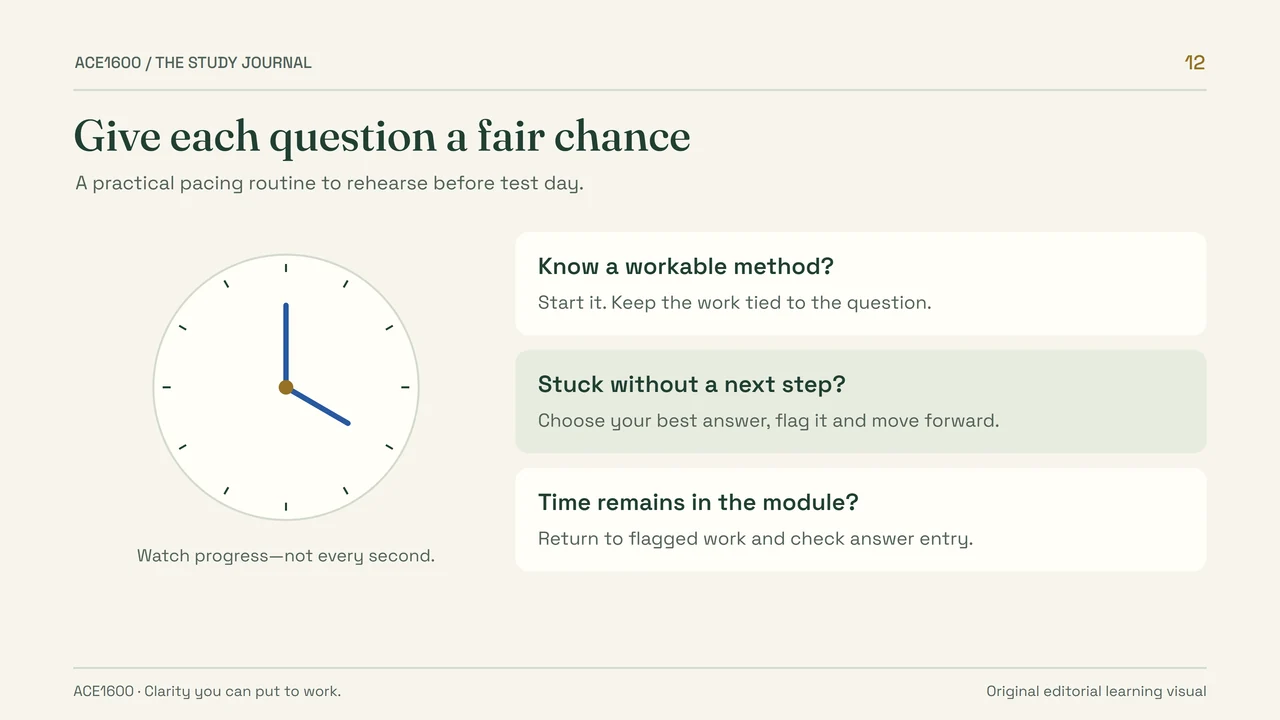
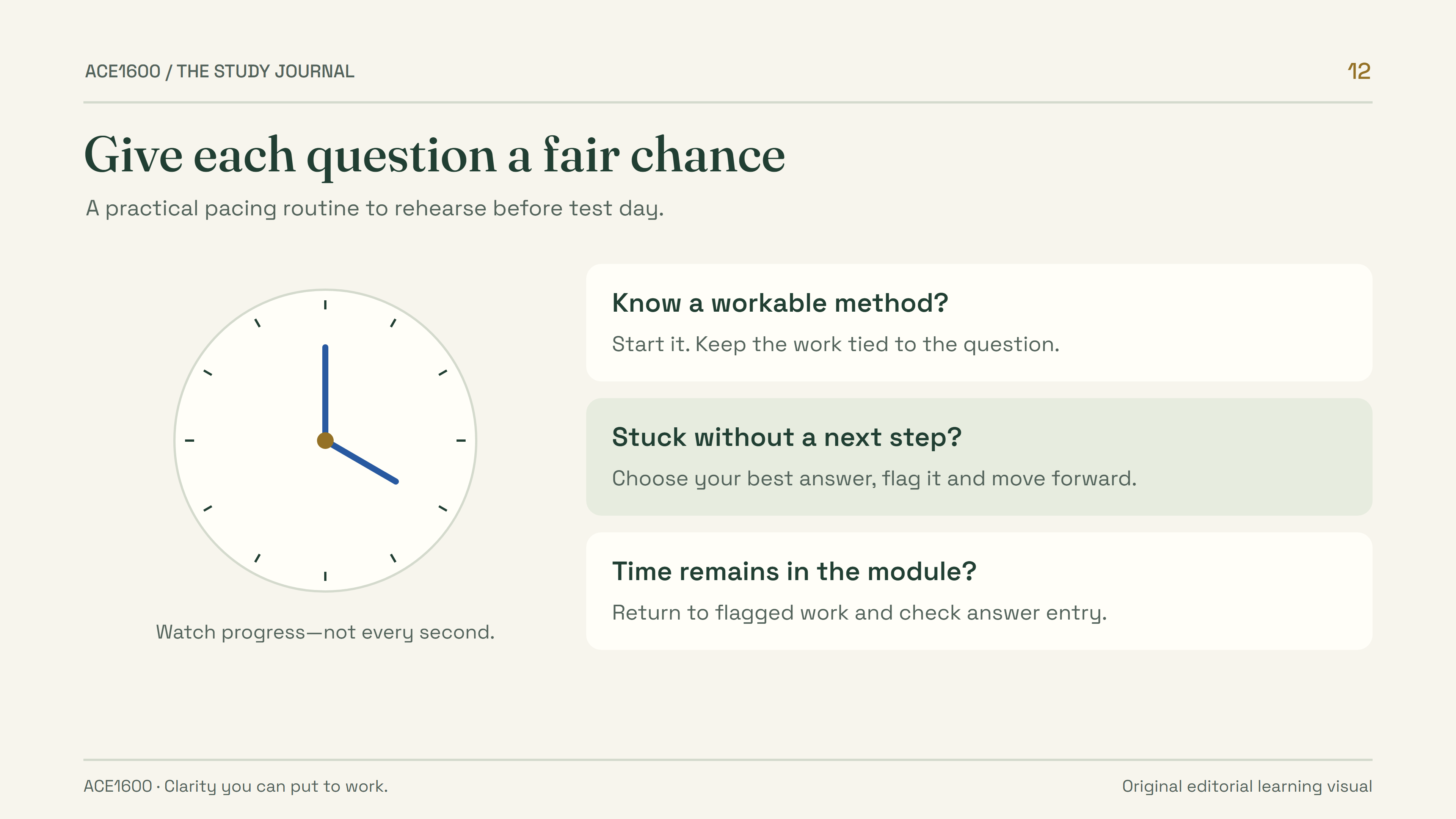
Read the visual as text
- When you know a workable method, begin and keep your work tied to the question.
- When stuck without a next step, choose your best answer, flag it and move on.
- If time remains in the current module, return to flagged questions.
- Rehearse this routine in practice and check answer entry before leaving a module.
1. Know the budget without treating it as a stopwatch per item
Under standard timing, Reading and Writing allows 32 minutes for 27 questions per module, while Math allows 35 minutes for 22. [1] Dividing gives about 71 seconds per Reading and Writing question and 95 seconds per Math question. Those are averages across a module, not instructions to stop at exactly those moments.
Averages conceal variation. A direct substitution may take far less time than its share, leaving room for a longer problem. Conversely, a question that appears short may require a relationship you have not yet noticed. Your job is to distribute time across the set, not to make each item conform to an artificial rhythm.
Average time is a budget, not a rule
- Reading & Writing≈71 seconds
32 minutes divided among 27 questions.
- Math≈95 seconds
35 minutes divided among 22 questions.
- Practical meaningFlexible allocation
Efficient work on familiar tasks creates room for careful work elsewhere.
The first diagnostic question is simple: where is the time going? After a practice module, look for stalled items, repeated rereading, unnecessary calculator setup, and excessive checking. “I need to be faster” is too broad to guide a lesson. “I spend a long time expanding expressions when the requested value is already visible” is something you can practice.
Avoid setting a speed target before you can solve the underlying task accurately. If a concept is unfamiliar, untimed work may be the right first step. Timing should eventually test a usable method; it should not replace learning that method.
2. Make the first pass a sequence of decisions
On each item, identify the request and choose an approach. If the approach is working, continue. If you are repeating the same action without gaining information, consider moving on. The relevant distinction is progress versus stagnation, not an exact number of seconds that every student must follow.
For Reading and Writing, a useful sign of progress is being able to state the passage’s claim, the relationship between ideas, or the specific grammar issue. For Math, it may be a defined variable, an equation, a diagram, or an elimination. If you cannot name what the next step will accomplish, pause before investing more time.
Original scenario: rereading without a purpose
A student reads a short science passage three times and still hesitates between two answers. Instead of reading it a fourth time in the same way, she writes a five-word summary: “Earlier estimate was too high.”
Now she tests each option against that claim. If one says the estimate was confirmed, she can reject it. If both still seem plausible, she marks the question and moves on with a note about the precise difference she needs to resolve.
The note changes a later return from “read everything again” to “check whether the passage supports cause or only association.”
Do not confuse a first pass with careless skimming. A rushed first reading can create work later because you must recover the meaning you skipped. Read the task accurately once, then decide whether to solve now or return. A disciplined pause is often more efficient than a hurried answer that you do not trust.
College Board’s Reading and Writing description explains that related skills are grouped within modules. [2] Learn the flow through practice, but avoid assuming that every position will take the same effort on every test. Let the actual task determine how you work.
3. Skip in a way that makes returning worthwhile
A useful skip leaves a clear place to resume. On scratch paper, note the question number and the unresolved step: “choose denominator,” “test positive root,” or “contrast versus result.” A bare question mark tells you only that you were uncertain. A short diagnosis preserves the useful thinking you already completed.
A purposeful skip
- RecognizeNo new progress
Notice repeated work or an approach that is no longer producing information.
- PreserveOne short note
Keep the equation, eliminated options, or exact unresolved distinction.
- MoveProtect coverage
Continue to another question while there is still time to inspect it.
- ReturnA named next step
Use the note to restart with a different action rather than repeating the same stall.
For a multiple-choice question, eliminate options only when you have a reason. A rushed cross-out can remove the correct answer and make the return harder. If you choose a provisional response, remember that it is provisional; mark the question if you still want to review it. Practice the interface so that your system for uncertainty is visible and consistent.
College Board advises trying every question rather than leaving answers blank. [3] Near the end of a module, make a sensible final attempt on unresolved items, using any valid eliminations or partial work. Do not spend the last available minute perfecting scratch notes while an answer you could enter remains blank.
Skipping is not a declaration that you cannot solve the problem. It is a choice about when to spend the remaining time. In review, distinguish a strategic skip that you returned to productively from a panic skip that left no plan. The first is a skill; the second shows where your routine needs support.
4. Test two or three checkpoints instead of watching constantly
Constant clock checks interrupt work and can amplify pressure. Try checking at a few preselected points during a practice module: after an initial group of questions, around the middle, and near the final review period. The exact positions should be chosen from your experience, not from someone else’s fastest performance.
Original practice experiment: a 35-minute Math module
A student decides to check the clock after questions 7 and 15, then again when about five minutes remain. These are observation points, not rigid deadlines.
At the first checkpoint, he notices that two questions consumed most of the opening time. At the second, he still has several unread items. He stops rechecking completed arithmetic and prioritizes seeing the remaining questions.
After the session, he reviews the two early stalls. One required a missing concept; the other had a much shorter substitution method. The next practice session addresses those causes rather than simply moving the checkpoints.
A checkpoint should lead to a decision. If your pace is comfortable, continue. If you are behind, reduce repeated checking, leave a stuck item, or choose a more direct method where you know one. Do not respond by rushing all later reading; that can turn a time problem into an accuracy problem.
Reserve some attention for the end, but treat an exact review allowance as a hypothesis. One student may benefit from more time to revisit difficult items; another may need to slow down initially because avoidable misreads are the main issue. Compare results across more than one session before deciding that a change has helped.
Record only a few observations during practice so measurement itself does not dominate the task. A rough note that one item took unusually long is enough to identify it for review. You do not need a detailed timing spreadsheet for every breath.
5. Give review time a priority order
When you return to marked questions, start with items where a specific additional step could resolve the uncertainty. A near-complete calculation may be a better use of a short interval than a concept you do not know at all. This is a practical priority decision, not a claim that you can predict which questions are worth more points.
| Situation | Useful next action |
|---|---|
| You solved for x but the question asks for 3x + 1. | Compute the requested expression and confirm the entry. |
| You narrowed two reading options to a precise difference. | Check that difference against the passage. |
| You obtained an implausible quantity or unit. | Inspect the setup before repeating the arithmetic. |
| You have no usable method. | Make the best remaining attempt after more resolvable items. |
Change an answer when you discover a reason: a missed condition, an arithmetic error, an unsupported inference, or a better interpretation. Do not change it merely because the option “looks too obvious.” Likewise, do not keep an answer solely because it was your first choice. The quality of the evidence is what matters.
Original example: review catches the target
A problem gives 5x + 2 = 32 and asks for 2x. The student solves x = 6 and enters 6. During review, rereading the final phrase reveals that the required answer is 12.
The repair takes little time because the algebra was already correct. A review routine that checks the requested object can catch this error more efficiently than repeating the entire calculation.
For Math, check signs, units, and answer-entry instructions where relevant. For Reading and Writing, check whether the choice matches the task’s scope. An answer may be true in general but fail to explain the specific sentence or meet the stated rhetorical goal.
6. Train speed through better methods
Efficient work usually grows from recognizing useful structure. In Math, compare a long algebraic solution with substitution, factoring, or a graph when appropriate. In reading tasks, compare repeated rereading with a short claim summary. The goal is a method you can explain and reproduce, not a trick whose success depends on luck.
Use three practice modes deliberately. First, solve untimed when learning a new idea. Next, use a short timed set to see whether the method remains clear under mild pressure. Finally, test the routine in an official full-length Bluebook practice exam. [4] Each mode answers a different question about your preparation.
Keep the question mix in mind when comparing sessions. A set of direct linear equations is not equivalent to a mixed set containing unfamiliar nonlinear models. If your average time rises, inspect the content before concluding that you have become slower. Record accuracy, unfinished items, and the nature of the tasks together.
Repeat a repaired question after a delay, then try a new one with a similar underlying relationship. The repeated item checks whether you can reconstruct the method; the fresh item checks whether the method transfers. If you can only solve the remembered example, spend more time explaining the general relationship.
A pacing improvement may initially look modest: one fewer unread item, less time spent on a repeated stall, or more reliable checking at the end. These process changes are useful evidence. They do not guarantee a particular score, but they show that the routine is becoming more controlled.
7. Run a one-week pacing experiment
Choose one pacing issue for the week. Perhaps you repeatedly stay too long on a difficult reading item, or finish Math quickly with several avoidable errors. Write a concrete change and a simple way to judge it. A useful experiment asks whether the change improves the quality of completed work, not just whether the timer looks better.
- Session one: complete a short set using your current routine and identify the main source of lost time.
- Session two: practice the missing skill or a shorter method without pressure.
- Session three: use a similar timed set with one new rule, such as leaving a stalled item with a specific return note.
- Session four: revisit the misses and inspect correct guesses as carefully as wrong answers.
- At the end of the week, keep the rule only if it helped accuracy, coverage, or the clarity of your decisions.
For students who finish with time left but make errors, the experiment may be to spend more time on the initial task reading. For students who leave several questions unseen, the experiment may be to move on sooner from unproductive work. The same advice will not solve both patterns.
Your final pacing plan should fit on a small card: a reminder to read the target, a rule for recognizing stagnation, a few checkpoints, and a review priority. Rehearse it until it supports your thinking quietly. The clock should help you choose the next action, not become the subject you are taking the test on.
Sources & further reading
Rules and policies were checked on October 4, 2026. Follow the linked official pages for changes. Study plans and worked examples are A1600 editorial guidance.