
In this guide
A student with school, activities, commuting, and family responsibilities does not need a plan that assumes unlimited evenings. The useful plan begins with the time that actually exists, then gives each session one clear job. A modest schedule you can use is more informative than an ambitious timetable that collapses after three days.
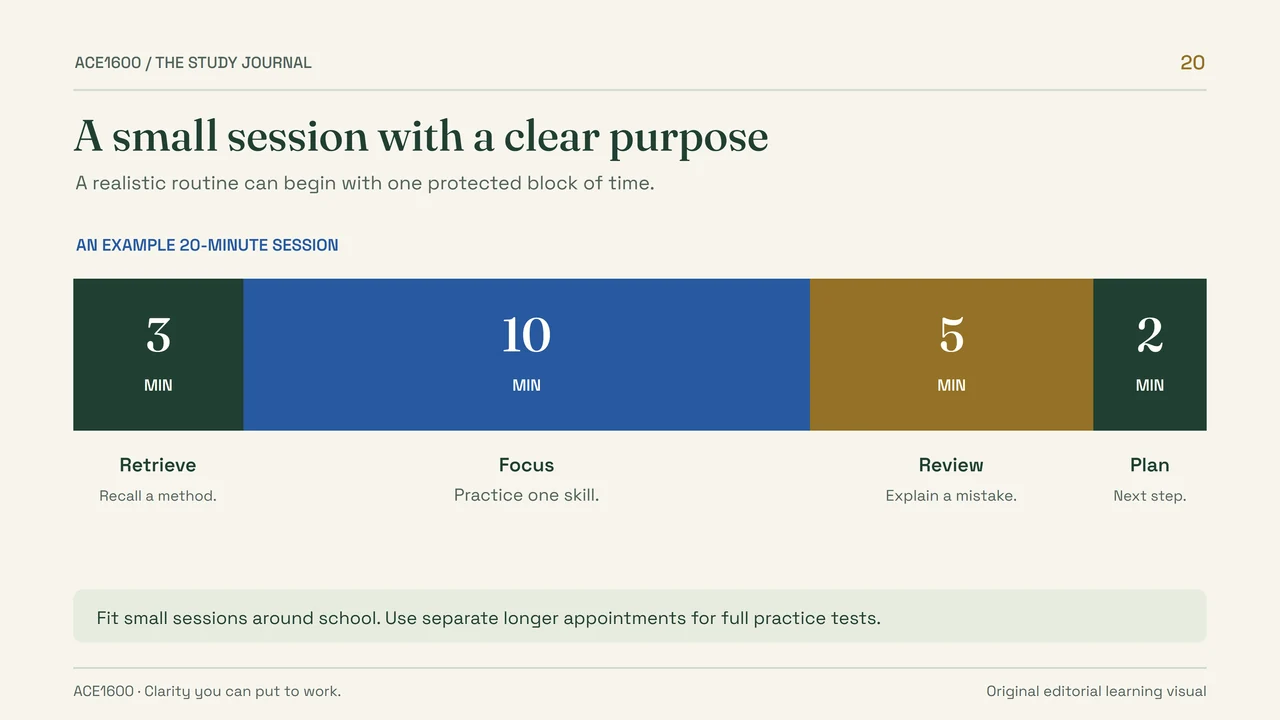
Thirty minutes is the session model in this guide, not a claim that thirty minutes a day is enough for every student or every target. Your preparation needs depend on your starting skills, deadlines, and available support. Some tasks, especially full-length practice, require a longer block. The opening infographic offers a compact twenty-minute fallback for a crowded day: three minutes of recall, ten of practice, five explaining an error, and two choosing the next task. The fuller thirty-minute routine below adds more room for learning and review.
The routines below are editorial examples you can adapt. They emphasize learning, review, and later verification, with a practical role for parents or guardians that supports the student’s independence.
Read the visual as text
- This is an example 20-minute study session, not a required schedule.
- Spend 3 minutes retrieving a method from memory.
- Spend 10 minutes practicing one skill and 5 minutes explaining a mistake.
- Use the final 2 minutes to choose the next step.
- Reserve separate longer appointments for full practice tests.
1. Start with the week you really have
List the fixed demands in a normal week: school, travel, meals, activities, household responsibilities, and existing study commitments. Then look for a few periods when you can work with reasonable attention. Do not fill every empty space. A schedule with no room for ordinary changes is difficult to maintain.
College Board offers study-plan guidance for organizing preparation. [1] Use that as a resource map, then personalize the workload from your own calendar and practice evidence. The number of sessions is less important than knowing what each session is meant to accomplish.
Original planning scenario: three reliable evenings
A student can reliably study on Monday, Wednesday, and Friday for thirty minutes, with a longer block on some Sundays. Tuesday and Thursday are already occupied by activities and travel.
Instead of pretending all five evenings are available, the student plans three focused sessions and uses Sunday for a mixed set or a scheduled full-length rehearsal. Review time is included rather than added only if something else finishes early.
When school exams approach, the plan can shrink temporarily because it was built around actual constraints rather than an uninterrupted streak.
Separate a normal week from a heavy week. A normal week may allow several new-skill sessions. A heavy week may allow only brief retrieval and maintenance. Naming both versions in advance reduces the need to redesign the schedule during a stressful period.
Choose a location and a starting cue that are practical: after a particular meal, at a desk with the needed materials ready, or during a dependable study period. The cue should make beginning easier. It is not a reason to force difficult work into a time when you are consistently unable to concentrate.
2. Give a short session one clear structure
A short session works best when you choose the task before the timer begins. Opening several resources and deciding what to study can consume much of the available time. End the previous session by leaving a specific next task, such as “three percent-change problems, then explain the denominator.”
A thirty-minute learning session
- Minutes 0–3Recall
Retrieve an earlier rule or method without looking at notes.
- Minutes 3–10Learn or repair
Work through the one idea that needs clarification.
- Minutes 10–23Apply
Solve a small set independently and explain the method.
- Minutes 23–30Review and queue
Inspect errors, write a correction, and choose the next task.
The blocks can shift. If the concept is new, the learning portion may take longer and the practice set should become smaller. If the skill is familiar, use more time for independent work and transfer. Do not rush the review merely to preserve the template’s appearance.
Keep one main objective. A session that tries to cover quadratics, punctuation, vocabulary, and registration will often finish none of them carefully. A narrower task can produce a clear result: you can now distinguish the vertex value from its x-coordinate, or explain why a particular transition expresses contrast.
Official SAT Prep on Khan Academy provides lessons and exercises that can support focused work. [2] Select the relevant lesson in advance. Pause to attempt the reasoning yourself, then close the explanation before solving a new example. Watching is useful when it leads into independent application.
3. Balance new learning, review, and maintenance
If every session introduces new material, earlier repairs may remain fragile. If every session repeats comfortable work, important gaps may persist. A weekly rhythm should include both a current priority and a small amount of earlier material that requires retrieval.
| When | Main purpose | A concrete example |
|---|---|---|
| Monday, 30 minutes | Repair one recurring concept. | Model percent increases and decreases with a named base. |
| Wednesday, 30 minutes | Practice a second priority. | Choose synthesis answers from a stated rhetorical goal. |
| Friday, 30 minutes | Retest and mix. | Retry earlier misses, then use fresh questions without topic labels. |
| Weekend, when available | Longer application or rehearsal. | Complete a mixed set, deeper review, or a planned full-length test. |
The weekend block is not automatically a test every week. It may be better used to finish reviewing an earlier attempt or to work through a prerequisite with a teacher. A full test is most useful when you have a reason to take it and time afterward to understand the results.
Original example: a week centered on one repair
A student repeatedly uses the final amount as the base in percent-change problems. Monday’s session builds the relationship with simple numbers. Wednesday includes several fresh applications. Friday asks for original amounts as well as final amounts.
The weekend check mixes those questions with other topics so the student must recognize the relationship without being told “this is percent change.”
The sequence checks learning across changing conditions rather than measuring how many near-identical problems can be completed in a row.
Use a small maintenance list: perhaps one recently repaired math idea and one reading habit. Rotate them rather than trying to revisit everything in every session. The aim is to keep useful knowledge available while leaving room for current priorities.
4. Choose work from evidence, not from mood alone
Comfortable topics are appealing when time is short because they make a session feel successful. Difficult topics can also attract too much attention if you interpret struggle as proof that the work must be valuable. Choose tasks from a recent diagnostic, an error log, or a specific question you cannot yet explain.
The Student Question Bank can help select official practice by skill and difficulty. [3] Use a narrow target, then widen the mix after the method becomes clearer. The resource is most useful when you know what you want to learn from the set.
Pick the next session in four questions
- What broke?Find the cause
Identify a missing concept, misread request, or unreliable step.
- What would repair it?Choose the task
Select a lesson, worked example, or short practice set.
- What can fit?Match the time
Reduce the scope until the work includes review.
- How will I know?Plan a check
Use a later attempt and a fresh example to test the repair.
Be specific about completion. “Do Reading and Writing” is not a task you can evaluate. “Explain the relationship in four transition questions and justify the closest elimination” is. If you finish the set but cannot explain the reasoning, the next session should address that gap rather than simply increase the quantity.
Keep a question for help when independent work stalls. Write the exact step you do not understand and what you have already tried. A teacher, tutor, or study partner can respond more effectively to that record than to “I do not get this topic.”
Do not let resource switching substitute for practice. Try a method, evaluate it, and make a deliberate change if it does not resolve the problem. Collecting another website or book can feel like progress while postponing the reasoning you need to do.
5. Protect occasional longer blocks for the full experience
Short sessions are useful for targeted learning, but they do not reproduce a complete exam. Plan occasional longer blocks when you need to evaluate pacing, endurance, interface familiarity, and the interaction between sections. Official full-length digital practice tests are available in Bluebook. [4]
Reserve review time as part of the booking. If a full-length practice attempt uses the only free block in a busy week, decide in advance when you will inspect the results. Otherwise, the score may become a verdict without producing a useful next step.
Original scenario: a weekend with limited time
A student has a free Sunday morning but little time during the following week. One option is to take a full practice test and leave its review unfinished. Another is to review the last attempt deeply and schedule the next test for a week with room to act on its results.
The better choice depends on the current need. If the student has not yet repaired clear recurring gaps, another immediate score may add less information than targeted work.
If the purpose is to rehearse the full routine before an approaching test, the longer attempt may be appropriate. The purpose should be explicit either way.
Use your intended testing arrangements for a meaningful rehearsal, including approved accommodations where applicable. Record interruptions and outside help honestly. A session can still teach something when conditions differ, but the differences affect how you interpret the result.
Do not turn the full-length score into the only measure of a week. Improved explanations, successful fresh retests, and more controlled pacing decisions are useful process evidence. They do not guarantee an outcome, but they help you decide whether the preparation is addressing the right problems.
6. Ask parents or guardians for specific support
Family support works best when the task is clear. A parent can help protect a quiet period, confirm a travel plan, review a calendar, or arrange access to a suitable device. These practical contributions can remove friction without requiring the parent to supervise every answer.
| Student owns | A parent or guardian can help with |
|---|---|
| Choosing a learning priority from practice evidence. | Asking what support would make the planned session possible. |
| Attempting problems and explaining the reasoning. | Providing a quiet period and access to needed materials. |
| Maintaining a short record of errors and next tasks. | Holding a brief scheduled check-in rather than repeated interruptions. |
| Knowing registration and test-day requirements. | Checking logistics, transport, and important dates together. |
Try a short weekly conversation with three questions: What became clearer? What still needs work? What support is needed next week? This keeps the discussion tied to actions rather than treating every practice result as a judgment about effort or ability.
Original conversation: make the request concrete
Student: “I understand the percentage method now, but I need a quiet half hour on Wednesday to check it on new questions.”
Parent: “I can protect that time. On Friday, show me one example and explain why you chose the original amount as the base.”
The parent does not need to teach the mathematics to support the routine. The student remains responsible for explaining the learning.
If a plan is repeatedly missed, inspect the workload and timing before assuming a motivation problem. The chosen slot may conflict with transport, school assignments, or exhaustion. Adjusting an unrealistic plan is part of planning well, not evidence that the student has failed at preparation.
7. Build a fallback and return without a catch-up spiral
A heavy week needs a smaller version of the plan. Choose one or two brief tasks that preserve continuity: retrieve a rule, re-solve a previously repaired item, or explain why a tempting answer is wrong. Keep the work purposeful, and postpone larger tasks openly instead of pretending the full schedule still fits.
Original ten-minute fallback
Spend two minutes recalling a method from memory. Use five minutes to solve one relevant example independently. Spend the final three minutes checking the reasoning and writing the next task.
For instance, recall how to find an original amount after a discount, solve 0.75P = 90 to get P = 120, and explain why adding 25% of 90 is not the same operation.
This brief session is not equivalent to a full practice block. It simply keeps one useful idea active during a crowded day.
After a missed session, resume with the next useful task rather than automatically doubling the following day’s workload. Catch-up plans can make the schedule harder to restart. If an important deadline is approaching, revise the remaining plan deliberately and prioritize what can realistically be completed.
At the end of each week, keep, change, or remove something. Keep a routine that helped you begin. Change a task that was too broad. Remove a repeated activity that produced no new understanding. This small review makes the plan responsive rather than rigid.
A sustainable study routine is a sequence of completed learning cycles: attempt, understand, repair, and check again. Thirty minutes can hold one of those cycles when the task is chosen carefully. The aim is to finish the week with clearer reasoning and a sensible next step, while leaving room for the rest of a student’s life.
Sources & further reading
Rules and policies were checked on October 4, 2026. Follow the linked official pages for changes. Study plans and worked examples are A1600 editorial guidance.