
In this guide
Knowing a word can help, but knowing one definition is not always enough. A familiar word may carry an unfamiliar meaning, and two near-synonyms may differ in strength or implication. Vocabulary questions reward the ability to fit a precise meaning into a particular sentence.
College Board describes words in context as part of Craft and Structure. [1] The practical task is to combine language knowledge with evidence from the passage. Context can narrow the answer, but it cannot reliably replace all vocabulary knowledge; both deserve a place in preparation.
This guide uses original teaching passages to show the process. You will predict a meaning, inspect clues, distinguish close choices, and build a small record of words that you can actually use rather than merely recognize.
Read the visual as text
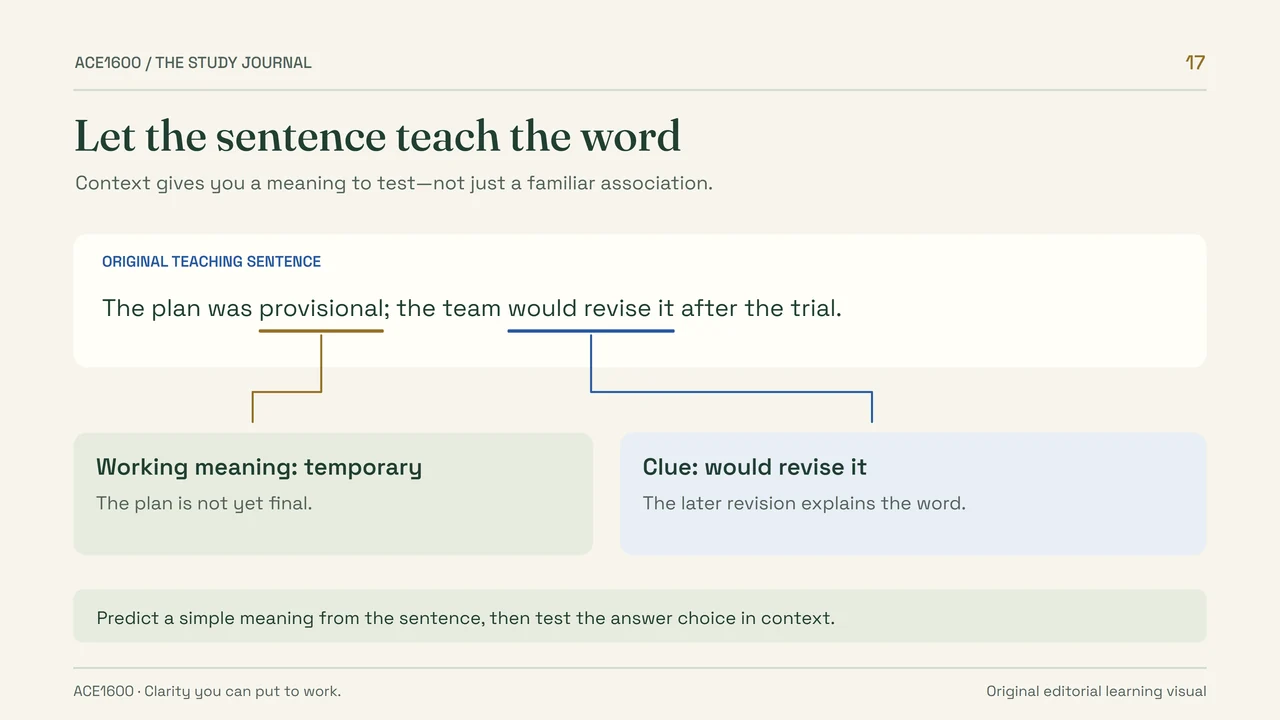
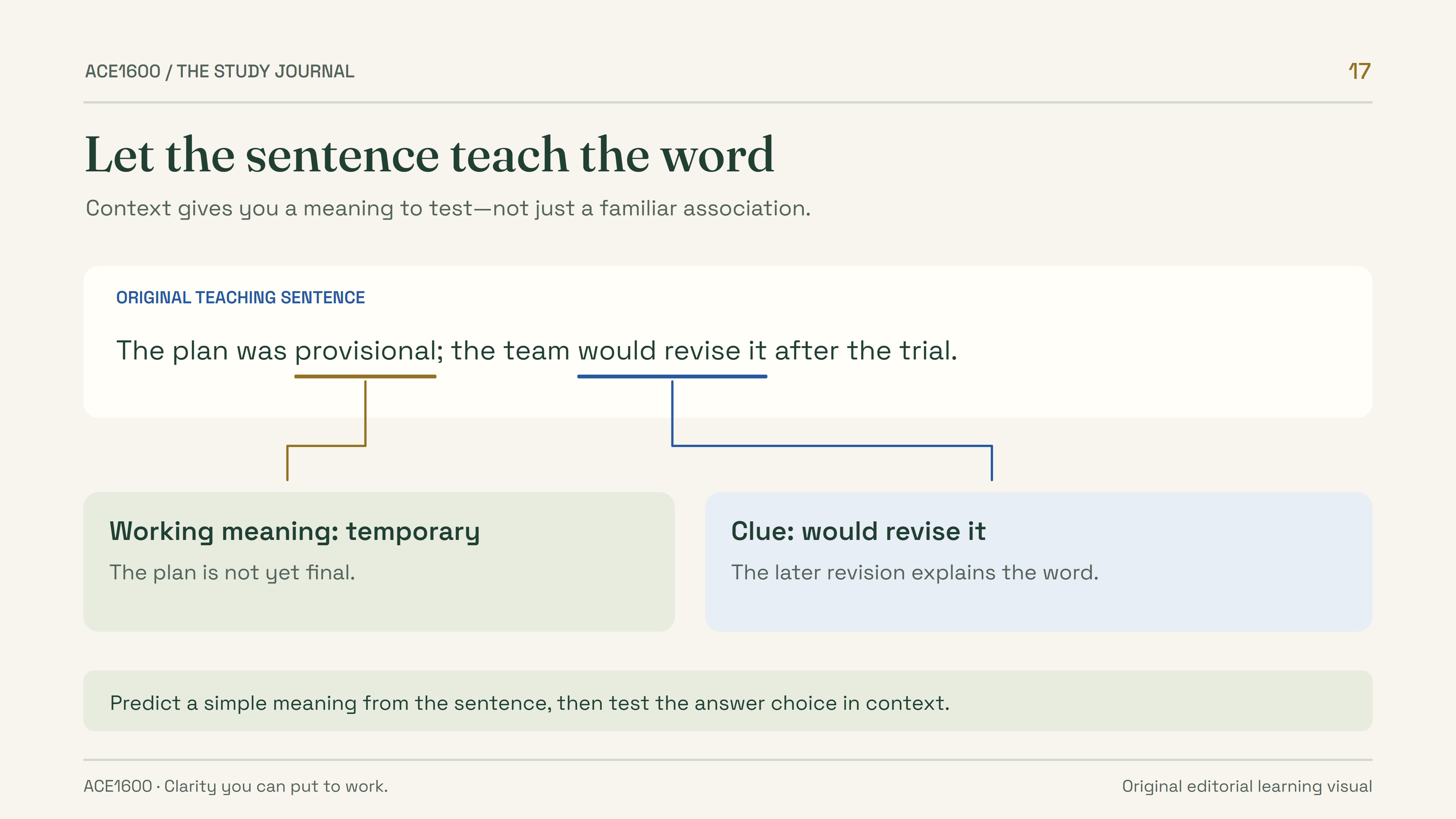
- Original sentence: The plan was provisional; the team would revise it after the trial.
- The clue “would revise it” suggests that the plan is not final.
- A useful working meaning for provisional here is temporary.
- Predict a plain meaning first, then test an answer choice in the full sentence.
1. Make a plain-language prediction
Read the complete sentence and enough surrounding text to understand its point. If there is a blank, describe what the missing word must do. If a word is supplied, replace it mentally with a short phrase. Your prediction can be ordinary language such as “not final,” “makes weaker,” or “careful and thorough.” It does not need to match an option exactly.
From context to a defensible word choice
- ReadFind the claim
Understand what the sentence says and how nearby ideas relate.
- PredictUse simple language
Describe the needed meaning without borrowing an answer choice.
- CompareCheck precision
Test sense, strength, and direction rather than surface familiarity.
- ReplaceRead it again
Confirm that the chosen word preserves the passage’s meaning.
Original example: a conclusion that may change
Teaching passage: “The researchers called their explanation provisional: it fit the first observations, but they expected to revise it when the larger study was complete.”
A useful prediction for “provisional” is “temporary or not yet final.” The planned revision is a direct clue. “Definitive” would reverse the meaning, while “irrelevant” would ignore that the explanation fit the early observations.
The passage does not say the explanation is certainly false. A provisional explanation can be useful while remaining open to revision.
Make the prediction specific enough to distinguish options. “Something positive” is usually too broad. A passage may need “supported by evidence” rather than merely “popular,” or “limited in scope” rather than simply “bad.” The more clearly you describe the role of the word, the less likely you are to be attracted to a familiar but imprecise choice.
College Board’s question-bank guide shows the forms of words-in-context tasks. [2] Familiarity with the instruction helps you focus on the meaning being tested instead of spending time decoding what the question wants.
2. Look for the relationship that constrains the meaning
Useful clues include definitions, examples, contrasts, restatements, and consequences. A colon may introduce an explanation. A phrase such as “rather than” may establish a contrast. An example may show the kind of behavior a word describes. Read these as evidence, not as automatic answer triggers.
Original example: contrast narrows the blank
Teaching passage: “The first map was crowded with decorative details. The revised version was comparatively ___, showing only the routes and essential landmarks.”
The contrast and the phrase “only the routes and essential landmarks” suggest “spare” or “uncluttered.” A word meaning “ornate” would repeat the first map’s quality rather than describe the revision.
“Inaccurate” is not supported: fewer details do not necessarily mean incorrect information. The task is about visual simplicity, not factual reliability.
Clues can work together. In the map example, both the comparison and the description of included information constrain the meaning. If you focus on just one word, you may miss the stronger pattern created by the whole sentence.
| Clue | Useful action |
|---|---|
| Definition or restatement | Translate the explanation into a short replacement phrase. |
| Contrast | Identify which quality changes or is opposed. |
| Example | Ask what common feature the examples illustrate. |
| Consequence | Determine what action or quality could produce the stated result. |
| Qualification | Reduce the strength of the claim to match its limits. |
Context does not always supply a dictionary definition. Sometimes it tells you only the direction or degree of meaning, leaving vocabulary knowledge to distinguish the remaining choices. If you cannot separate two words after a careful reading, mark the knowledge gap for later study rather than pretending a context trick can solve every case.
3. Be alert to familiar words in less familiar senses
A word you know from conversation may have another common academic meaning. “Qualified” can mean appropriately trained, but a “qualified endorsement” is limited by reservations. “Appreciate” can mean value, understand, or increase in value, depending on context. The passage chooses the sense.
Original example: a qualified endorsement
Teaching passage: “The committee offered a qualified endorsement of the proposal, supporting the main idea while requesting a smaller initial budget.”
Here “qualified” means limited or conditional, not professionally certified. The request for a smaller budget places a reservation on the support.
An answer meaning “enthusiastic and unconditional” would exaggerate the endorsement. An answer meaning “entirely opposed” would ignore that the committee supported the main idea.
When evaluating options, substitute each meaning into the sentence rather than asking whether it is ever a valid definition of the word. A dictionary can contain several correct senses, but only one may fit this use. The question is about the word here, not the word everywhere.
Parts of speech can also help. A noun, verb, and adjective may share a root while doing different jobs. Still, grammatical fit is only a first screen; several choices can fit the sentence structure while expressing different meanings. Do not stop after finding a word that sounds grammatically natural.
Create a two-sentence contrast when studying a familiar word with multiple senses. For “qualified,” write one sentence about a trained instructor and another about conditional support. That small exercise makes the distinction more memorable than a list of disconnected definitions.
4. Compare strength, direction, and implication
Close choices often differ by degree. “Suggest” is weaker than “prove.” “Reduce” is different from “eliminate.” “Unusual” does not necessarily mean “unique.” A passage that offers tentative evidence should not be completed with a word that claims certainty unless the text supports that stronger meaning.
Precision changes the claim
- Reduce vs. eliminateLess vs. none
A smaller amount is not the same as complete removal.
- Suggest vs. establishIndication vs. firm support
Tentative evidence should not silently become certainty.
- Unusual vs. uniqueUncommon vs. one of a kind
Rarity does not prove that no other example exists.
Original example: a moderate effect
Teaching passage: “The new procedure did not remove the source of the noise, but it substantially attenuated the sound reaching the next room.”
The contrast indicates that the sound became weaker while the source remained. “Attenuated” means reduced in strength here.
“Eliminated” would overstate the result, and “amplified” would reverse it. “Explained” might relate to an investigation of noise, but it does not describe the change in sound reaching the room.
Direction matters in argument vocabulary as well. Evidence can corroborate a claim by supporting it or undermine a claim by weakening it. If you confuse the direction, the completed sentence may reverse the author’s point even though it sounds polished.
Pay attention to implication. “Frugal” often describes economical use, while “stingy” conveys unwillingness to spend or share. “Assertive” and “aggressive” can overlap in behavior but differ in evaluation. The passage’s tone and concrete description help decide which implication is supported; do not rely on a personal preference for one word.
5. Handle an unfamiliar option without inventing its meaning
If one option is unfamiliar, first assess the choices you understand. Eliminate them only for a specific conflict with the passage. The unfamiliar word may remain a candidate, but unfamiliarity itself is neither evidence for nor against it. A difficult-looking word is not automatically the intended answer.
Word parts can offer a hypothesis, especially when you know a root or prefix securely. They are less reliable when you are guessing from a vague resemblance. English contains words whose current meanings are not transparent from their parts. Treat morphology as supporting evidence and check it against the sentence.
Original example: use known meanings responsibly
Teaching passage: “Although the two instruments looked different, repeated measurements produced nearly identical results, demonstrating that the methods were ___.”
You can predict “consistent with each other” or “comparable in result.” An option meaning “incompatible” conflicts with identical results, while one meaning “obsolete” adds a claim about age or usefulness that is absent.
If the remaining candidate is unfamiliar, you have still used valid reasoning to narrow the field. After practice, learn that word in context so the same uncertainty does not persist.
Do not force a choice to fit by rewriting the passage in your head. If a word requires assuming an unstated motive, changing a comparison, or ignoring a qualification, it is probably not a good match. Your explanation should point to the supplied language.
After a practice miss, record both the target word and the attractive wrong choice. Knowing their difference is often more useful than memorizing either alone. Ask what clue would have ruled out the wrong meaning before you saw the explanation.
6. Build a small vocabulary record you can use
A useful entry contains the word, a plain definition for the sense you encountered, the context clue, an original sentence, and a contrasting word or usage. That combination turns the entry into a decision aid. A long list of definitions can feel productive while remaining difficult to retrieve during reading.
Original vocabulary entry: provisional
Meaning in this context: temporary or subject to revision, pending further information.
Clue: the explanation fits early observations but may be revised after a larger study.
Original sentence: “The club adopted a provisional schedule while waiting for the venue to confirm its opening hours.”
Contrast: a definitive schedule is treated as settled; a provisional schedule may change. Do not confuse provisional with false or useless.
Review by recall. Cover the definition and explain the word; then use it in a new sentence. Later, distinguish it from the contrast word without looking at either entry. If you can recognize the definition but cannot use the word accurately, the knowledge is still fragile.
Choose words from meaningful reading and reviewed practice rather than trying to collect every rare word you encounter. A small set of high-utility words used precisely is easier to maintain than a huge list you never revisit. Keep reading full sentences and paragraphs so the words remain attached to relationships and ideas.
Official SAT Prep on Khan Academy provides reading and writing lessons and practice. [3] Use a lesson when you need help with a skill, then return to independent examples. The resource supplies material; your job is to explain the evidence for the meaning you choose.
7. Try a short context-and-precision workout
Set aside a brief session for three tasks: solve a few context questions, compare two close meanings, and retrieve several words from earlier entries. This combines application with memory without allowing vocabulary study to replace all other Reading and Writing preparation.
- For each practice passage, write a plain prediction before examining the choices.
- Underline or note the clue that most strongly supports that prediction.
- Explain why the nearest wrong choice changes the meaning, degree, or direction.
- Add only the words whose meaning or distinction you actually needed to learn.
- At a later session, use those words in fresh sentences without opening the definitions first.
Original final check: the evidence is limited
Teaching passage: “The preliminary results were promising, but the sample was too small to justify a definitive conclusion.”
“Preliminary” signals an early stage, while “definitive” refers to something settled or conclusive. The passage supports cautious interest rather than certainty.
A useful paraphrase is: “The early findings look encouraging, but stronger evidence is still needed.” That paraphrase preserves both the positive result and the limitation.
Use the Student Question Bank when you want additional official skill-focused practice. [4] Evaluate your explanations as well as your answer rate. A correct answer supported only by “it sounds right” deserves another look.
The goal is not to guess the most impressive word. It is to choose the word whose meaning the passage can support. With a clear prediction, attention to precision, and a manageable review routine, vocabulary becomes part of careful reading rather than a separate memorization contest.
Sources & further reading
Rules and policies were checked on October 4, 2026. Follow the linked official pages for changes. Study plans and worked examples are A1600 editorial guidance.